


Home-Based vs. Center-Based ABA Therapy
Find the differences between home-based vs. center-based ABA therapy.

Home-Based ABA Therapy
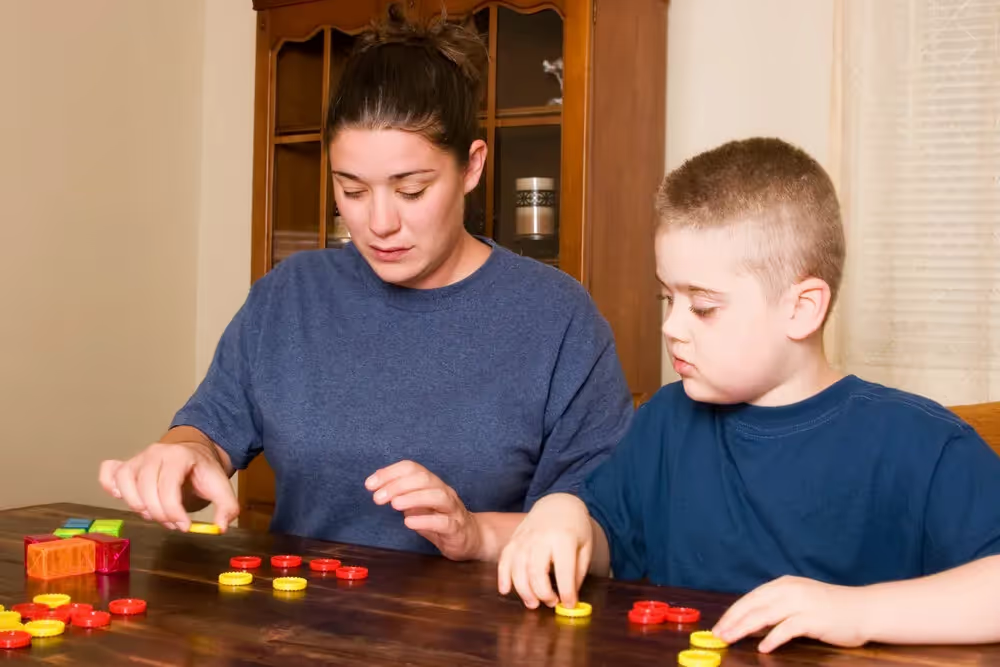
If you choose home-based ABA therapy for your child, a board-certified behavior analyst (BCBA) will come to your house regularly to work through your child's autism therapy plan. They'll help you design the perfect environment for them to work with your child and help them improve their social skills. It's important to have a designated area for your child to meet with their BCBA so they can associate that area with "learning time".
.avif)
Benefits Of Home-Based Over Center-Based ABA
- Family Environment - Your child will be comfortable with the autism treatment from the get-go because their home is where they're most familiar with. While we ensure each child is perfect comfortable in our center, it can't compare to being in the comfort of your own home.
- Family Involvement - ABA therapy is most effective when as many family members are involved. Our trained BCBAs and RBTs teach parents how to continue to implement ABA therapy techniques regularly.
- Convenience - One of the best parts about home-based ABA therapy is that your child doesn't need to go anywhere to get the therapy. Your child's ABA therapy appointments are scheduled to meet your needs.
Center-Based ABA Therapy
If you choose center-based ABA therapy for your child, your child will be provided with on-site autism therapy at one of Cross River Therapy's centers, rather than at home, school, or community.

Our center-based therapy model is designed to promote growth in your child's skills across many aspects of development. From play skills to communication, your child will receive all the tools they need to grow and become an independent person.
.avif)
Benefits Of Center-Based ABA Therapy
- Supervision - In center-based ABA therapy, your child will have access to a large number of BCBAs, who will collaborate and discuss their opinions on the spot. The result will be more of our therapists observing your child, collaborating, and helping them become the most sufficient person they can be.
- Structure - Some research suggests center-based ABA therapy can help children learn and grow faster than home-based ABA therapy. This could be because your child might have more temptations or distractions when they're at home. A center allows your child to focus on what's being shown to them in therapy, which can help them gain skills quicker.
- Social Interaction - One of the largest benefits of center-based ABA therapy is the ability for your child to practice social interaction. Our center's safe and clean interaction space enables your child to practice what they learn in their therapy sessions.

References:
- https://www.abatherapistjobs.com/blog/home-based-aba-therapy-for-kids
- https://atgtogether.com/home-based-aba-therapy-or-center-based-aba-therapy-which-one-is-right-for-your-child/
- https://www.brighterstridesaba.com/blog/home-based-vs-center-based-aba-therapy/
- https://blueabatherapy.com/aba/therapy-in-home-vs-center/
- https://autismpartnership.com.sg/en/home-vs-center-aba/
Recent News
Related articles

Working With Autistic Children: 10 Career Options
Want to work with autistic children? Here are 10 career options for you to consider.

What Is The Age Limit For ABA Therapy In North Carolina?
Find out what the age limit is for receiving Applied Behavior Analysis (ABA) therapy in North Carolina.

What Is The Age Limit For ABA Therapy In Indiana?
Find out what the age limit is for receiving Applied Behavior Analysis (ABA) therapy in Indiana.

What Is The Age Limit For ABA Therapy In Arizona?
Find out what the age limit is for receiving Applied Behavior Analysis (ABA) therapy in Arizona.

Verbal Operants In ABA: Definition & Examples
In Applied Behavior Analysis, verbal operants are a type of verbal behavior.

Token Economy: Examples & Applications in ABA
A token economy is a procedure that was developed to help reduce maladaptive behaviors and increased desire behaviors by providing a tangible conditioned reinforcer.

Trigger Analysis In ABA: Definition & Examples
Trigger analysis is a segment of ABA therapy where children are taught by therapists to pinpoint the behaviors and emotions that happen before, during, and after an event that takes place.

Variable Ratio Schedule & Examples
A variable-ratio schedule is a random reinforcement where responses are reinforced following varied responses afterward.

Task Analysis In ABA Therapy: Examples & Strategies
Task analysis is a process of teaching that divides complicated activities into sections involving easier steps for students to more easily take.

Stimulus Equivalence In ABA: Definition & Examples
Stimulus equivalence shows how relationships can manifest among different types of stimuli in different situations.

Speech Therapy For Autism: ABA vs. Speech Therapy
ABA therapy can help individuals with speech impairments learn to better identify and utilize the language skills they already have.

Stimulus Control Transfer ABA: Definition & Examples
Stimulus control is defined as an expression used to detail circumstances where a behavior is triggered by the existence or absence of a stimulus.