








ABA Therapy Techniques: An Overview of Common ABA Therapy Strategies
Exploring Effective Methods in ABA Therapy


Understanding ABA Therapy
Applied Behavior Analysis (ABA) is a widely recognized therapeutic approach focused on improving socially significant behaviors through structured interventions. ABA is especially effective in supporting individuals with autism, utilizing evidence-based techniques to foster communication, social skills, and academic growth. With a foundation in behaviorist theories, ABA employs systematic methods such as positive reinforcement and the A-B-C model to achieve lasting behavior modifications. This article provides a comprehensive overview of common ABA therapy strategies, aiming to equip readers with the knowledge and insight to appreciate its applications and effectiveness.
Core Principles of ABA Therapy
What is Applied Behavior Analysis (ABA) and its core principles?
Applied Behavior Analysis (ABA) is a robust therapeutic method grounded in the science of learning and behavior. Primarily aimed at assisting individuals with autism, ABA utilizes a systematic approach to behavior modification through various principles and strategies. ABA encompasses seven fundamental dimensions:
- Applied: Focused on significant behaviors that are socially relevant.
- Behavioral: Emphasizing observable and measurable behaviors.
- Analytic: Involving the use of data to understand behavior change.
- Technological: Ensuring techniques are described clearly enough to replicate.
- Conceptually Systematic: Methods are based on established principles of behavior.
- Effective: Interventions aimed at producing meaningful behavior changes.
- Generality: Skills learned should transfer to various settings and maintain over time.
How does ABA utilize reinforcement and the ABC model?
Central to ABA are the principles of reinforcement and the ABC model (Antecedent, Behavior, Consequence). These help in understanding and modifying behaviors effectively:
- Positive Reinforcement increases the likelihood of a desired behavior by providing a rewarding stimulus, such as praise or a tangible reward, immediately after the behavior occurs.
- Negative Reinforcement encourages desired behavior by removing an aversive stimulus, promoting a behavior's recurrence.
The ABC model supports therapists in identifying triggers (Antecedents), the specific behavior exhibited, and the resulting responses (Consequences), guiding the development of targeted intervention strategies. By leveraging these principles, ABA aims to enhance adaptive behaviors while reducing harmful or ineffective ones, ensuring the ethical treatment and respect for all individuals involved in the therapy.
Common Techniques in ABA for Autism

What are some common ABA therapy techniques used in the treatment of autism?
Some effective ABA therapy techniques include:
- Discrete Trial Training (DTT): This structured method breaks down skills into small, manageable steps, often using one-on-one interaction to reinforce learning. Sessions follow a clear format of instruction, response, and consequence, making it easier for children to understand and acquire new skills.
- Picture Exchange Communication System (PECS): Particularly helpful for non-verbal children, PECS uses visual aids like pictures to teach communication. It empowers children to express their needs and desires effectively, improving their overall communication skills.
- Reinforcement Systems: Positive reinforcement is a primary strategy in ABA therapy. It involves following desired behaviors with rewarding outcomes, such as praise or tangible rewards, which increases the likelihood of those behaviors being repeated in the future. Different forms of reinforcement systems can sustain engagement and promote positive behavior changes.
Additional ABA Techniques
Some other vital techniques in ABA include:
- Modeling: Demonstrating desired behaviors to encourage imitation, crucial for teaching social skills and daily tasks.
- Task Analysis: Breaking complex skills into smaller, sequential tasks to make learning more achievable.
- Natural Environment Training (NET): Teaching skills in real-life settings helps reinforce learning and encourages generalization of skills.
These techniques integrate to form comprehensive therapeutic plans tailored to support the unique needs of children with autism.
Implementing Positive Reinforcement in ABA

Role of Positive Reinforcement
Positive reinforcement is essential in Applied Behavior Analysis (ABA) therapy, as it encourages desired behaviors by immediately rewarding them with something the individual values. This could be verbal praise, a tangible reward, or other positive outcomes that are meaningful to the individual. The strategy focuses on increasing helpful behaviors, such as communication or social interaction, while aiming to decrease harmful ones.
This technique is deeply rooted in the principles of behaviorism and has been utilized effectively in autism therapy since the 1960s. By applying an A-B-C model (Antecedent, Behavior, Consequence), therapists can analyze why certain behaviors occur and effectively structure reinforcement to enhance those desired actions. For example, if a child speaks out instead of engaging in challenging behaviors, providing immediate praise reinforces that communication.
Customized Interventions
Each ABA intervention is tailored to meet the unique needs of the individual. After thorough assessments, including functional behavior assessments, therapists and board-certified analysts create personalized plans that integrate positive reinforcement strategies. The involvement of parents is crucial in this process, as they provide support and help maintain consistency throughout the individual's daily routines.
By customizing interventions and focusing on positive reinforcement, ABA therapy fosters significant behavior changes. These changes can substantially improve the overall quality of life for individuals with autism, empowering them to engage positively with their environment.
To maximize effectiveness, techniques like Discrete Trial Training and Natural Environment Training can be combined with positive reinforcement strategies to create a holistic approach that promotes learning in various settings.
ABA Techniques at Home
Can ABA techniques be effectively implemented at home?
Yes, ABA techniques can be effectively implemented at home with the right guidance and resources. Here are some key points to consider:
- Parental Involvement: Engaging parents and caregivers is crucial. They can help reinforce skills learned during therapy. Training programs assist parents in applying ABA principles effectively.
- Structured Environment: Establishing a consistent routine supports learning. Predictable schedules can help reduce anxiety and promote positive behaviors.
- Reinforcement Strategies: Utilize both positive and negative reinforcement to encourage desired behaviors. For instance, immediate praise or rewards following a good behavior can strengthen that behavior.
- Behavior Contracts: Writing behavior contracts can help define expectations and consequences, ensuring clarity for both caregivers and children.
- ABC Model: Employ the A-B-C (Antecedent-Behavior-Consequence) analysis to understand and modify behaviors. Identifying triggers can lead to more effective responses.
- Collaboration with Professionals: Working alongside Registered Behavior Technicians (RBTs) and Board Certified Behavior Analysts (BCBAs) ensures that the approach is tailored for individual needs.
- Utilizing Technology: Video modeling can be helpful for teaching social skills, allowing children to learn by observing.
How can parents support ABA at home?
Parents can create an environment that promotes skill practice by using various ABA techniques consistently. Knowledge from training and collaboration with professionals will empower parents to effectively reinforce their child's learning and development.
Classroom Applications of ABA

How are ABA strategies applied in the classroom setting?
ABA strategies are effectively applied in the classroom by creating structured environments that promote positive behaviors and minimize disruptions. These techniques can significantly enhance the learning experience for all students, especially those who may struggle with behavioral or learning challenges.
- Structured Teaching Methods: Techniques such as Discrete Trial Training (DTT) and Direct Instruction emphasize breaking skills into manageable components and providing explicit teaching. This approach helps support the diverse learning needs of students, ensuring that essential skills are taught effectively.
- Positive Reinforcement: Systems like token economies are commonly used in classrooms. In a token economy, students earn tokens for demonstrating desired behaviors, which can later be exchanged for rewards. This method not only encourages positive behavior but also helps students recognize the benefits of their actions.
- Visual Supports: Routines and visual aids are essential in setting clear expectations. Charts, schedules, and visual cues can help students understand the sequence of activities, promoting independence and focus.
What role does data collection play?
Data collection methods, such as A-B-C assessments (Antecedent-Behavior-Consequence), enable teachers to analyze behaviors systematically. By understanding what triggers certain behaviors and what consequences follow, teachers can tailor their interventions accordingly.
- Behavior Analysis: With effective data tracking, teachers can make informed decisions to adjust strategies and reinforce behaviors that support learning.
Overall, ABA strategies create a supportive and engaging classroom atmosphere that benefits students with various learning and behavioral challenges.
Seven Dimensions of ABA
What are the 7 dimensions of ABA that ensure the effectiveness of its programs?
The foundation of Applied Behavior Analysis (ABA) rests on seven key dimensions that ensure both the effectiveness and scope of its therapeutic interventions. Here’s a concise breakdown:
DimensionDescriptionImportanceApplied Focuses on socially significant behaviors that enhance quality of life, such as communication and social skills. Ensures therapy targets meaningful skills. Behavioral Emphasizes observable and measurable behaviors, which can be tracked for progress and intervention effectiveness. Enables precise monitoring of specific changes. Analytic Requires interventions to be evidence-based, drawing from careful data analysis to establish relationships and conclusions. Prevents reliance on subjective judgment. Technological Involves clear descriptions of procedures so that they can be replicated by others, enhancing the integrity of the method. Facilitates consistency across different settings. Conceptually Systematic Integrates ABA techniques with established scientific principles of behavior to ensure theoretical soundness. Fosters a deeper understanding of why strategies work. Effective Demonstrates observable significant changes in targeted behaviors, ensuring that interventions achieve desired goals. Validates the efficiency of therapeutic efforts. Generality Ensures that behavioral changes are durable and applicable across various settings and time frames, promoting independence. Supports the transfer of skills to real-world situations.
Each dimension serves to strengthen the overall approach of ABA, enabling therapists to customize interventions that cater to the individual's unique needs while also ensuring positive and lasting outcomes.
Teaching Styles in ABA
What are the most commonly used teaching styles in ABA?
The most commonly used teaching styles in Applied Behavior Analysis (ABA) include several distinct methods tailored to maximize learning efficiency. Here are some key strategies:
- Discrete Trial Training (DTT): This method simplifies complex skills by breaking them down into smaller, manageable steps. Each step represents a trial where specific skills are taught through structured one-on-one interactions, allowing for clear reinforcement after each successful response.
- Direct Instruction (DI): Emphasizing direct teacher-led guidance, DI involves explicit teaching of concepts and skills. This method values clarity and pace, ensuring that learners grasp each component before moving on to more complex tasks.
- Pivotal Response Training (PRT): PRT focuses on pivotal behaviors, such as motivation and social engagement. By enhancing these key areas, overall learning and behavior improve. It is a more child-centered approach that promotes learning through play and interaction.
- Natural Environment Teaching (NET): This technique emphasizes learning within naturalistic settings, such as home or community environments. It enhances practical applications of skills by embedding learning opportunities in everyday situations, resulting in increased engagement and motivation.
- Incidental Teaching: This is a less structured approach that capitalizes on learners' interests in spontaneous, natural contexts. Opportunities for learning are seized as they arise, fostering organic skill development.
Additionally, Functional Communication Training (FCT) stands out as a critical method, teaching individuals effective communication techniques to express needs and reduce challenging behaviors, which ultimately aids social interaction and learning.
These varied teaching styles in ABA not only cater to individual learning preferences but also work collectively to drive behavioral improvements.
Resources for Parents Learning ABA
Where can parents find resources or support to learn ABA techniques?
Parents seeking to learn ABA techniques can tap into a variety of resources designed to facilitate their understanding and application of these methods.
Parent Support Groups
Local and online support groups are invaluable. They not only provide parents with the opportunity to share experiences but also connect them with others who are navigating similar challenges. Organizations such as Autism Speaks host forums and discussion boards where parents can ask questions and receive guidance.
Online Resources
The internet offers an abundance of online resources. There are numerous websites and platforms that feature educational materials, instructional videos, and downloadable guides on ABA principles. For parents seeking structured learning, many websites provide online courses tailored specifically for understanding ABA techniques like positive reinforcement and task analysis.
Professional Consultations
Consulting certified ABA therapists can also be a significant asset. These professionals can offer tailored advice based on the unique needs of a child and family. Personalized sessions can help parents learn effective strategies that they can implement at home.
Parent Training Programs
Engaging in parent training programs can empower caregivers with essential skills. Many such programs focus on foundational ABA principles, enhancing parents’ ability to support their child's therapy effectively.
Creating a Supportive Home Environment
Establishing a supportive home environment is crucial for applying ABA techniques consistently. Using strategies learned can make a noticeable difference in a child's progress.
Utilizing these resources not only assists parents in learning ABA but also significantly impacts their child’s development positively.
ABA in Everyday Settings
How can skills learned through ABA be generalized to other settings?
Generalization in ABA therapy refers to the application of learned behaviors from structured sessions to various real-life situations. This process is essential as it ensures that skills acquired within the therapy context can be effectively adapted and utilized across multiple environments, such as at home, school, or within the community.
Techniques like Natural Environment Training (NET) and Functional Communication Training (FCT) significantly support this objective. NET emphasizes the practice of skills within the individual's everyday environment, allowing them to apply what they've learned in real-world scenarios. For instance, a child might practice social greetings during playdates, reinforcing their interactions in natural settings.
FCT also plays a vital role, teaching children appropriate ways to communicate their needs. By practicing these skills outside formal sessions, children can express themselves better in day-to-day interactions, reducing behavioral challenges stemming from frustration.
Real-Life Applications of ABA Techniques
Using ABA techniques beyond therapy sessions empowers children to gain independence in various settings. Here's how:
ABA Technique Real-Life Application Benefits Natural Environment Training (NET) Engaging in daily life activities and scenarios Promotes skill transfer and adaptability Functional Communication Training (FCT) Communicating needs within the home or community Reduces frustration and enhances social interactions Discrete Trial Training (DTT) Practicing academic or social skills in class settings Increases confidence and competence in social exchanges Pivotal Response Training (PRT) Utilizing play to foster learning during everyday activities Encourages motivation and engagement in learning
By reinforcing learned behaviors in diverse contexts, ABA therapists aim to facilitate the development of adaptive and independent living skills, promoting better integration into everyday life experiences.
Progress and Goals in ABA Therapy
What is the importance of setting goals in ABA therapy?
Setting goals in ABA therapy is essential for tailoring interventions to meet the unique needs of individuals. Each person has distinct challenges; therefore, personalized treatment is crucial for effective outcomes.
Well-defined goals facilitate the monitoring of progress and help in adjusting interventions as necessary. This allows therapists to provide individualized care and to pinpoint areas requiring further development. Regular evaluation of goals ensures therapists and caregivers can accurately track improvements in communication, social interactions, and daily living skills.
Furthermore, achieving these objectives leads to enhanced quality of life for individuals. It helps in fostering greater independence, enabling them to integrate more fully into their communities. By focusing on measurable goals, ABA therapy becomes not just a method, but a dynamic approach driving genuine progress in an individual’s overall development.
Topic Description Benefits Monitoring and Evaluation Continuous assessment of progress toward set goals. Helps in tailoring interventions effectively. Impact on Individual Growth Improvements in communication, social skills, and daily living through structured goal setting. Enhances quality of life and community integration.
The Transformative Potential of ABA Therapy
The application of Applied Behavior Analysis (ABA) therapy offers profound benefits for individuals with autism and other developmental disorders. Through structured intervention techniques such as positive reinforcement, discrete trial training, and natural environment training, ABA therapy lays the foundation for meaningful behavior changes and skill enhancements. The adaptability of ABA strategies allows for their integration into various settings, ensuring continuous learning and development. With ABA's emphasis on measurable outcomes, data-driven adjustments, and customized strategies, it remains a cornerstone of effective autism treatment, empowering families with the tools necessary for significant, life-altering progress.
References
- 10 Common ABA Therapy Techniques
- ABA Techniques: Strategies for Behavior Analysts - GSEP Blog
- ABA Therapy Examples, Definition & Techniques
- Applied Behavior Analysis (ABA) | Autism Speaks
- 13 Common ABA Therapy Techniques for Effective Treatment
- ABA Therapy Techniques and Usage - First Step Arkansas
- ABA Therapy: Definition, Types, Techniques, and Effectiveness
Recent News
Related articles

6 Arkansas Medicaid ABA Therapy Rules Families Need to Know
Arkansas Medicaid ABA therapy has age, diagnosis and approval rules. Families can check six requirements before care.

Arizona Autism Laws Every Parent Should Know Before Starting ABA Therapy
Autism laws Arizona parents should know cover ABA insurance, AHCCCS appeals, IEPs, and Section 504 rights. Check ABA coverage with Cross River.

ABA Therapist Salary in Arkansas: What BCBAs and RBTs Actually Earn in 2026
ABA therapist salary Arkansas figures compare RBT and BCBA rates, benefits, guaranteed hours, and contract terms. Explore careers at Cross River.

5 Autism Support Groups and Family Resources in New Mexico Alongside ABA Therapy
Autism support groups New Mexico families can use offer peer support, local events, and school help. Cross River can explain ABA therapy options.

Where to Get an Autism Evaluation in New Mexico Before Starting ABA Therapy
Autism evaluation New Mexico options include UNM, NMSU, FIT, and private providers. Compare providers, records, and ABA steps with Cross River.

7 North Carolina Autism Resources to Contact Before ABA Therapy Starts
Autism resources North Carolina families can call for diagnosis, early intervention, rights, and parent support. Start ABA intake with Cross River.

Does Indiana Medicaid Cover ABA Therapy? A Step-by-Step Eligibility Checklist for Parents
Medicaid ABA therapy Indiana covers eligible children under 21 with prior authorization. Your five-step coverage review can start with Cross River.
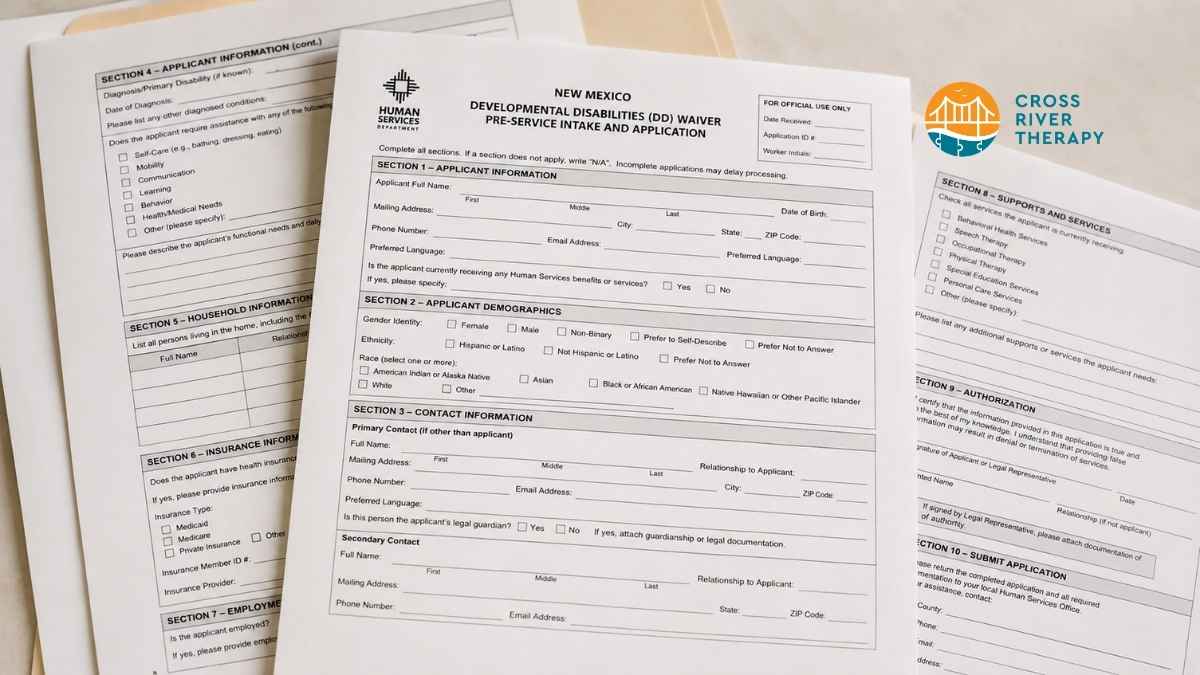
How to Apply for New Mexico’s DD Waiver While Starting ABA Therapy
Autism waiver New Mexico applications need DD Waiver records and proof of daily support needs. Your next step is to start ABA intake with Cross River.

Is ABA Therapy Covered by Insurance in New Jersey? What Every Parent Should Know
ABA therapy insurance New Jersey may cover medically necessary care based on plan type, network, and authorization. Verify benefits with Cross River.

How ABA Therapy Builds Communication for Nonverbal Children Without Forcing Speech
ABA therapy communication for nonverbal children starts with AAC, signs, and daily routines. See how kids ask, refuse, choose, and get help.

How to Start ABA Therapy in New Jersey With a First-Call Checklist
How to start ABA therapy in New Jersey begins with records, insurance details, and intake questions. Use this first-call checklist before you call.

How to Get an Autism Evaluation in Arkansas Before Starting ABA Therapy
How to get an autism evaluation in Arkansas starts with a referral, provider choice, and key records. Use this parent checklist before ABA intake.