








The importance of clear communication with your ABA team
Enhancing Collaboration: Clear Communication in ABA Therapy for Autism


Why Clear Communication with Your ABA Team Matters
Effective communication between families and ABA therapy teams is crucial to ensuring the best outcomes for children with autism. Applied Behavior Analysis (ABA) therapy is a highly specialized intervention that requires tailored approaches for each child, making open dialogue and collaboration essential. In this article, we explore how clear communication fosters successful therapy, strengthens partnerships with professionals, and ultimately supports children's development of vital communication skills.
Understanding Behavioral Analysis Therapy and Its Role in Autism Support
What is behavioral analysis therapy, and how is it used to support individuals with autism?
Behavioral analysis therapy, known as Applied Behavior Analysis (ABA), is a research-supported method designed to understand and change behaviors through reinforcement techniques. It aims to increase beneficial behaviors, such as effective communication, social abilities, and practical daily skills, while reducing behaviors that may hinder learning or social interaction.
ABA is carefully tailored to each individual, beginning with a thorough assessment to identify unique needs. This process guides the creation of a personalized therapy plan overseen by a certified professional, ensuring goals are relevant and progress is monitored closely.
Key ABA strategies include positive reinforcement—rewarding desired behaviors to encourage repetition—and techniques like prompting, modeling, and shaping that systematically teach new skills. This targeted approach helps children with autism develop communication capabilities and other social skills critical for their growth.
By addressing specific challenges such as delayed speech or social communication difficulties, ABA therapy supports individuals with autism in acquiring functional and spontaneous communication, ultimately improving their quality of life.
Who Are the Professionals Behind ABA Therapy?

What Roles Do BCBAs, BCaBAs, and RBTs Play?
Applied Behavior Analysis (ABA) therapy for autism is provided by a team of highly trained professionals with distinct roles. Board Certified Behavior Analysts (BCBAs) are the leading experts who design and oversee individualized treatment plans tailored to each child's unique needs. They hold advanced degrees and have extensive training in behavioral analysis.
Supporting BCBAs are Board Certified Assistant Behavior Analysts (BCaBAs), who assist in implementing therapy and developing interventions under BCBA supervision. Registered Behavior Technicians (RBTs) are frontline practitioners who deliver direct one-on-one therapy sessions, executing the plans designed by BCBAs and BCaBAs.
How Is the Team Structured and Supervised?
The ABA therapy team operates under a tiered supervision model. BCBAs supervise BCaBAs and RBTs to ensure fidelity in program delivery and to adjust interventions as needed based on ongoing assessments. This collaboration ensures that therapy remains personalized and evidence-based, enhancing outcomes.
In Which Settings Is ABA Therapy Provided?
ABA therapy is delivered in various environments depending on the child's needs and family preferences. Common settings include specialized clinics, schools, and home environments. This flexible approach allows therapy to be integrated into everyday activities, promoting generalization of communication and social skills.
Why Are Expert Qualifications Important?
The professionals involved in ABA must hold certifications that reflect their expertise and commitment to quality care. Certified credentials like BCBA, BCaBA, and RBT ensure that individuals have met rigorous education, training, and ethical standards. These qualifications are critical to providing effective, individualized interventions that support the developmental progress of children with autism.
Core Principles Driving Effective ABA Interventions
What are the core principles behind behavioral analysis therapy for autism?
Applied Behavior Analysis (ABA) therapy rests on a scientific understanding of human learning and behavior. It focuses on observable actions and their relationship with environmental factors, aiming to increase helpful behaviors while reducing harmful or obstructive ones.
The foundation of ABA involves analyzing what happens before a behavior (antecedents) and after (consequences) to effectively understand and modify behaviors. Key techniques include positive reinforcement, where desired behaviors—like requesting or labeling items—are encouraged by rewarding them. Prompting and modeling guide children in learning new skills, while functional behavior assessments identify triggers and reasons for behavior.
ABA therapy is highly individualized, beginning with a comprehensive assessment to tailor interventions to each child's unique needs. It utilizes strategies such as task analysis (breaking down complex skills), shaping (gradually reinforcing closer approximations to a behavior), and chaining (linking steps into a sequence).
Continuous data collection and assessment play a vital role in ABA, ensuring that the interventions remain effective and responsive to the child's progress. Ethical considerations also guide the practice, ensuring respectful and beneficial treatment.
Collaborations with other professionals, like speech-language pathologists, enhance intervention quality. ABA techniques cover communication, social interaction, and daily living skills, providing a broad support system for children with autism. This evidence-based approach is backed by extensive research demonstrating improvements in functional and spontaneous communication.
The Role of Clear Communication in Personalized ABA Therapy Planning

Why Are Thorough Initial Assessments Crucial?
A comprehensive assessment lays the foundation for effective ABA therapy. It helps applied behavior analysts understand each child’s unique communication abilities and challenges, ensuring interventions address specific needs rather than applying generic strategies.
How Is Collaborative Goal Setting Conducted?
Collaboration among behavior analysts, speech-language pathologists, families, and other professionals is essential. Together, they set clear, achievable communication goals that align with the child's developmental level and family priorities.
What Role Do Ongoing Feedback Loops Play?
Continuous communication between families and therapy teams allows for monitoring progress and sharing observations. This feedback enables timely adjustments to interventions, ensuring they remain relevant and effective.
How Is Therapy Adjusted Based on Individual Progress?
Personalized plans are dynamic. Applied behavior analysts use data gathered during sessions and from caregiver input to modify goals and strategies, adapting techniques like prompting, modeling, or introducing alternative AAC methods as needed. This flexible planning promotes meaningful communication growth tailored to each child.
Augmentative and Alternative Communication (AAC): Tools and Collaboration
What Are Common AAC Interventions for Children With Autism?
Children with autism often benefit from Augmentative and Alternative Communication (AAC) tools, which support the development of communication skills. These include:
- Picture Exchange Communication System (PECS): Initiates communication by encouraging children to request items without relying on verbal prompts, making it a natural starting point for many.
- Speech-Generating Devices (SGDs): Portable, voice-output devices that enhance social interaction and peer acceptance. However, they require additional materials and may be more costly.
- Sign Language: An effective method for communication, though it requires significant learning time and is not universally used.
- Communication Boards: Available in high-tech and low-tech formats, these boards aid in interactions and bonding activities. High-tech versions can be expensive.
How Do Professionals Collaborate to Tailor AAC Methods?
Applied behavior analysts (ABA professionals) work closely with speech-language pathologists to customize AAC interventions based on each child's unique communication needs. This collaboration ensures that therapy is tailored and research-based, often involving assessments to guide decisions.
What Are Important Considerations for AAC Use?
Choosing the right AAC tool involves balancing benefits with practical factors:
- Cost: High-tech tools like SGDs and advanced communication boards may involve greater expense.
- Learning Curve: Sign language requires time and effort to learn both by the child and their communication partners.
- Individual Needs: Tailoring AAC methods ensures that interventions align with the child's abilities and communication goals.
Through collaborative efforts and careful consideration, AAC interventions become powerful supports in fostering meaningful communication for children with autism.
How ABA Techniques Enhance Communication Skill Development
What are the components of Verbal Behavior Therapy in ABA?
Verbal Behavior Therapy (VBT), a subset of ABA, breaks down language skills into functional components called operants. These include mands (requests), tacts (labels), echoics (imitation), intraverbals (conversational responses), and autoclitics (modifiers). This system helps children with autism develop practical language abilities tailored to everyday communication.
How do prompting, modeling, imitation, and shaping support learning?
ABA employs techniques like prompting, modeling, imitation, and shaping to teach and strengthen communication skills. Prompting involves cues to encourage the desired response, modeling demonstrates the behavior, imitation reinforces learning by copying, and shaping rewards successive approximations toward the target skill.
What is the difference between Discrete Trial Training and Pivotal Response Treatment?
Discrete Trial Training (DTT) is a highly structured technique focusing on clear, repeated teaching of specific skills in controlled settings. In contrast, Pivotal Response Treatment (PRT) is a naturalistic method that integrates learning into everyday activities, promoting motivation and generalization of communication skills.
How do peer-mediated interventions and natural environment teaching enhance social communication?
Peer-mediated interventions engage typically developing peers to foster natural social interactions, improving pragmatic communication skills. Natural environment teaching embeds learning opportunities within daily routines and contexts, which increases the chances of spontaneous and functional communication.
Together, these ABA techniques provide a comprehensive, individualized approach that supports and accelerates communication skill development in children with autism.
Functional Communication Training (FCT) and Behavior Replacement Strategies
How does Functional Communication Training address challenging behaviors?
Functional Communication Training (FCT) is an evidence-based approach used within ABA therapy that focuses on replacing challenging behaviors with appropriate communication methods. Many children with autism may engage in behaviors such as tantrums or aggression as a way to communicate needs or desires. FCT identifies the purpose of these behaviors and systematically teaches alternative communicative responses to fulfill the same function.
How is communication taught to replace problem behavior?
FCT works by teaching the child a more effective and socially acceptable way to express themselves. For example, if a child throws objects to get attention, they are taught to request attention using words, signs, or AAC devices like PECS or speech-generating devices. This teaching can involve prompting, modeling, and reinforcing communication attempts using positive reinforcement to encourage continued use of the new behavior.
How does FCT improve social interactions?
By replacing challenging behaviors with functional communication, FCT enhances social interactions. When children can express needs clearly, they are more likely to engage positively with peers and adults, leading to greater social acceptance. Additionally, as children develop communication skills through FCT, their ability to participate in conversation and cooperative activities improves, which supports ongoing social growth.
In summary, Functional Communication Training is a vital ABA strategy that helps children with autism transition away from problem behaviors toward meaningful and effective communication, supporting their overall social development and quality of life.
Measuring Effectiveness: How Clear Communication Supports Successful Outcomes
How effective is behavioral analysis therapy in improving outcomes for individuals with autism?
Applied Behavior Analysis (ABA) therapy stands out as a scientifically validated approach for enhancing communication, social skills, and adaptive behaviors in individuals with autism. Research consistently shows that ABA promotes meaningful progress, especially when therapy is intensive, personalized, and implemented early.
Data-driven progress monitoring
ABA programs begin with comprehensive assessments to customize therapy plans. Throughout treatment, practitioners rely on continuous data collection to track communication skills such as requesting (mands), labeling (tacts), and conversational abilities (intraverbals). This focus ensures progress is measurable and objective, allowing teams to identify which strategies work best and where adjustments are necessary.
Adjusting interventions based on data and family input
Behavior analysts collaborate with families and other professionals like speech-language pathologists to interpret progress data. They tailor interventions accordingly, selecting or combining methods such as PECS, speech-generating devices (SGDs), sign language, or communication boards. Family insights are crucial for refining these choices to fit daily routines and cultural preferences, supporting more natural and effective communication development.
Empowering families to participate in therapy decisions
ABA emphasizes involving families in therapy planning and decision-making to strengthen outcomes. When caregivers understand the data and intervention goals, they can reinforce communication skills consistently across settings. This partnership helps generalize skills beyond therapy sessions, making improvements more sustainable.
Research supporting ABA effectiveness
Numerous studies support ABA’s efficacy in improving communication for children with autism. PECS and SGDs, often integrated into ABA, are backed by evidence showing significant gains in requesting, social interaction, and peer acceptance. ABA’s use of positive reinforcement and structured teaching methods like Discrete Trial Training (DTT) and Pivotal Response Treatment (PRT) further enhances communication outcomes.
By combining data-driven approaches with family collaboration and evidence-based techniques, ABA therapy offers a comprehensive framework for fostering clear, functional communication in children with autism.
Addressing Challenges: The Need for Transparent Communication About AAC Options
Balancing Benefits and Limitations of AAC Devices
AAC interventions like PECS, speech-generating devices (SGDs), sign language, and communication boards offer valuable communication support for children with autism. Each has distinct strengths: PECS, for example, fosters requesting without verbal prompts, while SGDs enhance social interaction through voice output. However, these tools also come with limitations that families and therapists must understand. Sign language requires significant learning time and is not universally used, which can hinder consistent communication across different settings. Communication boards, while versatile for bonding activities, vary from low-tech to expensive high-tech options, influencing accessibility.
Cost Considerations of High-Tech Tools
High-tech AAC devices, such as advanced SGDs, can be costly due to their sophisticated technology and additional material needs. Families and providers need to consider budget limitations and potential insurance coverage when selecting these options. Low-tech communication boards offer a more affordable alternative but may lack the dynamic features of electronic devices. Transparent discussions about costs help set realistic expectations and facilitate better decision-making.
Learning Curve for Sign Language
Though effective in enabling communication, sign language demands consistent practice and time investment from both the child and caregivers. This learning curve may pose challenges, especially if family members or peers do not also learn the signs, potentially limiting communication efficiency. Understanding this requirement helps families gauge commitment and compare it to other AAC options.
Importance of Setting Realistic Expectations
Applied behavior analysts and speech-language pathologists collaborate closely to tailor AAC interventions customized to each child's needs. It is vital to communicate openly about the capabilities and constraints of each method and the time needed for skill development. Setting realistic goals supports progress through positive reinforcement and structured ABA techniques, preventing frustration and reinforcing successful communication behaviors.
Fostering a Collaborative Relationship: Tips for Families Communicating with ABA Teams
Strategies for Effective Communication
Building a strong collaboration between families and ABA teams begins with clear, consistent communication. Families should feel comfortable asking questions and sharing insights about their child's behaviors and preferences. Scheduling regular meetings or check-ins helps maintain an open dialogue and ensures everyone stays informed about therapy approaches and progress.
Sharing Observations and Concerns
Families play a crucial role by observing their child's communication and social interactions in various settings. By sharing these observations and any concerns with the ABA team, they provide valuable context that enhances personalized intervention plans. This partnership supports timely adjustments to strategies, such as incorporating AAC tools like PECS or SGDs, tailored to the child's evolving needs.
Clarifying Therapy Goals and Progress
It's important for families to seek clarity on therapy objectives and milestones. Understanding goals related to communication skills, whether focusing on requesting (mands) or labeling (tacts), empowers families to reinforce these skills at home. Discussing progress openly encourages transparency and helps identify successful techniques or areas needing modification.
Building Trust and Mutual Respect
Effective collaboration hinges on trust and respect. Recognizing the expertise of applied behavior analysts and speech-language pathologists while valuing family insights creates a balanced partnership. Families should feel valued in decision-making processes, fostering a supportive environment where the child's development is the shared priority.
Building Bridges for Better Outcomes
Clear and consistent communication with your ABA therapy team is foundational to crafting individualized, effective interventions for children with autism. By understanding the principles of ABA, the roles of professionals involved, and the range of communication tools available, families can actively participate in shaping their child's developmental journey. Open dialogue fosters collaboration, allowing for timely adjustments and supports that empower children to reach their full potential. Embracing transparent communication not only improves therapy outcomes but also strengthens the partnership between families and professionals, creating a united front dedicated to meaningful progress.
References
- 4 Methods for Increasing Communication Within Applied ...
- How ABA Therapy Can Improve Communication Skills in ...
- Who Can Provide ABA Therapy?
- Who can provide ABA therapy?
- Applied Behavior Analysis (ABA)
- ABA Certification Explained: RBT, BCaBA, BCBA, BCBA-D
- Applied Behavior Analysis (ABA)
- Applied Behavior Analysis (ABA)
- 6 Benefits of ABA Therapy for Children with Autism
Recent News
Related articles

6 Arkansas Medicaid ABA Therapy Rules Families Need to Know
Arkansas Medicaid ABA therapy has age, diagnosis and approval rules. Families can check six requirements before care.

Arizona Autism Laws for ABA Coverage and School Rights
Arizona autism laws for ABA coverage vary by plan. Families can check insurance, appeal options, and school rights.

ABA Therapist Salary in Arkansas for RBTs and BCBAs
Compare ABA therapist salary in Arkansas by role. See how paid hours and benefits affect earnings before applying.

5 Autism Support Groups and Family Resources in New Mexico
Autism support groups in New Mexico connect families. Local resources offer events, parent support, and school help.

Where to Get an Autism Evaluation in New Mexico
Autism evaluation options in New Mexico include UNM and NMSU. Age and referral details help parents prepare.

7 North Carolina Autism Resources to Contact Before ABA Therapy Starts
Autism resources North Carolina families can call for diagnosis, early intervention, rights, and parent support. Start ABA intake with Cross River.

Does Indiana Medicaid Cover ABA Therapy? A Parent Checklist
Indiana Medicaid ABA therapy may cover care for eligible children. The checklist covers coaching and renewals.
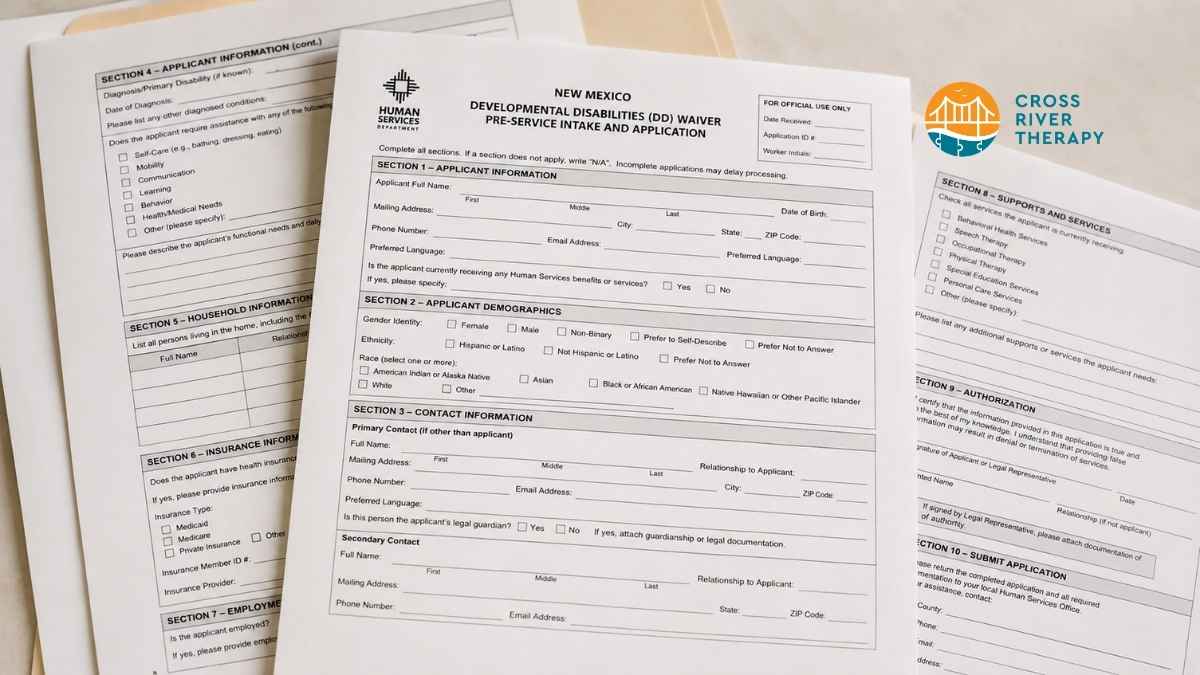
How to Apply for the New Mexico DD Waiver
Your NM DD waiver application starts with state intake. The steps cover records, submission, and enrollment.

Does Insurance Cover ABA Therapy in New Jersey?
ABA therapy insurance in New Jersey varies by plan. Learn what NJ FamilyCare covers and how to check costs.

How ABA Therapy Builds Communication for Nonverbal Children Without Forcing Speech
ABA therapy communication for nonverbal children starts with AAC, signs, and daily routines. See how kids ask, refuse, choose, and get help.

How to Start ABA Therapy in New Jersey With a Checklist
Your guide explains how to start ABA therapy in New Jersey. A first-call checklist covers records and next steps.

How to Get an Autism Evaluation in Arkansas Before Starting ABA Therapy
How to get an autism evaluation in Arkansas starts with a referral, provider choice, and key records. Use this parent checklist before ABA intake.