








Supporting transition to adulthood using ABA strategies
Empowering Young Adults with Autism: Effective ABA Strategies for Life Beyond School


Navigating the Path to Adulthood with Applied Behavior Analysis
Transitioning from adolescence to adulthood presents unique challenges for individuals with autism spectrum disorder. Applied Behavior Analysis (ABA) therapy offers evidence-based strategies to help young adults develop the skills they need for independence, employment, and social integration. This article explores how ABA supports this critical transition phase, detailing assessment, intervention techniques, family involvement, and collaborative workplace approaches.
Understanding Applied Behavior Analysis (ABA) Therapy for Autism
What is applied behavior analysis (ABA) therapy for autism?
Applied Behavior Analysis (ABA) therapy is a scientifically supported method designed to help individuals with autism improve socially significant skills such as communication, social interaction, and daily living abilities. Grounded in behavioral science principles, ABA uses techniques like positive reinforcement, visual modeling, prompting, and behavior chaining to teach and strengthen helpful behaviors while reducing interfering ones.
Scientific basis and evidence supporting ABA therapy
ABA is widely recognized as an evidence-based approach, with research confirming its effectiveness across the lifespan, not just in childhood. It relies on systematic assessment and data-driven interventions created by certified professionals, such as Board Certified Behavior Analysts (BCBAs). These professionals develop personalized treatment plans based on functional assessments that identify the individual's strengths and areas for growth.
What are the key goals of ABA therapy?
ABA therapy focuses on increasing independence and adaptive skills tailored to each individual's needs. Common targets include communication, social skills, executive functioning, vocational readiness, and daily living activities like self-care and organization. The approach emphasizes measurable objectives, often set using SMART (Specific, Measurable, Achievable, Relevant, Time-bound) criteria, ensuring goal progression and meaningful behavior change.
Where and by whom is ABA therapy provided?
ABA interventions can be delivered across diverse environments such as homes, schools, and community settings to promote generalization of skills. Qualified practitioners—often BCBAs and trained therapists—lead the therapy, frequently involving families through parent enrichment programs to reinforce gains. Providers may tailor sessions to the individual's everyday environments, supporting real-world application and sustained improvements.
| Aspect | Details | Notes |
|---|---|---|
| Definition | Behavioral science-based therapy for autism | Uses reinforcement and behavioral techniques |
| Evidence | Scientifically backed with broad age efficacy | Data-driven, personalized interventions |
| Key Goals | Communication, social, vocational, daily living skills | SMART-goal oriented |
| Providers and Settings | BCBAs, therapists; home, school, community | Family involvement and natural environments |
This comprehensive approach makes ABA a foundational treatment for supporting autistic individuals toward greater independence and quality of life.
Benefits of ABA Therapy in Preparing Young Adults with Autism for Independence

How does ABA therapy benefit individuals with autism?
ABA therapy is a scientifically supported approach that helps individuals with autism by encouraging positive behaviors and diminishing challenging ones. Techniques like positive reinforcement, where desired behaviors are rewarded, play a central role. This approach helps improve communication, social interaction, daily living skills, and academics, fostering greater independence.
Skill development in communication, social interaction, and daily living
ABA therapy targets personalized goals using SMART criteria—specific, measurable, achievable, relevant, and time-bound—to enhance crucial skills. Communication skills include both verbal and non-verbal methods. Social abilities focus on understanding cues and respecting boundaries. Daily living skills encompass self-care, home management, and personal organization, all vital for independent living.
Reducing challenging behaviors
Challenging behaviors, often linked to anxiety or sensory sensitivities, are addressed through ABA tools like relaxation exercises, sensory modifications, and extinction methods that withhold reinforcement for harmful behaviors. These strategies help individuals adapt better to workplace or community settings.
Personalization and individualization
Each individual's strengths and needs are assessed by a Board Certified Behavior Analyst (BCBA), who creates a customized treatment plan. This ensures the therapy aligns closely with the person's abilities and goals. The involvement of families and communities further personalizes support, maximizing skill generalization and retention.
Improving independence
ABA therapy not only teaches skills but also supports generalization through role-playing, job coaching, and practice in various environments. This holistic, ongoing approach increases the chances of successful, long-term independent employment and daily functioning.
By integrating evidence-based techniques with tailored planning and family involvement, ABA therapy prepares young adults with autism to become self-reliant and confident in their personal and vocational lives.
The Role and Qualifications of ABA Therapy Providers in Transition Support
Who provides ABA therapy and what qualifications do they have?
ABA therapy is delivered by a team of professionals trained specifically in behavior analysis and autism support. The central figures include Board Certified Behavior Analysts (BCBAs), Registered Behavior Technicians (RBTs), and licensed therapists.
Credentials of Providers such as BCBAs and RBTs
BCBAs are highly qualified practitioners who possess at least a master's degree in Applied Behavior Analysis, Psychology, or a related field. They complete specialized coursework and gain considerable supervised practical experience before passing a rigorous credentialing exam administered by the Behavior Analyst Certification Board (BACB).
RBTs, on the other hand, undergo a focused certification process that is shorter than that for BCBAs but still requires professional training and ongoing supervision. Their role is to implement therapy plans under the guidance of BCBAs or other certified professionals.
Training and Certification Requirements
Both BCBAs and RBTs must follow strict training protocols centered on evidence-based practices such as data collection, behavior assessment, and individualized intervention planning. Certification ensures they stay current with advances in ABA therapy interventions for autism.
Importance of Professional Supervision and Licensure
Professional supervision is essential; BCBAs typically supervise RBTs and other staff to maintain high-quality service delivery. Depending on the region, additional licensure is required by the state to legally provide therapy services, which safeguards clients and ensures ethical standards. Background checks are routine to ensure safety and reliability.
Provider Roles in Treatment Planning and Delivery
BCBAs lead the comprehensive assessment process, including functional behavior assessments and skill evaluations. They develop personalized treatment plans that incorporate SMART goals targeting communication, social, and vocational skills critical for successful employment transitions. RBTs and therapists implement these plans in various settings like homes and workplaces, use ABA techniques such as reinforcement and visual modeling, and provide role-playing and coaching for skill generalization.
Providers work in collaboration with families, schools, and employers to foster an inclusive environment conducive to ongoing skill development. This team approach helps ensure young adults with autism are supported throughout their transition to employment and adulthood.
Key ABA Methods and Techniques Used in Transition Planning
What methods and techniques are used in ABA therapy?
ABA therapy utilizes a range of evidence-based techniques designed to foster meaningful behavior change and skill acquisition, especially important during the transition to adulthood for individuals with autism.
Positive and Negative Reinforcement play a central role. Positive reinforcement entails rewarding desired behaviors to increase their frequency, while negative reinforcement involves removing unpleasant stimuli when positive behavior occurs, thus encouraging repetition.
Prompting and Fading guide learning by initially providing verbal or physical cues to initiate behavior and gradually reducing these prompts to promote independence.
Behavior Chaining breaks down complex tasks into smaller, manageable steps taught sequentially, allowing the young adult to master each part and build toward overall task completion.
Modeling and Extinction are also pivotal techniques. Modeling involves demonstrating desired behaviors for imitation, enhancing skill acquisition. Extinction reduces challenging behaviors by withholding the reinforcement that previously maintained them.
In addition, Visual Modeling and Script Fading support learning through videos, charts, or pictures, and by practicing social scenarios with gradually reduced prompts, respectively. These methods help generalize skills to real-world work and community settings.
The effectiveness of ABA lies in the individualization of techniques. Each intervention starts with a functional assessment by a BCBA who collaborates to develop personalized goals. The therapy adapts strategies to the individual's unique strengths, developmental stage, and needs, ensuring relevant skill-building for communication, social interaction, executive functioning, and vocational readiness.
Through a combination of these methods, ABA therapy creates a structured yet flexible framework to prepare young adults with autism for successful employment and independent living.
From Assessment to Personalized Goals: Crafting Effective ABA Plans for Employment
How does a BCBA contribute to the assessment process?
The transition to employment for young adults with autism begins with a functional assessment conducted by a Board Certified Behavior Analyst (BCBA). This expert evaluates the individual's current abilities, focusing on their strengths and areas that need support. Such comprehensive assessments ensure that therapy is tailored to the unique profile of each person.
What is involved in functional assessments?
Functional assessments identify essential skills and behavioral challenges in various domains like communication, social interaction, executive functioning, and vocational abilities. By understanding these factors, the BCBA can develop a detailed picture of where support and training are most needed for successful workplace integration.
How are SMART goals used in ABA therapy?
Following assessment, personalized goals are set based on SMART criteria—that is, goals that are Specific, Measurable, Achievable, Relevant, and Time-bound. This structured goal setting method ensures clarity in treatment plans and facilitates tracking progress effectively. For example, a SMART goal might be improving punctuality to 90% over two months by implementing time management strategies.
What skills are targeted through these personalized goals?
ABA therapy goals cover a wide range of competencies including:
- Communication: Enhancing verbal and non-verbal skills to improve workplace interactions.
- Social Interaction: Learning to read social cues and respect boundaries.
- Executive Functioning: Developing organization, time management, and problem-solving skills.
- Vocational Skills: Completing tasks efficiently and understanding workplace etiquette.
How is the client's involvement integrated?
Active participation from the individual is essential in creating and implementing these goals. Encouraging self-awareness and collaboration fosters ownership of the learning process, which boosts motivation and the likelihood of lasting behavioral change. This approach ensures the treatment plan remains relevant and empowering throughout the transition to employment.
Teaching Essential Workplace and Daily Living Skills through ABA
What Skills Are Taught Through ABA Therapy?
ABA therapy targets a comprehensive array of skills vital for successful employment and independence, especially for individuals with autism.
Verbal and Non-Verbal Communication
ABA programs emphasize both speaking skills and body language awareness. This includes learning to use words effectively and recognizing cues like facial expressions and gestures to improve interaction in workplace settings.
Social Skills
Young adults are taught how to interpret social cues, such as tone of voice and personal space, promoting respectful and positive social interactions. These skills help navigate workplace dynamics and build relationships.
Executive Functions
ABA supports development of executive functions crucial for job success. Skills like organization, planning tasks, and managing time effectively are practiced through personalized goals and routines.
Vocational Skills
Practical workplace skills are integral to ABA goals. This covers completing tasks independently, understanding business etiquette, and following schedules, preparing individuals for a variety of job roles.
Daily Living Skills
In addition to work competencies, ABA teaches daily living skills including self-care routines, appropriate dressing, and personal hygiene. These contribute to overall independence and readiness for employment.
ABA therapists use techniques such as modeling, task breakdown, and reinforcement to ensure skills are learned and generalized across settings, supporting long-term independence and job success.
Generalization, Collaboration, and Long-Term Support for Sustainable Employment
How Does ABA Therapy Promote Skill Generalization for Employment?
ABA therapy emphasizes the generalization of learned skills across various work environments to ensure young adults with autism maintain long-term employability. This is achieved through methods such as role-playing different workplace scenarios, repeated practice, and job coaching. These strategies help individuals apply communication, social, and vocational skills in real-life settings beyond therapy sessions.
What Role Does Collaboration with Employers Play?
Collaboration between ABA practitioners and employers is crucial in fostering inclusive and supportive work environments. Professionals engage employers through autism awareness training, which educates them about the unique needs of autistic employees. This collaboration promotes empathy and understanding, enabling employers to better support their workforce.
How Are Workplace Modifications Used to Enhance Inclusivity?
Workplace modifications tailored for autistic employees may include sensory adjustments, flexible scheduling, and clear visual instructions. These modifications accommodate sensory sensitivities and help individuals adapt more comfortably to their jobs. Such environmental supports reduce workplace anxiety and improve focus and performance.
Why Is Long-Term Monitoring Important?
Sustaining employment success requires ongoing monitoring and recurrent assessments conducted by behavior analysts. These follow-ups track progress, identify emerging challenges, and allow for timely intervention. They ensure that skills remain sharp and behavioral challenges continue to be addressed effectively.
How Does Continued Professional Involvement Support Sustainable Employment?
Ongoing professional involvement by Board Certified Behavior Analysts and therapists ensures adaptive support as individuals encounter new workplace demands or life changes. Continuous guidance helps in adjusting ABA strategies, reinforcing positive behaviors, and maintaining skill levels necessary for career growth.
| Aspect | Approach | Outcome/Benefit |
|---|---|---|
| Skill Generalization | Role-playing, job coaching | Application of skills in diverse work settings |
| Employer Collaboration | Autism awareness training | Enhanced workplace understanding and support |
| Workplace Modifications | Sensory adjustments, flexible scheduling | Increased employee comfort and productivity |
| Long-Term Monitoring | Recurrent assessments | Continuous progress tracking and intervention |
| Professional Involvement | Ongoing behavioral support | Sustained employment and adaptability |
Family Involvement and Community Integration in ABA Transition Programs
What are the benefits of in-home ABA therapy?
In-home ABA therapy provides young adults with autism the comfort and familiarity of their own surroundings while learning vital skills. This setting helps minimize distractions and anxiety often associated with new environments, allowing for more effective acquisition of communication, social, and vocational skills. Therapists can also directly observe everyday challenges and customize interventions that are immediately relevant to the family's routine.
How do parent enrichment programs support families?
Parent enrichment programs empower families by offering education on ABA principles, effective reinforcement techniques, and strategies to reinforce skills learned during therapy sessions. These programs cultivate confidence in caregivers, enabling them to become active collaborators in the therapeutic process. By enhancing parental involvement, the positive behaviors and skills are more consistently supported and generalized across settings.
What role does holistic development play in these programs?
Holistic development emphasizes a comprehensive approach that integrates professional guidance, family participation, and personalized planning. This method addresses not only behavioral goals but also emotional regulation, daily living skills, and social relationships essential for employment and independence. By uniting these elements, the programs foster balanced growth, preparing young adults for smooth transitions into adulthood and work environments.
How do family and community contribute to successful transitions?
Families, alongside community programs and schools, play vital roles in teaching, modeling, and reinforcing essential life and vocational skills. Collaboration ensures consistency between home, therapy, and community environments, increasing the generalization of skills. Community involvement also promotes social inclusion and provides opportunities for practical experiences, such as volunteer work or internships, which are crucial for building self-confidence and workplace readiness.
How do these programs support autonomy and self-advocacy?
ABA transition programs equip young adults with self-awareness and self-advocacy skills critical for independence. By involving them actively in goal-setting and decision-making processes, these programs nurture their confidence and ability to express needs or preferences. Support from families and therapists ensures that learners develop the competence to manage challenges and pursue their vocational aspirations effectively.
How can families select the right ABA therapy provider?
Families should carefully research providers by verifying staff credentials, especially the involvement of Board Certified Behavior Analysts (BCBAs), and understanding their program approaches. Visiting therapy centers, inquiring about supervision, data tracking, individualized planning, and safety protocols help determine quality. Seeking recommendations and ensuring providers support family collaboration and ethical standards lead to more successful and supportive interventions.
| Aspect | Description | Impact on Transition |
|---|---|---|
| In-home ABA Therapy | Therapy delivered in the family home | Enhances comfort and contextual learning |
| Parent Enrichment Programs | Training and support for caregivers | Empowers families to reinforce skills consistently |
| Holistic Development | Integration of professional, familial, and personal goals | Addresses all developmental areas for employment |
| Family and Community Roles | Joint participation in teaching and practicing skills | Promotes generalization and social inclusion |
| Autonomy and Self-Advocacy | Encouraging self-awareness and communication | Builds confidence for independent decision-making |
| Provider Selection Tips | Criteria for choosing qualified providers | Ensures effective, ethical, and family-centered care |
Bridging the Gap to Adulthood with ABA-Informed Strategies
Applied Behavior Analysis offers a robust framework for supporting young adults with autism during the complex transition to independence and employment. Through personalized assessments, scientifically grounded techniques, and inclusive collaboration among providers, families, and employers, ABA fosters the development of essential life and work skills. Critical to this success is the ongoing involvement of families and long-term professional support, ensuring skills are generalized and sustained across environments. By embracing these ABA strategies, stakeholders empower autistic individuals to achieve meaningful, self-directed adult lives, paving the way for greater autonomy, confidence, and participation in their communities.
References
- The Role of ABA in Transitioning Young Adults with Autism
- ABA Techniques: Strategies for Behavior Analysts - GSEP Blog
- What can ABA offer young adults with autism?
- ABA and School-Ready Teens: Transitioning to Adulthood
- Applied Behavior Analysis (ABA)
- The Top 10 Reasons Children With Autism Deserve ABA
- Applied Behavior Analysis (ABA)
Recent News
Related articles

6 Arkansas Medicaid ABA Therapy Rules Families Need to Know
Arkansas Medicaid ABA therapy has age, diagnosis and approval rules. Families can check six requirements before care.

Arizona Autism Laws for ABA Coverage and School Rights
Arizona autism laws for ABA coverage vary by plan. Families can check insurance, appeal options, and school rights.

ABA Therapist Salary in Arkansas for RBTs and BCBAs
Compare ABA therapist salary in Arkansas by role. See how paid hours and benefits affect earnings before applying.

5 Autism Support Groups and Family Resources in New Mexico
Autism support groups in New Mexico connect families. Local resources offer events, parent support, and school help.

Where to Get an Autism Evaluation in New Mexico
Autism evaluation options in New Mexico include UNM and NMSU. Age and referral details help parents prepare.

7 North Carolina Autism Resources to Contact Before ABA Therapy Starts
Autism resources North Carolina families can call for diagnosis, early intervention, rights, and parent support. Start ABA intake with Cross River.

Does Indiana Medicaid Cover ABA Therapy? A Parent Checklist
Indiana Medicaid ABA therapy may cover care for eligible children. The checklist covers coaching and renewals.
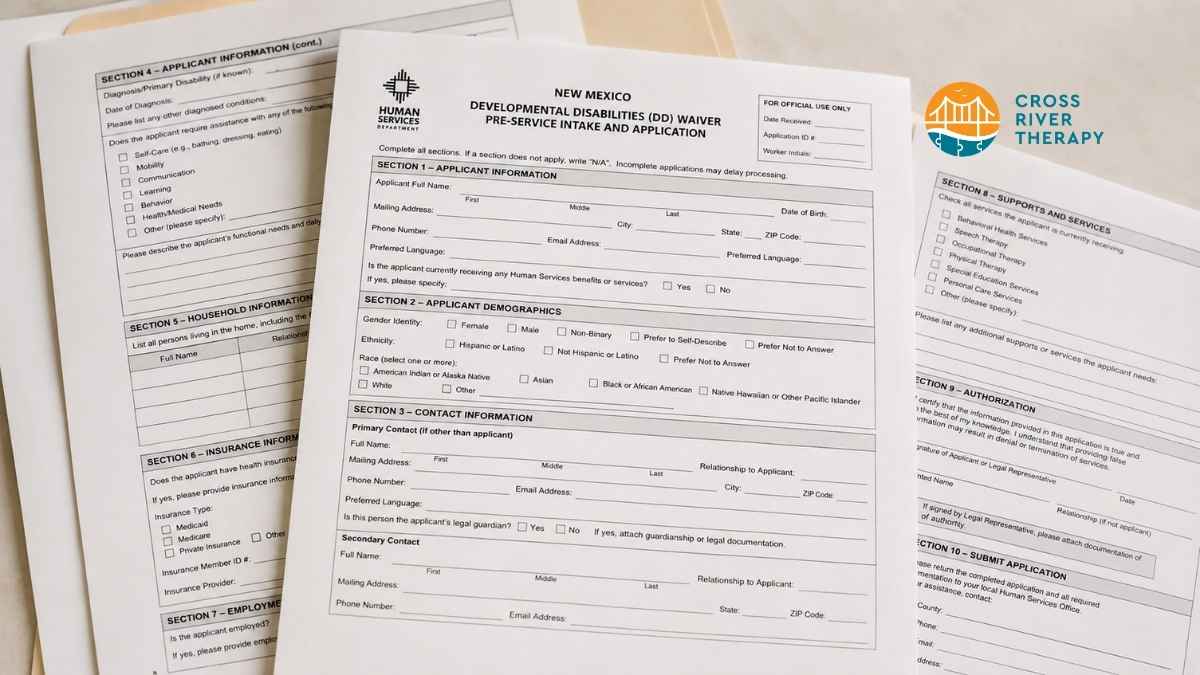
How to Apply for the New Mexico DD Waiver
Your NM DD waiver application starts with state intake. The steps cover records, submission, and enrollment.

Does Insurance Cover ABA Therapy in New Jersey?
ABA therapy insurance in New Jersey varies by plan. Learn what NJ FamilyCare covers and how to check costs.

How ABA Therapy Builds Communication for Nonverbal Children Without Forcing Speech
ABA therapy communication for nonverbal children starts with AAC, signs, and daily routines. See how kids ask, refuse, choose, and get help.

How to Start ABA Therapy in New Jersey With a Checklist
Your guide explains how to start ABA therapy in New Jersey. A first-call checklist covers records and next steps.

How to Get an Autism Evaluation in Arkansas Before Starting ABA Therapy
How to get an autism evaluation in Arkansas starts with a referral, provider choice, and key records. Use this parent checklist before ABA intake.