








Teaching flexible language use in different contexts
Enhancing Communication Through Contextual Language Flexibility in Autism Therapy


Understanding the Role of Language Flexibility in Autism Support
Teaching flexible language use across different contexts is a cornerstone of effective behavioral therapies for individuals with autism. Applied Behavior Analysis (ABA) therapy, recognized as an evidence-based approach, utilizes specialized techniques to support communication development and adapt language skills to diverse situations. This article explores how ABA integrates flexible language instruction, its goals in behavioral therapy, the professionals involved, progress measurement methods, and practical applications across environments such as home, school, and community settings.
Defining Applied Behavior Analysis (ABA) and Its Role in Autism Therapy
What is Applied Behavior Analysis (ABA) therapy, and how is it used to support individuals with autism?
Applied Behavior Analysis (ABA) therapy is a scientific method focused on understanding and modifying behavior through observation and data-driven strategies. Rooted in behaviorism, ABA aims to increase helpful skills like communication and social interaction while reducing behaviors that interfere with learning or functioning.
ABA is widely recognized as an effective intervention for individuals with autism. It involves creating personalized programs tailored to each individual's needs across different environments—home, school, and community. Qualified behavior analysts assess behavior patterns and design goals incorporating communication, self-care, play, and academic skills.
Several teaching techniques are utilized in ABA to promote skill acquisition. Discrete Trial Training (DTT) breaks skills into small steps with prompts and rewards, while Natural Environment Training (NET) encourages learning during everyday activities, enhancing generalization. Verbal Behavior Therapy (VBT) focuses on developing communication skills, and Pivotal Response Treatment (PRT) targets motivation and social responses to produce broad improvements.
Reinforcement, especially positive reinforcement, is a cornerstone strategy where desired behaviors are encouraged through rewards. Other approaches include task analysis, behavioral momentum, token systems, and visual supports—all tailored to foster learning in ways best suited to the individual.
Evidence shows that intensive, long-term ABA therapy can significantly improve intellectual functioning, language development, daily living, and social skills, making it a cornerstone treatment for autism spectrum disorders.
Core Goals of Behavioral Analysis Therapy in Autism
What are the main goals of behavioral analysis therapy for autism?
Behavioral analysis therapy, especially Applied Behavior Analysis (ABA), focuses on several critical goals to support children with autism. A primary aim is to improve communication skills, enabling individuals to express their needs and interact effectively with others. This often involves teaching both verbal and non-verbal communication through specific techniques like Verbal Behavior Therapy (VBT).
Enhancement of social interactions and independence is another vital goal. Through learning pivotal skills such as motivation and response to social cues, therapies like Pivotal Response Treatment (PRT) help children engage more naturally in social settings and daily activities. Teaching life skills using Task Analysis also promotes greater independence by breaking down complex behaviors into simpler, manageable steps.
ABA therapy seeks to reduce problematic behaviors that could impede learning or social functioning. Functional Communication Training (FCT) and token reinforcement systems are typical strategies used to replace challenging behaviors with functional communication and positive behaviors.
Utilizing reinforcement techniques, especially positive reinforcement, encourages individuals to repeat desirable behaviors by rewarding them. Behavioral Momentum and errorless teaching methods further support learning by building confidence and minimizing frustration.
Importantly, ABA programs are tailored to meet individual needs. Assessment by behavior analysts guides the creation of personalized treatment plans that adjust to the learner's progress and unique challenges. This customization increases the therapy's effectiveness and relevance.
Finally, early and consistent therapy plays a crucial role. Intensive ABA intervention starting at a young age, often ranging from 25 to 40 hours per week for 1 to 3 years, has been shown to yield meaningful improvements in intellectual functioning, communication, daily living skills, and social behaviors.
Together, these goals highlight how behavioral analysis therapy strives to foster meaningful developmental gains and improve quality of life for individuals on the autism spectrum.
Techniques for Teaching Flexible Language Use within ABA Therapy
What is Discrete Trial Training (DTT) and how does it help in teaching language?
DTT is a structured teaching method that breaks down language skills into small, manageable steps. Each step involves prompts to guide the learner and reinforcement to encourage correct responses. Because of its stepwise approach, DTT is highly effective in both home and clinical settings for developing foundational communication skills.
How does Natural Environment Training (NET) support learning language in real life?
NET encourages language learning within natural, everyday contexts such as during play or daily activities. This approach helps learners apply new language skills where it matters most, improving generalization beyond therapy sessions.
What role does Verbal Behavior Therapy (VBT) play in communication development?
VBT focuses on teaching both verbal and non-verbal communication essential for individuals with speech delays. It targets specific language functions to expand communication abilities in a meaningful and functional way.
How is task analysis used to teach complex language tasks?
Task analysis breaks down complex language tasks into simpler, sequential steps. This makes challenging skills more accessible and promotes independence in using language effectively.
What does Pivotal Response Treatment (PRT) target in language learning?
PRT aims at pivotal areas such as motivation and response to social cues. By improving these core skills, learners experience broader gains in communication and social interaction.
How does Errorless Teaching boost learner confidence?
Errorless Teaching minimizes mistakes during learning by carefully designing tasks to prevent errors. This strategy builds confidence, especially for learners who may become frustrated or discouraged easily.
What visual supports are used to assist language development?
Visual supports include schedules and social stories that provide cues and guidance. These aids help learners understand expectations and navigate social and communication tasks more effectively.
Utilizing Functional Communication Training to Address Problem Behaviors
Teaching Functional Communication to Replace Maladaptive Behaviors
Functional Communication Training (FCT) is an ABA technique designed to teach individuals effective ways to communicate their needs and desires. By replacing challenging or disruptive behaviors—such as aggression and tantrums—with functional communication, learners gain more appropriate tools to express themselves. This approach not only reduces problem behaviors but also enhances social interaction and quality of life.
Reduction in Aggression and Tantrums Through Communication
One of the main benefits of FCT is its ability to decrease behaviors like aggression and tantrums that often result from communication difficulties. By providing the individual with clear, functional alternatives, frustration and negative outbursts are minimized. This promotes a calmer environment and supports more positive relationships with caregivers and peers.
Token Systems as Motivational Reinforcers
To support FCT, Token Systems are often employed as motivational reinforcers. Learners earn tokens for using functional communication skills, which can later be exchanged for preferred rewards. This system encourages consistent use of appropriate communication and helps maintain engagement throughout learning.
Role of Positive Reinforcement in Encouraging Adaptive Language Use
Positive reinforcement is central to strengthening desired communication behaviors within FCT. When learners successfully use functional language, immediate and meaningful rewards encourage repetition and skill growth. This encourages the learner to adopt and generalize adaptive communication over time.
Behavioral Momentum to Build Confidence and Compliance
Behavioral Momentum uses the strategy of starting with easy communication tasks to build the learner’s confidence. By initially reinforcing simple requests or responses, the learner is more motivated and prepared to handle more complex verbal behaviors. This momentum increases compliance and participation during training.
Behavior Chaining to Develop Complex Verbal Behaviors
Behavior chaining breaks down complex communication processes into smaller, teachable steps. Each link in the chain is taught sequentially, gradually building intricate verbal behaviors. This scaffolded approach supports learners in mastering multi-step communication skills necessary for effective interaction in everyday life.
Role of Multidisciplinary Teams and Specialized Providers in ABA Therapy
Who are the professionals and companies typically involved in providing autism therapy using behavioral analysis?
Applied Behavior Analysis (ABA) therapy involves a team of specialized professionals working collaboratively to deliver effective treatment for individuals with autism. At the core are Board Certified Behavior Analysts (BCBAs), who conduct detailed assessments and develop personalized treatment plans. These plans cover goals in communication, social skills, self-care, and more.
Registered Behavior Technicians (RBTs) are frontline therapists who execute these ABA interventions directly with clients, following the BCBA’s guidance and supervision.
ABA therapy often integrates expertise from speech therapists, occupational therapists, and psychologists to address speech delays, sensory processing challenges, and emotional or cognitive needs.
What settings provide ABA services?
ABA services are delivered across various environments, including private clinics, hospitals, schools, and sometimes within home and community settings. This flexibility allows the therapy to be tailored to the individual's daily life and promotes skill generalization.
Why is individualized treatment planning important?
Each person’s needs are unique, requiring ABA programs to be highly individualized. BCBAs use ongoing data collection to adjust goals and techniques to fit the evolving strengths and challenges of the client. This ensures the most effective progress in behavior and skill development.
Together, these specialized providers and multidisciplinary teams create a supportive network that fosters meaningful behavioral change and personal growth through ABA therapy.
Measuring Progress and Adapting ABA Therapy Plans
How does behavioral analysis therapy measure progress in individuals with autism?
Behavioral analysis therapy relies on systematic data collection to monitor progress effectively. Therapists track specific target behaviors by measuring their frequency (how often behaviors occur), duration (how long they last), and intensity (the strength or severity). These measurable data points provide a clear picture of behavioral changes over time.
To guide this process, well-defined, measurable goals are set across multiple domains such as communication skills, social interactions, and emotional regulation. For instance, goals might focus on increasing eye contact, enhancing verbal requests, or improving response to social cues.
Caregiver feedback and observations in natural environments also add rich insights into the individual's performance in day-to-day contexts. These observations help verify behavioral improvements beyond clinical settings, promoting real-world applicability.
Therapists use all collected data to adjust treatment plans as needed, ensuring interventions remain personalized and effective. Celebrating milestones serves to reinforce positive behaviors and motivate learners. Additionally, a strong focus on generalization helps individuals apply newly acquired skills across different situations and environments, which is crucial for long-term success.
In summary, progress in ABA therapy is seen through detailed behavioral measurements, continual assessment of personalized goals, collaborative feedback, and flexible treatment strategies that celebrate achievements and promote lifelong skill development.
Integrating Visual Modeling and Prompting for Language Flexibility
Visual Modeling Techniques
Visual modeling uses video clips, picture charts, and other visual aids to demonstrate behaviors clearly. This method is especially effective for individuals with autism, who may find verbal instructions challenging. Watching a modeled behavior helps learners understand and imitate desired actions.
Prompting to Initiate Behaviors
Prompting involves giving cues or hints to help start desired responses or behaviors. These prompts can be verbal, gestural, or physical. They provide initial support, guiding learners to perform new behaviors correctly.
Fading Prompts for Independence
Over time, prompts are gradually reduced through a process called fading. This encourages learners to perform behaviors independently without relying on external cues, fostering confidence and autonomy.
Script Fading for Social Navigation
Script fading offers verbal or written guides to assist individuals in social situations. Gradually, these scripts are faded to promote spontaneous and flexible communication, improving social skills.
Role of Modeling in Social Skill Development
Modeling demonstrates social behaviors that learners can imitate, such as greetings, sharing, and turn-taking. This hands-on observation supports learners' social understanding and interaction abilities.
Redirection Strategies
Redirection is used to manage disruptive behaviors by gently shifting the individual's attention toward positive or alternative activities. This strategy helps maintain focus and encourages appropriate behavior in social settings.
Applying Behavioral Contracts and Extinction Methods in Communication Training
How Are Behavioral Contracts Used to Set Clear Expectations and Rewards?
Behavior contracts are formal agreements between the therapist, individual, and often caregivers, outlining expected communication behaviors and the rewards or consequences linked to them. These contracts provide clear, structured guidance on desired communication skills, helping learners understand the benefits of using functional language. This clarity increases motivation and accountability in communication training.
What Is the Role of Extinction in Reducing Challenging Behaviors?
Extinction involves withholding reinforcement for maladaptive communication behaviors, such as tantrums or aggression used to avoid requests. By no longer providing the usual payoff for these behaviors, extinction aims to decrease their occurrence. Although effective, this method can initially lead to a temporary increase in challenging behaviors, known as an extinction burst.
How Can Redirection Support Transitions From Maladaptive to Adaptive Communication?
To ease transitions during extinction, redirection is used to guide individuals toward appropriate communication alternatives. This strategy diverts attention from problem behaviors to positive language use, promoting flexible and functional communication. Redirection operates as a gentle prompt that supports learners in adopting new skills without frustration.
What Is the Overall Impact on Flexible and Functional Language Use?
When combined, behavioral contracts and extinction methods create a structured, motivating, and effective framework for developing flexible communication skills. Contracts provide clear expectations and incentives, while extinction removes reinforcement for undesired behaviors. Redirection supports this process, making communication training more functional and adaptable to real-life situations, contributing to significant improvements in language use and social interaction.
The Importance of Environment in Generalizing Language Skills

How Does Natural Environment Training (NET) Support Language Learning?
Natural Environment Training (NET) is an ABA technique that focuses on teaching language skills within real-life, everyday settings such as during playtime or routine activities. This approach helps learners apply communication in practical contexts, promoting better generalization of skills beyond therapy sessions.
What Role Do Family and Caregivers Play in Supporting Language Use?
Family members and caregivers are essential to language development. By incorporating language practice naturally during daily interactions and routines, they reinforce learning and encourage spontaneous communication. Their involvement ensures consistent support and helps bridge therapy goals with real-world use.
How Are Skills Transferred Across Home, School, and Community?
ABA therapy aims to ensure skills learned in one setting, like therapy or school, are functional in other environments. Therapists often work across various settings, collaborating with educators and caregivers to promote consistency. This multi-setting approach supports seamless skill transfer, increasing confidence and independence.
How Do Visual Supports and Schedules Maintain Consistency?
Visual supports such as cue cards, schedules, and social stories provide clear guidance on expectations and routines. These tools help learners understand and anticipate activities, reducing anxiety and aiding consistent language use. They act as reminders that strengthen learning and generalization.
How Does Task Analysis Promote Independence in Daily Living?
Task Analysis involves breaking down complex daily skills into smaller steps that are easier to master. This method improves independence by teaching learners each step sequentially, building confidence to communicate needs effectively throughout daily activities. It complements other strategies by fostering autonomy both in language and practical skills.
Training and Certification for ABA Professionals Delivering Language-Focused Therapy

Educational Programs Like Pepperdine University's Master of Science in ABA
Pepperdine University provides a comprehensive Master of Science program in Applied Behavior Analysis. This program combines theoretical coursework on ABA techniques with practical hands-on training. Students gain a deep understanding of behavior analysis principles, including language-focused therapy methods crucial for working with individuals with communication challenges.
Practicum Experiences Supervised by Board Certified Behavior Analysts (BCBAs)
A vital component of ABA training is practicum experience under the supervision of a Board-Certified Behavior Analyst (BCBA). During these supervised practicum courses, trainees apply evidence-based strategies in real-world settings. This mentorship ensures that emerging therapists effectively develop and implement flexible language instruction tailored to individual needs.
Certification Preparation for BCBA Credential
The Master’s program and practicum collectively prepare candidates for the rigorous BCBA certification exam. Achieving this credential validates the therapist’s expertise and readiness to deliver high-quality ABA therapy, including specialized language interventions. BCBA certification is widely recognized and often required for professional practice.
Importance of Skilled, Trained Therapists for Effective Language Instruction
Effective language-focused ABA therapy depends heavily on skilled and well-trained therapists. The ability to adapt techniques like Verbal Behavior Therapy, Natural Environment Training, and other strategies requires accurate assessment, data-driven adjustments, and solid clinical judgment—all cultivated through specialized education and supervised practice.
Ongoing Professional Development and Adherence to Evidence-Based Practices
ABA professionals continue to enhance their skills through ongoing professional development. Staying current with the latest research and adhering to evidence-based practices is essential to maintaining therapy effectiveness. This commitment ensures that individuals receive the most up-to-date, scientifically supported interventions for enhancing communication and behavioral outcomes.
Accessing ABA Therapy: Recommendations, Insurance, and Provider Selection
Role of Pediatrician or Medical Provider Referrals
Accessing ABA therapy typically begins with a recommendation or referral from a pediatrician or medical provider. These professionals evaluate the child's developmental needs and can prescribe ABA as medically necessary, ensuring appropriate care aligned with the individual's condition.
Insurance Coverage Considerations
Coverage for ABA therapy often depends on insurance policies. Both private insurance and Medicaid may cover ABA services if deemed medically necessary. It's important for families to verify their specific insurance benefits and understand any requirements, such as prior authorization or treatment plans.
Assessing Provider Fit and Therapy Suitability
Choosing the right ABA provider involves more than credentials; families should evaluate how well the provider’s approach aligns with their child’s needs. Factors to consider include the therapist's experience, communication style, flexibility in settings (home, school, community), and the ability to tailor techniques to individual goals. Asking questions about intervention methods and hours of therapy can help determine if the provider is a good match.
Importance of Early Intervention Access
Early access to ABA therapy plays a critical role in maximizing outcomes. Intensive and timely intervention—ideally initiated soon after diagnosis—has been shown to improve language, social skills, and adaptive behaviors. Families are encouraged to seek services promptly to benefit from these evidence-based practices.
Collaboration with Families in Therapy Selection and Planning
ABA therapy is most effective when families are actively involved. Collaboration includes joint planning, training, and ongoing communication between therapists and caregivers. This partnership ensures consistent support across all environments, fostering skill generalization and making therapy more meaningful and sustainable.
Advancing Flexible Language Use Through Tailored Behavioral Interventions
Teaching flexible language use in individuals with autism requires comprehensive, individualized approaches grounded in Applied Behavior Analysis. Utilizing a variety of evidence-based techniques such as discrete trial training, naturalistic teaching, functional communication training, and visual supports, therapists foster meaningful improvements in communication across diverse contexts. Progress is continuously measured and therapy plans adjusted by skilled professionals, ensuring relevance and efficacy. Collaboration among multidisciplinary teams and active involvement of caregivers further enhances generalization and independence. As accessibility to qualified providers increases alongside growing awareness, ABA therapy remains a vital, scientifically validated pathway to empowering individuals with autism to navigate the complexities of language and social interaction flexibly and confidently.
References
- ABA Therapy Techniques: Key Methods Explained
- Applied Behavior Analysis (ABA)
- ABA Techniques: Strategies for Behavior Analysts - GSEP Blog
- Behavioral Therapy for Autism Spectrum Disorder in Children
- Applied Behavior Analysis (ABA)
- Treatment and Intervention for Autism Spectrum Disorder
- Applied Behavior Analysis (ABA)
- Applied Behavior Analysis (ABA)
Recent News
Related articles

6 Arkansas Medicaid ABA Therapy Rules Families Need to Know
Arkansas Medicaid ABA therapy has age, diagnosis and approval rules. Families can check six requirements before care.

Arizona Autism Laws for ABA Coverage and School Rights
Arizona autism laws for ABA coverage vary by plan. Families can check insurance, appeal options, and school rights.

ABA Therapist Salary in Arkansas for RBTs and BCBAs
Compare ABA therapist salary in Arkansas by role. See how paid hours and benefits affect earnings before applying.

5 Autism Support Groups and Family Resources in New Mexico
Autism support groups in New Mexico connect families. Local resources offer events, parent support, and school help.

Where to Get an Autism Evaluation in New Mexico
Autism evaluation options in New Mexico include UNM and NMSU. Age and referral details help parents prepare.

7 North Carolina Autism Resources to Contact Before ABA Therapy Starts
Autism resources North Carolina families can call for diagnosis, early intervention, rights, and parent support. Start ABA intake with Cross River.

Does Indiana Medicaid Cover ABA Therapy? A Parent Checklist
Indiana Medicaid ABA therapy may cover care for eligible children. The checklist covers coaching and renewals.
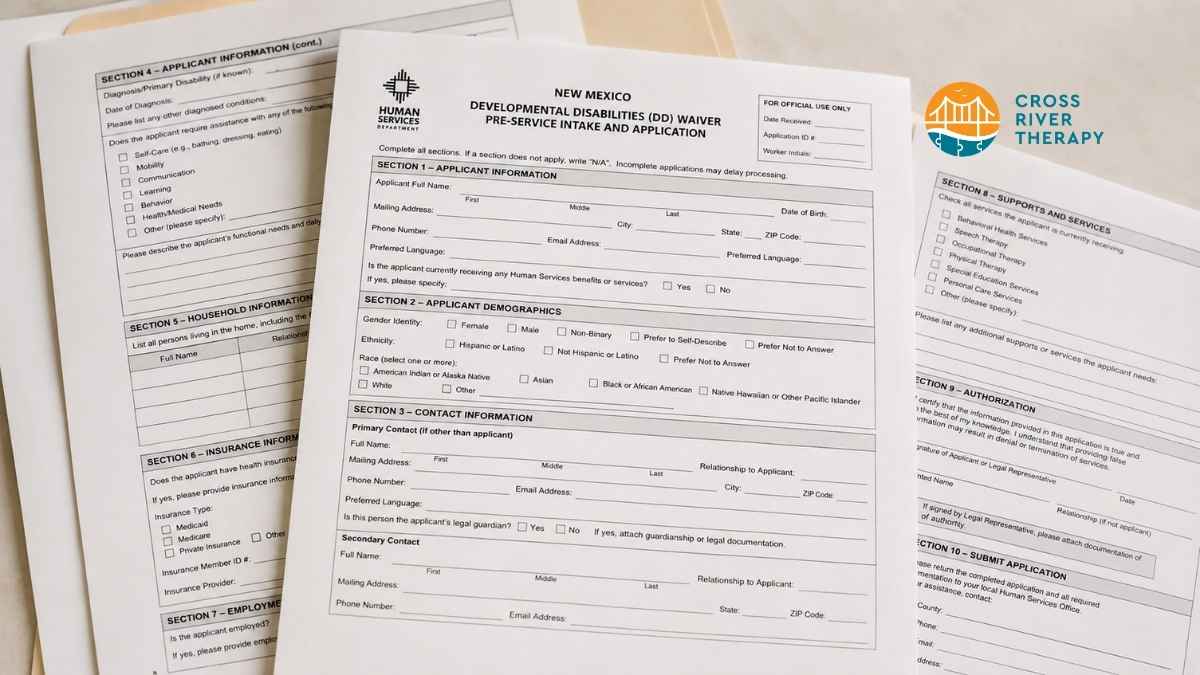
How to Apply for the New Mexico DD Waiver
Your NM DD waiver application starts with state intake. The steps cover records, submission, and enrollment.

Does Insurance Cover ABA Therapy in New Jersey?
ABA therapy insurance in New Jersey varies by plan. Learn what NJ FamilyCare covers and how to check costs.

How ABA Therapy Builds Communication for Nonverbal Children Without Forcing Speech
ABA therapy communication for nonverbal children starts with AAC, signs, and daily routines. See how kids ask, refuse, choose, and get help.

How to Start ABA Therapy in New Jersey With a Checklist
Your guide explains how to start ABA therapy in New Jersey. A first-call checklist covers records and next steps.

How to Get an Autism Evaluation in Arkansas Before Starting ABA Therapy
How to get an autism evaluation in Arkansas starts with a referral, provider choice, and key records. Use this parent checklist before ABA intake.