








ABA Therapy Techniques for Improving Focus and Attention
Enhancing Attention in Children with Autism Through ABA Strategies


Understanding the Role of ABA Therapy in Developing Focus
Applied Behavior Analysis (ABA) is a proven, structured approach aimed at improving focus and attention in children with autism. By harnessing evidence-based techniques such as positive reinforcement, modeling, and tailored activities, ABA therapy addresses core attention challenges, facilitating better engagement, learning, and independence. This comprehensive approach combines behavior modification with sensory regulation, activity planning, and caregiver training to produce measurable improvements in attention spans that support overall development.
Core ABA Techniques to Foster Focus and Attention
What are some ABA therapy techniques used to improve focus and attention in children with autism?
Applied Behavior Analysis (ABA) offers several effective strategies aimed at enhancing focus and attention in children with autism. One foundational technique is positive reinforcement, where desired behaviors are rewarded to encourage continued attention and engagement.
Modeling plays a significant role—therapists demonstrate tasks or behaviors, providing children with visual or behavioral cues to imitate. Prompting involves guiding a child through a task using cues or hints, which are gradually faded to promote independent attention.
Visual supports are widely utilized, including visual schedules, checklists, and timers. These tools help children understand expectations, manage transitions smoothly, and stay engaged with tasks.
Incorporating sensory strategies can make a difference as well. For example, calming sensory tools like fidget toys or sensory bins can reduce sensory overload and increase the child's capacity to focus. Creating structured routines and environments free from distractions is crucial for maintaining attention.
Finally, engaging children with activities aligned with their personal interests enhances motivation, which in turn improves concentration. Consistency across routines, individualized planning, and involving family members contribute to the success of these techniques.
These approaches are combined within personalized ABA programs that systematically work towards increasing attention span, ultimately supporting children with autism in more effectively participating in learning and social activities.
The Significance of Play and Environment in Attention Development

How do play activities and environmental modifications contribute to enhancing attention in children with autism during ABA therapy?
Engaging children with autism in play activities that match their interests is a powerful way to boost their attention span. These activities naturally motivate children to participate, helping them focus on specific tasks and practice social and communication skills in a fun, non-threatening setting.
Incorporating structured play, such as sensory bins, finger painting, or interactive games, creates a predictable and stimulating environment. This structure minimizes confusion and helps children understand what to expect, fostering a sense of safety and reducing anxiety.
Environmental modifications also play a crucial role. Creating clutter-free, calm spaces with minimal distractions allows children to concentrate better. Visual supports like charts, schedules, and timers help guide their attention and clarify transitions between activities.
Sensory-friendly spaces equipped with calming tools—such as weighted blankets, noise-canceling headphones, or soft lighting—regulate sensory input, preventing overload and helping children maintain focus.
These modifications work synergistically with play activities to maintain engagement, reinforce positive behaviors, and support learning. The use of reinforcement systems, including tokens or stickers, further motivates children to stay attentive and participate consistently.
Overall, integrating tailored play activities with thoughtfully designed environmental adjustments creates a supportive setting where children with autism can develop their attention skills effectively and enjoyably.
Strategies to Enhance Focus in ABA Interventions

What are effective strategies used in ABA therapy to help children with autism improve their attention skills?
Applied Behavior Analysis (ABA) therapy employs a variety of techniques to help children with autism improve their ability to focus and sustain attention. One core strategy involves selecting engaging activities that align with the child's interests and are designed with clear, achievable goals. Using well-structured routines and visual supports such as checklists, charts, and timers makes tasks more manageable and helps children understand what is expected, reducing uncertainty and distractions.
Incorporating sensory-friendly tools can significantly calm sensory sensitivities and enhance attention. Items like fidget toys, weighted blankets, sensory bins, and noise-canceling headphones help regulate sensory input, creating an optimal environment for focus. Creating a calm, clutter-free space devoid of extraneous distractions further supports sustained attention.
Teaching techniques such as modeling, prompting, and behavior chaining play a crucial role. These methods demonstrate desired behaviors, use cues to initiate attention, and break down complex activities into manageable steps, progressively increasing the child's engagement and independence. Consistent reinforcement of positive behaviors through rewards and prompts that are gradually faded encourages ongoing improvement.
Mindfulness and sensory awareness activities, including focused breathing or calming sensory exercises, can help children develop self-regulation skills, which are vital for attention control. Incorporating physical activity or sensory breaks into routines allows children to expend excess energy and reset their focus.
Tailoring these approaches to each child's individual needs ensures effectiveness. Whether through play, structured routines, or daily activities, the combination of engaging activities, visual tools, sensory supports, and calm environments creates a comprehensive framework that enhances attention and learning capacity in children and teenagers with autism.
The Role of Matching, Imitation, and Manding in Attention Development
How do ABA techniques like matching, imitation, and manding contribute to improving attention in children with autism?
Applied Behavior Analysis (ABA) uses several core techniques to boost attention and engagement in children with autism. Among these, matching skills, imitation, and manding (making requests) are particularly influential.
Matching skills involve recognizing and pairing objects, symbols, or actions, which helps children develop visual discrimination and focus on relevant features of their environment. This fundamental skill can serve as a foundation for more complex attention-related tasks.
Imitation is central in ABA therapy because it encourages children to observe and replicate actions, gestures, or sounds. When children learn to imitate, they become more responsive to cues and more willing to participate actively in learning activities. Establishing imitation sequences often prompts children to produce vocalizations and initiate manding behaviors—requests for desired objects or activities.
Manding involves teaching children to communicate their needs effectively through gestures or words. These purposeful communications draw children’s attention to specific stimuli and promote focus on relevant cues, thereby making interactions more meaningful and engaging.
Together, these techniques create a structured framework that fosters attentive participation. Matching and imitation skills serve as gateways for initiating communication, while manding directly involve children in expressing their interests.
Research shows that when children with autism successfully develop matching, imitation, and manding skills, they demonstrate increased responsiveness during therapy sessions. This responsiveness supports sustained attention and enables them to acquire new skills more efficiently.
Implementing these strategies systematically, with positive reinforcement, makes learning both effective and enjoyable. By actively engaging children in meaningful interactions, ABA techniques like matching, imitation, and manding significantly enhance attention span and overall engagement, which are crucial for their ongoing development.
Guidance for Caregivers and Professionals in ABA Implementation
What guidance can be provided to caregivers and professionals for implementing ABA strategies to improve focus and attention?
Implementing ABA (Applied Behavior Analysis) techniques effectively requires comprehensive training and assessment. Caregivers and professionals should be well-versed in positive reinforcement methods, which involve rewarding desirable behaviors to encourage their recurrence. Teaching children alternative, socially acceptable behaviors—such as requesting instead of tantrums—helps in redirecting attention towards positive actions.
A detailed assessment of each child's unique triggers and the reasons behind attention-related behaviors is crucial. This evaluation guides the creation of personalized intervention plans that combine proactive and reactive strategies.
Proactive strategies include using visual supports like charts, schedules, and timers to organize tasks, alongside prompting and engaging activities aligned with the child's interests. This approach encourages sustained attention and participation.
Reactive strategies should be consistent across all caregivers and professionals. Techniques such as planned ignoring of attention-seeking behaviors, employing timeouts, and providing structured opportunities for breaks help diminish problematic behaviors by reducing their reinforcement.
Additional evidence-based methods, including discrete trial training (DTT), visual modeling, and behavior chaining, bolster skill acquisition and enhance attention span. These methods segment learning into manageable steps, making it easier for children with autism to focus and master new skills.
Consistency in implementing these strategies is vital for ensuring skills generalize to different settings and situations. Regular professional training, ongoing progress monitoring, and active family involvement further enhance the success of ABA interventions in improving attention and focus in children with autism.
Addressing Focus Challenges in Children with Autism through ABA

How do ABA techniques address the focus challenges faced by children with autism?
Applied Behavior Analysis (ABA) offers a structured, personalized approach that targets attention and focus issues common in children with autism. One of its main strategies involves creating individualized intervention plans after comprehensive assessments, ensuring that therapy is tailored to each child's specific challenges.
ABA employs a wide range of techniques to develop essential skills for maintaining attention. For example, positive reinforcement rewards children when they successfully shift or sustain focus, encouraging ongoing engagement. Techniques like discrete trial training (DTT) break down tasks into small, manageable steps with clear instructions, helping children learn to attend to each part actively.
Modeling and prompting are also central to ABA. Demonstrations of desired behaviors, combined with fading prompts over time, teach children to imitate actions, fostering visual and social attention. Reinforcing these skills within natural environments ensures tasks are relevant and motivating, which increases the likelihood of sustained focus.
Behavioral strategies like behavior chaining help children learn multi-step routines, gradually building their attention span. Furthermore, teaching self-regulation strategies, such as using visual cues like timers or checklists, allows children to monitor their own focus and progress.
Incorporating activities such as turn-taking games and incidental teaching encourages children to engage with their environment actively while maintaining interest. The integration of innovative tools, such as Pinnacle TherapeuticAI™, personalizes the therapy process and monitors improvements in real-time, further enhancing focus.
Overall, ABA’s evidence-based methods systematically improve attention by teaching basic skills like eye contact, imitation, and visual scanning, alongside behavioral management practices. These targeted interventions help children with autism better sustain attention across social, educational, and daily activities, fostering greater independence and social engagement.
Evidence of Effectiveness and Long-Term Outcomes of ABA

How effective are various ABA approaches in enhancing attention skills in children with autism?
Applied Behavior Analysis (ABA) is widely recognized for its success in improving attention among children with autism. Research confirms that personalized ABA programs, which include techniques like positive reinforcement, task analysis, and systematic instruction, can significantly boost attention span and focus. When these interventions are delivered intensively and tailored to individual needs, children often show marked improvements in their ability to concentrate, engage with tasks, and regulate behaviors.
Studies from numerous organizations, including Pinnacle TherapeuticAI™, demonstrate the effectiveness of ABA across diverse settings and populations. These programs often incorporate structured routines, visual supports, sensory regulation techniques, and natural environment teaching (NET) to foster attention. Additionally, combining ABA with other therapies such as occupational or speech therapy enhances outcomes.
The importance of early intervention and consistent practice is evident. Children who begin therapy at a young age and receive it regularly tend to develop better attention skills, leading to improved social interactions, learning capabilities, and independence. Long-term follow-ups indicate that gains made through ABA are often maintained and can translate into increased adaptive functioning.
While the core techniques are effective broadly, individual differences influence results. Factors like the intensity of intervention, duration, family involvement, and the child's baseline functioning all play roles in the degree of attention improvement. Overall, the scientific consensus supports ABA as a highly effective approach for fostering attention and supporting the developmental progress of children with autism.
Fostering Focus for a Brighter Future
ABA therapy provides a comprehensive framework for improving focus and attention in children with autism. By combining behavioral techniques such as positive reinforcement, modeling, and structured routines with sensory regulation and environmental modifications, ABA creates a supportive learning environment tailored to each child's needs. The incorporation of play, visual supports, and caregiver training amplifies the effectiveness of interventions, leading to meaningful improvements in attention and overall developmental progress. Continued research and personalized approaches remain key to optimizing outcomes, empowering children with autism to reach their full potential.
References
- Effective Strategies for Autism & Attention Span Improvement
- ABA Therapy for Enhanced Focus and Concentration at Pinnacle ...
- Activities to Help Improve Attention Span in Autism
- 10 Common ABA Therapy Techniques
- How to Develop Better Focus When You Have Autism | Strides ABA
- Attention Improving Activities For Kids With Autism - Austin Center
- ABA Techniques: Strategies for Behavior Analysts - GSEP Blog
- ABA Interventions for Attention-Seeking Behavior
Recent News
Related articles

6 Arkansas Medicaid ABA Therapy Rules Families Need to Know
Arkansas Medicaid ABA therapy has age, diagnosis and approval rules. Families can check six requirements before care.

Arizona Autism Laws Every Parent Should Know Before Starting ABA Therapy
Autism laws Arizona parents should know cover ABA insurance, AHCCCS appeals, IEPs, and Section 504 rights. Check ABA coverage with Cross River.

ABA Therapist Salary in Arkansas: What BCBAs and RBTs Actually Earn in 2026
ABA therapist salary Arkansas figures compare RBT and BCBA rates, benefits, guaranteed hours, and contract terms. Explore careers at Cross River.

5 Autism Support Groups and Family Resources in New Mexico Alongside ABA Therapy
Autism support groups New Mexico families can use offer peer support, local events, and school help. Cross River can explain ABA therapy options.

Where to Get an Autism Evaluation in New Mexico Before Starting ABA Therapy
Autism evaluation New Mexico options include UNM, NMSU, FIT, and private providers. Compare providers, records, and ABA steps with Cross River.

7 North Carolina Autism Resources to Contact Before ABA Therapy Starts
Autism resources North Carolina families can call for diagnosis, early intervention, rights, and parent support. Start ABA intake with Cross River.

Does Indiana Medicaid Cover ABA Therapy? A Step-by-Step Eligibility Checklist for Parents
Medicaid ABA therapy Indiana covers eligible children under 21 with prior authorization. Your five-step coverage review can start with Cross River.
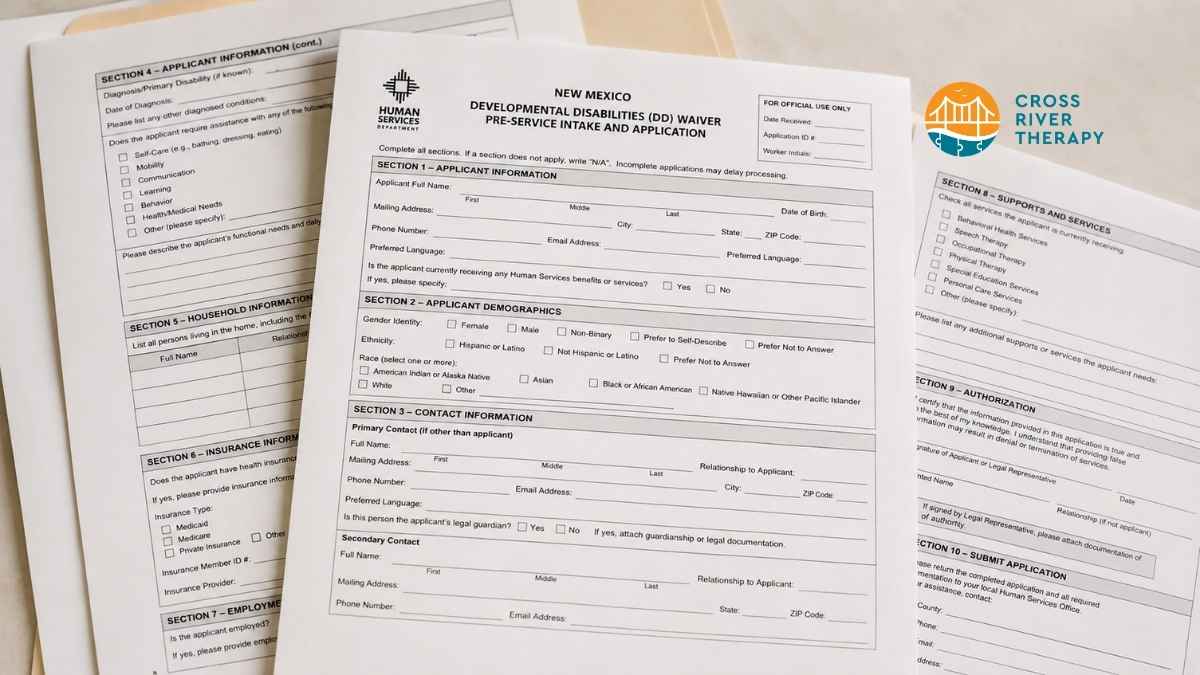
How to Apply for New Mexico’s DD Waiver While Starting ABA Therapy
Autism waiver New Mexico applications need DD Waiver records and proof of daily support needs. Your next step is to start ABA intake with Cross River.

Is ABA Therapy Covered by Insurance in New Jersey? What Every Parent Should Know
ABA therapy insurance New Jersey may cover medically necessary care based on plan type, network, and authorization. Verify benefits with Cross River.

How ABA Therapy Builds Communication for Nonverbal Children Without Forcing Speech
ABA therapy communication for nonverbal children starts with AAC, signs, and daily routines. See how kids ask, refuse, choose, and get help.

How to Start ABA Therapy in New Jersey With a First-Call Checklist
How to start ABA therapy in New Jersey begins with records, insurance details, and intake questions. Use this first-call checklist before you call.

How to Get an Autism Evaluation in Arkansas Before Starting ABA Therapy
How to get an autism evaluation in Arkansas starts with a referral, provider choice, and key records. Use this parent checklist before ABA intake.