








Common ABA Therapy Techniques Used in Center-Based Programs
Exploring Key ABA Techniques in Structured Learning Environments


Understanding ABA in Center-Based Programs
Applied Behavior Analysis (ABA) has long been recognized as a cornerstone in autism treatment. Particularly in center-based programs, ABA techniques are structured to provide targeted interventions, enhancing learning outcomes for children with Autism Spectrum Disorder (ASD). This article delves into the common ABA techniques used in these settings, how they are implemented, and their overall effectiveness.
What is Center-Based ABA?
Definition of center-based ABA
Center-based Applied Behavior Analysis (ABA) refers to a therapeutic model where therapists interact with children in a specially designed clinical setting. This structure allows for concentrated learning experiences tailored to individual needs. The environment is equipped with resources and tools that facilitate various ABA techniques, helping children with Autism Spectrum Disorders (ASDs) gain essential skills effectively.
Market Influences
The growing demand for autism services has led to a rise in center-based ABA programs. Legislative mandates for insurance coverage have pushed private equity firms to invest heavily in this market, drawn by the higher reimbursement potential. While this can increase the availability of services, it often results in a rapidly changing landscape. Such economic influences may impact the consistency and quality of care provided to children.
Service Delivery Concerns
Despite the benefits of increased funding and access, there are concerns regarding the quality of care in many private equity-owned facilities. High employee turnover and inadequate investment in staff training have been common issues. Centers may prioritize profit over personalized care, which can diminish the effectiveness of interventions. Therefore, while center-based ABA programs have expanded opportunities for children, ongoing monitoring and enhancement of care standards are crucial to ensure the treatment remains effective and beneficial.
Core Concepts in ABA Strategies
What are some of the key concepts used in ABA strategies or programs?
Applied Behavior Analysis (ABA) incorporates a variety of concepts designed to enhance learning and behavioral outcomes for children. Reinforcement strategies play a pivotal role, as both positive and negative reinforcement are utilized to encourage appropriate behaviors. Positive reinforcement involves rewarding good behavior, making it more likely to recur, while negative reinforcement removes unpleasant elements to reinforce desired actions.
Another essential component is video modeling, which helps children learn social skills by observing appropriate behaviors depicted in videos. This technique is especially effective for visual learners, allowing them to imitate behaviors seen in various scenarios.
Prompting and fading are also integral to ABA, where initially, cues or prompts are provided to aid learning, and eventually, this support is reduced to foster independence. By building skills in naturalistic settings, natural environment teaching allows children to practice learned behaviors in everyday situations, enhancing their ability to use skills contextually.
The use of behavior chains simplifies tasks by breaking them down into smaller, manageable steps, helping children understand and perform complex actions without feeling overwhelmed. Additionally, concepts such as generalization, which ensures skills can be applied in different contexts, and behavior contracts for older children are also significant. These contracts help track behaviors and rewards, promoting accountability and motivation.
Ultimately, ABA is highly individualized, with qualified behavior analysts designing treatment plans tailored to each child's unique needs, ensuring that therapy is both effective and personal.
Diving into ABA Therapy Techniques

What are ABA therapy techniques?
ABA therapy techniques are based on Applied Behavior Analysis (ABA), an evidence-based practice crucial for individuals with Autism Spectrum Disorder (ASD). These techniques focus on systematically improving specific behaviors through structured interventions.
One cornerstone of ABA is the Antecedent-Behavior-Consequence (ABC) model. This model allows therapists to analyze what occurs before a behavior (antecedent), the behavior itself, and the consequences that follow, thereby guiding interventions. Positive reinforcement plays a significant role in encouraging desirable behaviors, making them more likely to be repeated.
Skill enhancement techniques
Several specific techniques are commonly employed within ABA therapy:
- Discrete Trial Training (DTT): This highly structured teaching method breaks skills into smaller components.
- Process: Instruction → Child Response → Reward.
- Goal: Simplifying learning to specific actions like the alphabet.
- Pivotal Response Training (PRT): Emphasizes motivation, focusing on pivotal behaviors that can lead to wider skill improvements.
- Focus Areas: Improving communication and social interaction in natural settings, often using play.
- Picture Exchange Communication System (PECS): Utilizes visual aids, enabling children with limited verbal skills to communicate needs effectively.
- Natural Environment Teaching (NET): Engages children in real-life scenarios where they can apply skills, promoting motivation and practical learning.
These techniques collectively work towards replacing challenging behaviors with constructive skills, fostering independence and enhancing the quality of life for individuals with ASD. The integration of varied approaches in ABA therapy ensures that learning is tailored to each individual's unique needs.
The Five Teaching Styles in ABA

What are the five teaching styles in ABA?
The five teaching styles in Applied Behavior Analysis (ABA) include:
- Discrete Trial Training (DTT): This method involves breaking down skills into smaller parts, making them easier to teach and learn. By structuring the learning process into discrete components, children receive clear instruction and feedback, often leading to effective skill acquisition.
- Direct Instruction (DI): DI focuses on delivering clear, step-by-step instruction, particularly for academic skills. This technique emphasizes guided practice with immediate feedback to ensure proper understanding and competency.
- Pivotal Response Training (PRT): PRT enhances engagement by targeting pivotal behaviors that can lead to broader changes. This approach often utilizes natural interactions and play to facilitate learning, making the experience enjoyable for children while encouraging social communication.
- Natural Environment Teaching (NET): In NET, learning occurs within real-life contexts. Children practice skills in their everyday environments, promoting generalization of learned behaviors. This style enhances motivation and effective learning through play.
- Incidental Teaching: This approach takes advantage of naturally occurring opportunities for teaching. By leveraging a child's interests, teachers can reinforce skills during spontaneous moments, making learning more meaningful and relevant.
Teaching Style Key Characteristics Application Context Discrete Trial Training Structured, skills broken into smaller parts Teaching various skills effectively Direct Instruction Clear, step-by-step academic instruction Guided practice in structured settings Pivotal Response Training Engagement through pivotal behavior focus Natural contexts and play Natural Environment Teaching Real-world application of skills Everyday environments Incidental Teaching Harnessing spontaneous opportunities for learning Based on child’s interests
These diverse teaching styles ensure that ABA therapy can be tailored to meet the unique needs and learning preferences of each child, thereby enhancing their overall development.
Effective Techniques: Discrete Trial Training and Pivotal Response Training
What is Discrete Trial Training (DTT)?
Discrete Trial Training (DTT) is a structured method used in ABA therapy that breaks learning into small, manageable parts. This approach consists of three components:
- Instruction: The therapist presents a clear prompt or command to the child.
- Response: The child responds to the prompt.
- Consequence: The therapist provides feedback, often in the form of positive reinforcement, encouraging the child to connect correct responses with rewards.
This step-by-step structure helps simplify the learning process, effectively teaching skills like the alphabet or personal information in a focused manner.
How does Pivotal Response Training (PRT) work?
Pivotal Response Training (PRT) offers a more naturalistic approach to learning. Instead of focusing on isolated skills, PRT targets pivotal behaviors that can lead to broader improvements in various areas. The key features of PRT include:
- Child Interest: Lessons are tied to the child’s interests to foster engagement and motivation.
- Natural Environment: Learning occurs within familiar contexts like play, making it easier for children to generalize skills.
- Social Interaction: Emphasis is placed on communication and social behaviors, allowing children to improve their overall interaction skills.
How do these techniques promote skill advancement?
Both DTT and PRT contribute to skill advancement in distinct ways:
- DTT: Given its structured approach, children often see rapid mastery of specific skills, leading to increased confidence and readiness for more complex tasks.
- PRT: Leveraging natural contexts enhances motivation and encourages children to apply learned behaviors in a variety of situations, supporting overall development.
By employing these techniques, ABA therapists can create tailored interventions that foster effective learning and developmental outcomes.
Exploring Natural Environment and Incidental Teaching
Contextual Learning
Natural Environment Teaching (NET) plays a vital role in Applied Behavior Analysis (ABA) therapy by facilitating learning in real-world settings. This approach allows children to practice and reinforce their skills in environments that mimic daily life, making learning more relevant and engaging. For instance, a child may learn to ask for a snack in the kitchen rather than a controlled classroom environment. This method helps children understand how to apply their skills across various scenarios, enhancing their ability to generalize concepts in everyday situations.
Motivation and Natural Opportunities
Another effective strategy within ABA is Incidental Teaching (IT), which leverages spontaneous learning opportunities that arise during daily interactions. This approach taps into a child's natural interests and motivation, using real-life moments to teach desired behaviors. For example, if a child shows interest in a toy, an adult can encourage them to communicate their wants or needs in that moment. By capitalizing on these opportunities, IT fosters a more organic learning experience, making skill acquisition feel less like a chore and more like a part of an enjoyable activity.
Both NET and IT demonstrate the power of using natural contexts and motivation in ABA, promoting independence and functional communication for children.
The Role of Positive and Negative Reinforcement
Understanding Reinforcement Applications
In Applied Behavior Analysis (ABA), positive and negative reinforcement are foundational techniques to promote desirable behaviors in children. Positive reinforcement involves rewarding good behavior—such as through praise or tangible rewards—to make it more likely to occur in the future. This could be as simple as a sticker for completing a task or verbal acknowledgment of the child’s effort.
Negative reinforcement, on the other hand, is about removing an unpleasant stimulus when a desired behavior is exhibited. For example, if a child is allowed to leave the table upon finishing their meals, the removal of the uncomfortable scenario encourages them to repeat the behavior of eating at mealtimes.
Long-term Behavioral Changes
The consistent application of reinforcement techniques fosters long-lasting changes in behavior. With positive reinforcement, children not only learn what behaviors are acceptable but also develop self-motivation to engage in them. As they experience success through consistent feedback, children become more confident in their abilities, facilitating a more profound transformation in their learning and social interactions.
By carefully tracking these reinforcements and their effects, qualified behavior analysts can personalize programs that effectively support children's growth and learning strategies over time.
The Importance of Modeling and Video Techniques
Modeling for behavior learning
Modeling is a valuable technique in Applied Behavior Analysis (ABA) that allows individuals to observe and replicate desired behaviors. By demonstrating how to engage in an action, a therapist or educator provides a clear example for children to emulate. For instance, a child might learn to hold a marker properly by watching a therapist demonstrate the grip. This visual aid helps clarify expectations and creates a strong framework for learning.
Video modeling advantages
Video modeling takes this concept a step further by employing recorded sequences that depict appropriate behaviors in various contexts. This method is especially beneficial for visual learners. Children can see real-life examples of how to interact in social situations, use toys, or perform self-care tasks. Research shows that video modeling can significantly improve the ability to generalize learned behaviors across different settings, enhancing overall learning effectiveness.
ABA in Center-Based Programs: A Holistic Approach
Center-based ABA programs offer a structured environment where children with autism can receive intensive, tailored interventions. By employing a variety of techniques such as positive reinforcement, modeling, and discrete trial training, these programs not only aim to enhance individual skills but also ensure that learning translates into real-world settings. The focus remains on customizing strategies to meet each child's unique needs, backed by ongoing assessments and professional oversight. As the landscape of ABA continues to evolve, these center-based settings play a pivotal role in advancing effective autism treatment methodologies.
References
- Understanding ABA Techniques: 7 Strategies You Need to Know
- 5 Common Techniques That Are Used in ABA Therapy
- Applied Behavior Analysis (ABA) | Autism Speaks
- School-Based and Center-Based ABA Programs
- ABA Therapy Examples - LeafWing Center
- Applied Behavior Analysis (ABA) - Cleveland Clinic
- Understanding ABA Techniques: 7 Strategies You Need to Know
- What You Can Expect in an ABA Therapy Center
Recent News
Related articles

6 Arkansas Medicaid ABA Therapy Rules Families Need to Know
Arkansas Medicaid ABA therapy has age, diagnosis and approval rules. Families can check six requirements before care.

Arizona Autism Laws Every Parent Should Know Before Starting ABA Therapy
Autism laws Arizona parents should know cover ABA insurance, AHCCCS appeals, IEPs, and Section 504 rights. Check ABA coverage with Cross River.

ABA Therapist Salary in Arkansas: What BCBAs and RBTs Actually Earn in 2026
ABA therapist salary Arkansas figures compare RBT and BCBA rates, benefits, guaranteed hours, and contract terms. Explore careers at Cross River.

5 Autism Support Groups and Family Resources in New Mexico Alongside ABA Therapy
Autism support groups New Mexico families can use offer peer support, local events, and school help. Cross River can explain ABA therapy options.

Where to Get an Autism Evaluation in New Mexico Before Starting ABA Therapy
Autism evaluation New Mexico options include UNM, NMSU, FIT, and private providers. Compare providers, records, and ABA steps with Cross River.

7 North Carolina Autism Resources to Contact Before ABA Therapy Starts
Autism resources North Carolina families can call for diagnosis, early intervention, rights, and parent support. Start ABA intake with Cross River.

Does Indiana Medicaid Cover ABA Therapy? A Step-by-Step Eligibility Checklist for Parents
Medicaid ABA therapy Indiana covers eligible children under 21 with prior authorization. Your five-step coverage review can start with Cross River.
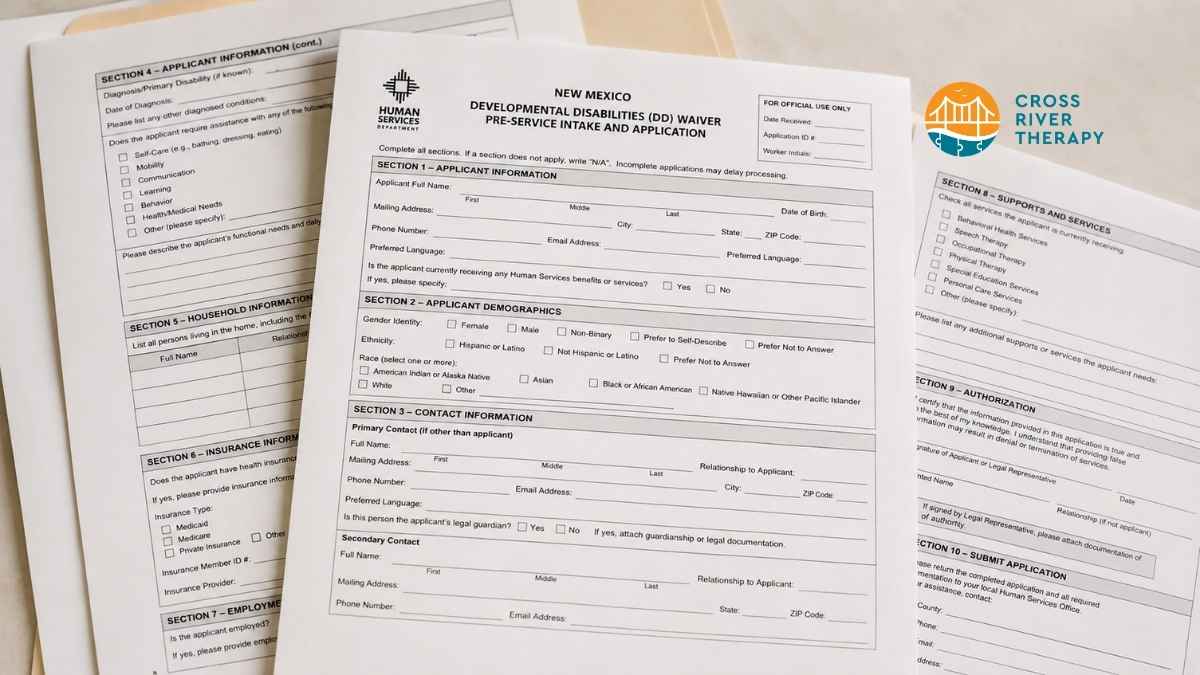
How to Apply for New Mexico’s DD Waiver While Starting ABA Therapy
Autism waiver New Mexico applications need DD Waiver records and proof of daily support needs. Your next step is to start ABA intake with Cross River.

Is ABA Therapy Covered by Insurance in New Jersey? What Every Parent Should Know
ABA therapy insurance New Jersey may cover medically necessary care based on plan type, network, and authorization. Verify benefits with Cross River.

How ABA Therapy Builds Communication for Nonverbal Children Without Forcing Speech
ABA therapy communication for nonverbal children starts with AAC, signs, and daily routines. See how kids ask, refuse, choose, and get help.

How to Start ABA Therapy in New Jersey With a First-Call Checklist
How to start ABA therapy in New Jersey begins with records, insurance details, and intake questions. Use this first-call checklist before you call.

How to Get an Autism Evaluation in Arkansas Before Starting ABA Therapy
How to get an autism evaluation in Arkansas starts with a referral, provider choice, and key records. Use this parent checklist before ABA intake.