








How ABA therapy builds life skills for teens with autism
Empowering Teens with Autism: The Role of ABA in Developing Life Skills


Unlocking Potential Through Tailored Interventions
Applied Behavior Analysis (ABA) therapy is a scientifically supported approach designed to cultivate essential life skills in teens with autism. By focusing on individualized, structured, and evidence-based techniques, ABA helps adolescents develop communication, social, emotional, and practical skills vital for independence and success in everyday life. This article explores how ABA therapy builds these competencies, emphasizing personalized strategies, real-world applicability, and the profound impact on teens’ lives.
Core Techniques and Methods in ABA Therapy

What techniques and methods are used in ABA therapy to build social, communication, and daily living skills?
ABA therapy utilizes a diverse array of strategies to teach essential skills in social interaction, communication, and daily routines. These methods are selected and tailored based on each individual's unique needs, ensuring effective learning and generalization of skills.
A foundational technique is discrete trial training (DTT), which involves breaking down skills into small, manageable steps and practicing each with repetition and reinforcement. This structured approach helps children learn concepts such as asking for help or following instructions.
Natural environment teaching (NET) emphasizes teaching in real-life settings, allowing children to apply their skills in natural contexts like home, school, or community outings. This method promotes spontaneous use of language and social behaviors.
Task analysis is used to divide complex daily routines—such as dressing, cooking, or transportation—into step-by-step procedures. This breakdown makes learning manageable and helps children master routines independently.
For social skills, approaches like social stories and video modeling are effective. Social stories teach children about social norms and appropriate behaviors through personalized narratives, while video modeling shows desired behaviors through videos, encouraging imitation.
Peer-mediated approaches involve training peers to engage and interact with children with autism, fostering social engagement and decreasing social isolation.
Visual supports are integral, including checklists, visual schedules, and timers. They help children understand and anticipate routines, reducing anxiety and increasing independence.
Picture Exchange Communication Systems (PECS) and sign language are two prominent methods for developing communication, especially for children with limited verbal abilities. These systems enable children to express their needs and thoughts non-verbally.
Functional Communication Training (FCT) teaches children functional ways to communicate their needs and desires to minimize problematic behaviors and promote appropriate responses.
To foster social understanding and practical skills, therapists incorporate role-playing and scenario-based activities. These activities simulate real-life situations, enhancing confidence and competence in social interactions.
Through the employment of these techniques—ranging from structured drills to naturalistic interactions—ABA therapy effectively builds social, communication, and daily living skills, empowering individuals with autism to navigate their environments more independently and successfully.
| Technique/Method | Purpose | Typically Used For | Additional Details |
|---|---|---|---|
| Discrete Trial Training (DTT) | Structured learning of specific skills | Communication, daily routines, social skills | Repetition and reinforcement in a controlled setting |
| Natural Environment Teaching (NET) | Generalizing skills in real-world settings | Social, communication, daily living skills | Promotes spontaneous and functional use of skills |
| Task Analysis | Breaking tasks into steps | Daily routines, self-care, cooking | Facilitates independent mastery of complex activities |
| Behavioral Skills Training (BST) | Teaching practical and social skills | Social skills, safety skills | Includes instructions, modeling, rehearsal, and feedback |
| Social Stories | Teaching social norms and expectations | Social interactions | Narrative format customized for individual needs |
| Video Modeling | Learning via visual demonstration | Social behaviors, communication | Repeated viewing encourages imitation |
| Peer-Mediated Approaches | Promoting peer interaction | Social skills, social initiation | Peers are trained to facilitate engagement |
| Visual Supports (Schedules, Checklists) | Enhancing understanding and routine adherence | Daily routines, transitions | Reduce anxiety and increase independence |
| Picture Exchange Communication Systems (PECS) | Alternative communication development | Verbal and non-verbal communication | Uses pictures, helps express needs non-verbally |
| Sign Language | Non-verbal communication | Communication, particularly non-verbal children | Promotes expressive and receptive language |
| Functional Communication Training (FCT) | Teaching functional requests | Reducing problem behaviors | Reinforces effective ways to communicate needs |
| Role-Playing and Scenario-Based Activities | Real-life skill practice | Social, practical, safety skills | Builds confidence in various environments |
Overall, these techniques work synergistically to teach and reinforce vital skills, making ABA therapy a comprehensive approach to supporting individuals with autism in achieving greater independence and social integration.
Why ABA Therapy is Essential for Improving Independence and Social Functioning
Why is ABA therapy considered important in helping teens with autism achieve greater independence and social functioning?
ABA (Applied Behavior Analysis) therapy plays a vital role in supporting teens with autism by focusing on essential skills such as communication, self-care, and social interactions. These skills are fundamental for daily living and social integration.
One reason ABA is so effective is its emphasis on early intervention. During critical developmental stages, the brain is highly adaptable, or neuroplastic, allowing teens to learn and transfer new skills more effectively when therapy begins early. This can lead to more enduring improvements.
The approach relies on proven techniques like positive reinforcement—rewarding desirable behaviors to encourage their recurrence—and detailed methods such as task analysis, prompting, and fading, which break complex skills into manageable steps.
Goals in ABA therapy are clear and measurable. Therapists continuously assess progress, adjusting strategies as needed. This systematic method helps teens build confidence, develop independence, and enhance social skills.
Specific daily skills taught include personal hygiene routines, dressing, preparing simple meals, handling money, and using transportation. Social skills training involves understanding social cues, initiating conversations, taking turns, and resolving conflicts.
By reducing challenging behaviors and reinforcing positive, functional behaviors, ABA fosters greater autonomy in teens. Additionally, community-based learning and vocational training help prepare them for real-world situations, such as working or living independently.
Involvement of families and educators is crucial, ensuring skills learned in therapy are practiced and maintained across environments. This comprehensive, personalized approach enables teens with autism to participate more fully in everyday life and build meaningful relationships.
How does ABA therapy promote social and communication skills?
ABA therapy employs techniques such as modeling, social skills training, and natural environment teaching to improve interaction capabilities. For example, teens learn to make eye contact, interpret body language and facial expressions, and engage appropriately in conversations.
Communication skills—both verbal and non-verbal—are developed by teaching requesting, following instructions, and expressing emotions. Visual aids, sign language, or techniques like PECS (Picture Exchange Communication System) support those with speech challenges.
Real-life scenarios such as role-playing help teens practice social interactions, reducing social anxiety and building confidence. These skills are transferred from therapy settings to everyday life, making social exchanges more natural and less stressful.
What specific life skills are taught through ABA for teens?
Some of the practical life skills addressed include:
| Skill Area | Examples | Purpose |
|---|---|---|
| Self-care | Hygiene routines, dressing | Foster independence and personal hygiene awareness |
| Daily routines | Meal prep, organization | Help teens manage daily tasks without constant supervision |
| Safety awareness | Responding to emergencies, hazards | Prepare for real-world safety challenges |
| Transportation | Use of public transit, planning routes | Enable independent travel |
| Financial skills | Money management, shopping | Promote responsible handling of money |
These targeted lessons increase teens' confidence and capacity to handle everyday responsibilities.
What techniques are used in ABA therapy?
The core techniques include:
- Positive reinforcement: Giving rewards for desired behaviors.
- Task analysis: Breaking complex tasks into smaller, manageable steps.
- Prompting and fading: Providing cues initially and gradually reducing assistance.
- Modeling: Demonstrating behaviors for imitation.
- Discrete Trial Training (DTT): Structuring learning sessions with repetition.
Each method is tailored to align with an individual teen’s needs, strengths, and interests, which enhances engagement and learning efficiency.
How is progress monitored and integrated into daily life?
Progress in ABA programs is tracked through ongoing assessments and data collection. These evaluations guide modifications in therapy plans, ensuring continuous improvement.
Family members, teachers, and caregivers collaborate closely with therapists. They receive training to reinforce skills at home, in school, and in community settings.
Community outings, vocational activities, and social exercises further help generalize skills beyond the clinical environment. This holistic approach ensures that advances are meaningful, lasting, and applicable across all areas of life.
| Aspect | Description | Impact |
|---|---|---|
| Individual Planning | Custom goals based on thorough evaluation | Personalizes intervention for maximum effectiveness |
| Family Involvement | Training caregivers to support skills outside therapy | Reinforces learning and promotes consistency |
| Community Skills | Real-world practice through outings and activities | Encourages independence and social engagement |
| Transition to Adulthood | Focus on employment, independent living skills | Prepares teens for adult independence |
Overall, ABA therapy enables teens with autism to develop the skills necessary for a more autonomous, socially connected, and fulfilling life. Its structured yet flexible approach, supported by ongoing assessment and family involvement, makes it a comprehensive tool for fostering independence and social success.
Developing Practical and Daily Living Skills in Teens with Autism

What role does ABA therapy play in promoting independence and practical skills among teens with autism?
ABA therapy is essential in helping teenagers with autism develop independence and practical skills. The approach is systematic and personalized, focusing on teaching fundamental life skills necessary for daily living.
One of the primary focuses of ABA is teaching self-care routines such as hygiene, dressing, and grooming. Therapists break down these tasks into small, manageable steps, then reinforce each successful attempt with praise or rewards. This task analysis helps teens gain confidence and mastery over personal care.
In addition to personal hygiene, ABA teaches household tasks like setting the table, cleaning, and organizing belongings. These skills promote independence and are often learned through modeling, prompting, and reinforcement, making daily routines more routine and less stressful.
Communication skills are also crucial for independence. ABA techniques utilize visual supports, alternative communication methods like AAC (Augmentative and Alternative Communication), and speech exercises to improve requesting, following instructions, and expressing emotions. Better communication helps teens navigate social situations and participate more fully in their communities.
Social skills, including understanding social cues, initiating conversations, sharing, and taking turns, are taught through structured activities and real-life practice. These skills are vital for building friendships and engaging in social settings.
To support systematic learning, ABA employs visual schedules and structured routines. These tools help teens understand daily sequences, prepare for transitions, and reduce anxiety. Techniques like timers and visual cues guide behavior, making changes in activities or environments smoother.
Transitions between activities often cause stress. ABA addresses this by teaching routines, using visual timers, and role-playing, making shifts easier and less overwhelming.
Community and vocational skills are also incorporated into therapy programs. Teens learn about safety rules, money handling, shopping, and workplace etiquette, preparing them for independent living and employment.
Overall, ABA therapy equips teens with the necessary skills to become more autonomous in everyday life. The individualized approach ensures that each teen’s strengths are built upon, and challenges are addressed through data-driven adjustments, maximizing the potential for success.
| Skill Area | Techniques Used | Examples of Skills Taught |
|---|---|---|
| Self-care routines | Task analysis, reinforcement, modeling | Hygiene, dressing, grooming, personal organization |
| Communication | Visual aids, AAC, modeling, reinforcement | Requesting, following instructions, expression of feelings |
| Social interaction | Role-playing, social modeling, natural environment training | Sharing, turn-taking, making eye contact, understanding social cues |
| Household tasks | Structured routines, visual schedules, prompting | Cleaning, setting the table, organizing belongings |
| Transitions | Visual timers, routines, role-playing | Moving between activities, adapting to change |
| Community and vocational | Role-playing, practicing real-life scenarios | Money handling, shopping, workplace etiquette |
ABA therapy’s individualized plan, developed through ongoing assessments and involving family and educators, ensures that teens acquire practical skills aligned with their personal goals and environments. The overall impact is a noticeable increase in independence and confidence, setting the foundation for successful adult living.
Supporting Emotional Regulation, Safety, and Transitions
How does ABA therapy support emotional regulation, safety, and transition skills in teens with autism?
ABA therapy plays a vital role in helping teens with autism develop the ability to manage their emotions, stay safe, and smoothly transition between activities or environments. It employs a range of strategies tailored to each individual’s needs, making daily life more manageable and less stressful.
One of the fundamental aspects of ABA in this area is teaching teens to recognize and label their feelings. Visual tools such as feelings charts and Zones of Regulation are commonly used. These visuals categorize emotions and help teens understand what they are experiencing, providing a clear language for expressing feelings. By identifying emotions, teens become better equipped to choose appropriate responses rather than reacting impulsively.
Coping strategies are another cornerstone of emotional regulation support in ABA. Techniques such as deep breathing exercises, taking breaks, or using sensory tools are practiced repeatedly. These methods are often taught through role-playing scenarios that simulate real-life situations, enabling teens to apply their skills in a safe and controlled environment.
Reflective feedback and positive reinforcement are used to encourage the consistent use of these coping mechanisms. For example, therapists and caregivers praise a teen for successfully calming down or expressing emotions appropriately, helping reinforce these behaviors over time.
Transition periods — such as moving from class to recess or preparing for a change in activity — can be stressful for teens with autism. ABA employs structured routines and visual schedules to prepare teens for these shifts. Visual schedules depict upcoming activities, reducing uncertainty and anxiety. Routine charts and calendars help teens know what to expect, fostering a sense of predictability and control.
Behavior plans are also customized to address specific challenges during transitions and to promote safety. These plans outline steps to manage behavior, incorporate calming techniques, and prevent meltdowns or risky actions.
Beyond emotional regulation and safety, ABA emphasizes the development of social skills to help teens navigate social environments confidently. Practice in role-playing social interactions, understanding social cues, and initiating conversations are integrated into therapy sessions.
Crucially, collaboration with parents and schools ensures that strategies are reinforced consistently across all environments. Parent training equips caregivers with tools to support emotional regulation at home, while coordination with teachers ensures that routines and visual supports are used in school.
All these approaches work together to build a comprehensive support system. The goal is to enable teens with autism to handle their emotions, stay safe, and adapt to changes with confidence, ultimately fostering independence and emotional well-being.
Building Comprehensive Life Skills for a Better Future
What is the process and expected outcomes of ABA therapy related to life skills development?
ABA therapy is a carefully structured, evidence-based approach designed to support children and teens with autism in developing essential life skills. The process begins with thorough assessments to understand each individual’s strengths and challenges. Based on this, therapists set personalized goals that target communication, social interaction, self-care, academic skills, and behavior management.
These goals are taught through various techniques, including discrete trial training, natural environment teaching, prompting and fading, modeling, and positive reinforcement. For example, a child might learn to dress independently by breaking the task into smaller steps, practicing in a supportive environment, and receiving rewards for success.
Progress is continuously monitored through data collection and regular evaluations, ensuring that interventions remain effective and are adjusted as needed. Family members and educators are actively involved in this process, reinforcing skills across different settings to promote generalization.
The outcome of ABA therapy often includes significant improvements in social and communication abilities, increased independence in daily routines like hygiene and cooking, and better academic performance. Behavioral challenges, such as tantrums or separation anxiety, tend to decrease as children learn more appropriate responses.
Importantly, ABA encourages the transfer of newly acquired skills to home, school, and community settings, which helps children adapt better to real-life situations. This holistic approach aims not only to teach skills but also to foster confidence, independence, and a higher quality of life.
Overall, ABA therapy plays a crucial role in helping children and teens reach their full potential by providing targeted, personalized support that leads to meaningful, lasting improvements in everyday functioning.
The Overall Impact of ABA Therapy on Teens' Lives
How does ABA therapy benefit teens with autism in real-life situations?
ABA therapy significantly improves how teens with autism navigate their daily lives. It focuses on teaching vital communication, social skills, and practical daily routines, empowering teens to become more independent. For example, teens learn self-care activities such as hygiene, dressing, and responsible meal preparation, which they can carry out confidently in their homes and communities.
The therapy emphasizes emotional regulation and social understanding, helping teens recognize social cues, take turns in conversation, and initiate interactions with peers. Role-playing, real-world practice, and natural environment training are common techniques used to transfer skills from therapy to everyday settings.
Tailoring interventions to each teen’s unique interests and strengths increases motivation and learning retention. This personalized approach makes it easier for them to understand and remember new skills.
Through reinforcement strategies and consistent practice, teens develop greater confidence and resilience in handling social situations, reducing anxiety and frustration. They become more adept at responding to emergencies, respecting boundaries, and managing transitions — all critical for real-world independence.
Ultimately, ABA therapy prepares teens to face everyday challenges more effectively, boosting their confidence in social settings, fostering meaningful friendships, and enhancing overall quality of life. This comprehensive skill development not only supports their personal growth but also promotes successful integration into community and educational environments.
Fostering Independence and Confidence for the Future
ABA therapy plays a pivotal role in equipping teens with autism with the skills necessary to lead independent, fulfilling lives. Through personalized, evidence-based strategies, it fosters improvements in communication, social skills, emotional regulation, and practical daily routines. The success stories and ongoing assessments demonstrate that with dedicated intervention and family involvement, teens can overcome challenges and thrive in various environments—home, school, and community. As a transformative approach, ABA continues to empower adolescents on their journey toward greater independence, confidence, and social integration, laying a strong foundation for their future.
References
- ABA Therapy for Teens: Building Independence
- How In-Home ABA Therapy Builds Real-Life Skills for ...
- 7 Surprising Benefits of ABA Therapy for Kids You Need to ...
- What Is ABA Therapy For Teens And How Does It Work?
- How ABA Therapy Prepares Kids for Life Experiences
- Enhancing Life Skills through ABA Therapy for Autism
- ABA Therapy and the Pursuit of Independence in Daily Life
- How to Teach Social Skills Using ABA Principles
- Key Life Skills Taught in ABA Therapy for Kids
Recent News
Related articles

ABA Therapist Salary in Arkansas: What BCBAs and RBTs Actually Earn in 2026
ABA therapist salary Arkansas figures compare RBT and BCBA rates, benefits, guaranteed hours, and contract terms. Explore careers at Cross River.

5 Autism Support Groups and Family Resources in New Mexico Alongside ABA Therapy
Autism support groups New Mexico families can use offer peer support, local events, and school help. Cross River can explain ABA therapy options.

Where to Get an Autism Evaluation in New Mexico Before Starting ABA Therapy
Autism evaluation New Mexico options include UNM, NMSU, FIT, and private providers. Compare providers, records, and ABA steps with Cross River.

7 North Carolina Autism Resources to Contact Before ABA Therapy Starts
Autism resources North Carolina families can call for diagnosis, early intervention, rights, and parent support. Start ABA intake with Cross River.

Does Indiana Medicaid Cover ABA Therapy? A Step-by-Step Eligibility Checklist for Parents
Medicaid ABA therapy Indiana covers eligible children under 21 with prior authorization. Your five-step coverage review can start with Cross River.
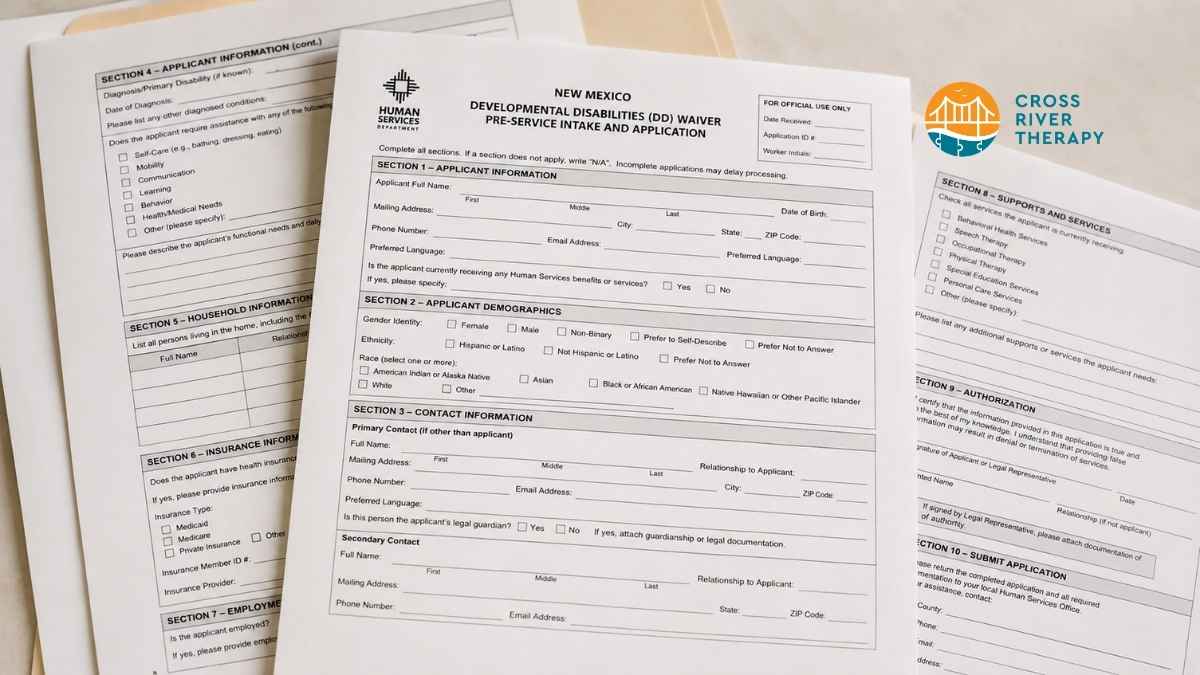
How to Apply for New Mexico’s DD Waiver While Starting ABA Therapy
Autism waiver New Mexico applications need DD Waiver records and proof of daily support needs. Your next step is to start ABA intake with Cross River.

Is ABA Therapy Covered by Insurance in New Jersey? What Every Parent Should Know
ABA therapy insurance New Jersey may cover medically necessary care based on plan type, network, and authorization. Verify benefits with Cross River.

How ABA Therapy Builds Communication for Nonverbal Children Without Forcing Speech
ABA therapy communication for nonverbal children starts with AAC, signs, and daily routines. See how kids ask, refuse, choose, and get help.

How to Start ABA Therapy in New Jersey With a First-Call Checklist
How to start ABA therapy in New Jersey begins with records, insurance details, and intake questions. Use this first-call checklist before you call.

How to Get an Autism Evaluation in Arkansas Before Starting ABA Therapy
How to get an autism evaluation in Arkansas starts with a referral, provider choice, and key records. Use this parent checklist before ABA intake.

Center-Based vs In-Home vs School-Based ABA Therapy and How to Choose the Right Fit
Center-based, in-home, and school-based ABA therapy each fit different goals, routines, and settings. Compare options before your intake call.

Early Signs of Autism: A Guide for North Carolina Parents
Early signs of autism North Carolina parents notice can include speech, play, sensory, or skill loss patterns. See what to track before screening.