








How ABA Therapy Enhances Problem-Solving Skills for Children with Autism
Unlocking Potential: The Role of ABA in Developing Critical Problem-Solving Skills in Autistic Children


Enhancing Cognitive and Social Abilities through Structured Interventions
Applied Behavior Analysis (ABA) has emerged as a leading evidence-based intervention to support children with autism in developing essential problem-solving skills. Through personalized, systematic strategies, ABA fosters cognitive flexibility, independence, and social competence, thereby empowering children to navigate everyday challenges more effectively. This article explores how ABA techniques facilitate problem-solving and critical thinking, backed by scientific evidence, and highlights their benefits in promoting overall developmental progress.
Core Techniques of ABA Therapy for Problem-Solving Development
How does ABA therapy improve problem-solving skills in children with autism?
ABA therapy enhances problem-solving abilities in children with autism through systematic, evidence-based methods. One of the foundational techniques is task analysis, which involves breaking down complex problems into smaller, manageable steps. For example, brushing teeth can be taught as a sequence of simple actions, making the process less overwhelming and encouraging independent execution.
Visual supports and social stories are also central. These tools provide visual cues and narratives that help children understand what to expect and guide their responses during problem-solving. They offer clear, concrete information that reduces anxiety and promotes understanding.
Natural Environment Teaching (NET) integrates learning into daily routines like mealtime, play, and homework. By practicing skills in familiar settings, children transfer their problem-solving strategies across diverse scenarios, fostering generalization.
Reinforcement strategies play a vital role by rewarding successful problem-solving attempts, which builds confidence and motivates continued effort. Techniques such as guided play, role-playing, and modeling are employed to teach children to think flexibly, explore multiple solutions, and adapt to new challenges.
In addition, ABA incorporates emotional regulation strategies, like deep breathing and emotion labeling, which help children stay focused and calm during problem-solving tasks. Functional communication training encourages children to ask for help or clarify instructions, facilitating collaborative problem-solving.
Altogether, these methods create a structured learning environment that addresses the cognitive, social, and emotional aspects involved in problem-solving. This comprehensive approach helps children with autism develop independence, resilience, and adaptable thinking skills, which are essential for navigating everyday challenges successfully.
Methods and Strategies in ABA to Boost Cognitive and Critical Thinking
ABA therapy employs a variety of structured, evidence-based methods to enhance cognitive and critical thinking skills in children with autism. Central techniques include Discrete Trial Training (DTT) and Pivotal Response Treatment (PRT), which focus on teaching foundational skills such as language, problem-solving, attention, and memory through repetitive, reinforcement-based sessions.
In addition to these core approaches, ABA integrates visual supports, social stories, and daily routines to help children understand social cues, expectations, and transitions. These tools facilitate learning in natural contexts, enabling children to generalize skills across different environments.
Family involvement is a crucial aspect of ABA, with caregivers trained to reinforce strategies at home and during daily activities. Natural Environment Training (NET) adds to this by embedding problem-solving opportunities within routine activities like play, mealtime, and homework, making learning practical and meaningful.
Task analysis is frequently used to break complex challenges into smaller, manageable steps, fostering independence and confidence in children. Positive reinforcement and SMART goals—specific, measurable, achievable, relevant, and time-bound—are employed to motivate progress. This personalized approach builds critical skills such as executive functioning, social cognition, and cognitive flexibility.
Overall, ABA’s comprehensive methods aim not only to improve specific behaviors but also to develop children’s ability to think critically, solve problems independently, and adapt to new situations, supporting their growth toward greater self-sufficiency.
Scientific Evidence Supporting ABA’s Effectiveness

Is there scientific evidence supporting the effectiveness of ABA therapy in improving problem-solving abilities?
Yes, there is strong scientific support for ABA therapy's role in enhancing problem-solving skills in children with autism. Over the past four decades, research has consistently shown positive outcomes across multiple studies.
Controlled studies, including randomized controlled trials, have demonstrated that ABA interventions lead to meaningful improvements in problem-solving, social, and adaptive behaviors. For example, research involving 60 children with autism aged 4 to 11 found significant gains in social skills, communication, and independence after structured ABA sessions.
In particular, problem-solving training using tools like worksheets and natural environment teaching has proven effective. Participants learned to resolve social conflicts independently, even in unfamiliar situations, by applying skills learned in therapy. These results are reinforced by error correction strategies, reinforcement, and modeling.
Long-term benefits include increased flexibility, resilience, and confidence in handling daily challenges. Task analysis and play therapies further promote generalization of skills across settings, ensuring meaningful, real-world improvements.
Overall, the scientific evidence confirms that ABA therapy is a validated, effective method for improving problem-solving capabilities and broader developmental outcomes in children with autism.
Study Type Sample Size Main Focus Notable Outcomes Evidence Quality Controlled trials 60 children aged 4-11 Problem-solving, social skills Significant improvements post-intervention High Single-case studies 3 participants Conflict resolution, natural environments Successful use of worksheets for social conflicts Moderate Longitudinal research Various ages Developmental growth Sustainability of skills over time High
This body of research strongly supports ABA as an effective, evidence-based approach for fostering problem-solving abilities and overall development in children with autism.
Teaching Social Skills and Conflict Resolution with ABA
How does ABA therapy help teach social conflict resolution and social skills?
ABA therapy employs proven techniques like modeling, role-playing, and reinforcement to enhance social interaction abilities in children with autism. These methods provide children with concrete examples of positive social behaviors, allowing them to observe, imitate, and internalize appropriate ways to engage with others.
Through structured practice, children learn how to manage conflicts effectively. ABA programs often incorporate specific conflict resolution strategies such as negotiation, compromise, and even withdrawal when necessary. These skills are introduced systematically and reinforced consistently, helping children understand how to navigate disagreements responsibly.
Additionally, curricula like Canter®’s Teaching Students to Get Along® are integrated into therapy to ensure that children learn respectful and cooperative dispute resolution skills. These programs use structured activities and social narratives to teach children how to handle social conflicts calmly and constructively.
Overall, ABA therapy fosters social competence by equipping children with the tools they need to interact positively, resolve conflicts, and build meaningful relationships beyond therapy sessions.
Benefits of ABA: Fostering Overall Development and Independence
Applied Behavior Analysis (ABA) therapy plays a crucial role in nurturing the growth and independence of children with autism. It not only enhances skills such as communication and socialization but also fosters critical problem-solving abilities. Through personalized, structured interventions, children learn to analyze situations, make decisions, and find solutions by breaking down complex tasks into manageable steps.
One of the standout features of ABA is its emphasis on the generalization of skills. Children are taught strategies in one setting and encouraged to apply them across various environments like home, school, and community. This consistency helps solidify their learning and boosts confidence in handling everyday challenges.
Early, intensive ABA intervention has demonstrated significant, long-lasting impacts. Studies show that many children who undergo early treatment can make substantial progress—up to half of them eventually return to mainstream classrooms. This highlights the importance of early engagement and sustained therapy.
Overall, ABA therapy not only addresses immediate behavioral and developmental concerns but also sets a foundation for lifelong benefits. By promoting essential life skills through evidence-based methods, it empowers children with autism to become more independent, improve their quality of life, and effectively navigate complex social and daily situations.
Incorporating Play and Emotional Regulation into ABA to Support Cognitive Growth

How does ABA therapy help teach social conflict resolution and social skills?
ABA therapy employs structured, evidence-based methods to improve social interactions and conflict management among children with autism. One effective approach involves using modeling, role-playing, and reinforcement to teach children how to navigate social conflicts. Therapists explicitly demonstrate appropriate behaviors and guide children through practicing these skills in safe settings.
In addition, ABA programs often incorporate specific conflict resolution techniques—such as problem-solving negotiations, smoothing, compromising, and withdrawing—to help children effectively handle disagreements. These strategies are integrated into curricula like Canter®’s Teaching Students to Get Along®, which emphasizes respectful and cooperative dispute resolution.
By participating in these structured activities, children learn to recognize social cues, communicate their needs, and resolve conflicts peacefully. This not only enhances their social competence but also prepares them for real-world social scenarios where they can apply these skills independently.
Play therapy to enhance cognitive and social skills
Play therapy is a vital component in ABA aimed at improving cognitive and social development. It provides a natural, engaging context for children to express themselves, explore new behaviors, and develop problem-solving skills. Different forms, such as child-centered, floor time, and integrated play groups, foster opportunities for children to practice sharing, turn-taking, and imaginative play.
Play-based approaches stimulate neuroplasticity, the brain's ability to reorganize and form new neural connections. This neurodevelopmental process enhances cognition, social understanding, and emotional regulation. When children manipulate toys or participate in guided play activities, their executive functions—such as planning, flexibility, and impulse control—are strengthened.
Emotional regulation strategies
Managing emotions is crucial for children's social success and cognitive growth. ABA incorporates emotional regulation techniques like deep breathing, emotion labeling, and mindfulness exercises to help children stay calm amid challenges. These strategies make it easier for children to focus on problem-solving tasks and adapt to changes.
Role-playing activities also teach children how to express feelings appropriately and respond empathetically to others, further supporting social harmony and resilience.
Neuroplasticity and brain development
Studies support that ABA therapy promotes neuroplasticity by engaging children in targeted interventions that challenge and reshape neural pathways. This ongoing brain development underpins improved problem-solving, critical thinking, and social skills.
Incorporating play and emotional regulation within ABA creates a comprehensive approach that nurtures not just behavioral changes but also deep cognitive growth. These methods help children become adaptable, confident, and socially competent learners.
Techniques and Focus Areas Benefits Examples Play therapy Enhances social, emotional, and cognitive skills Symbolic play, role-playing, toy-based activities Emotional regulation strategies Promotes focus, resilience, and calmness Deep breathing, emotion labeling Neuroplasticity promotion Supports brain development and skill transfer Targeted skill exercises, engaging activities
This integrated approach of ABA therapy fosters independence and equips children with autism to navigate their environments with confidence and resilience, ultimately supporting their lifelong learning journey.
Transforming Development: The Lasting Impact of ABA on Children with Autism
Overall, ABA therapy stands as a powerful and scientifically validated approach to enhancing problem-solving, critical thinking, social understanding, and emotional regulation in children with autism. Through tailored interventions that promote independence and resilience, ABA equips children to face future challenges confidently, fostering a pathway toward meaningful growth and integration into daily life. As ongoing research continues to reinforce its benefits, ABA remains indispensable in supporting children with autism to reach their full potential.
References
- ABA Therapy for Problem-Solving and Critical Thinking Skills
- The effectiveness of applied behavior analysis program training on ...
- Teaching Individuals with Autism Problem-Solving Skills for ...
- Teaching Everyday Problem-Solving Skills with In-Home ABA Therapy
- How ABA Therapy Enhances Play Skills in Children - Step It Up ABA
- Task Analysis in ABA Therapy: Empowering Your Child's Progress
- Play therapy in children with autism: Its role, implications, and ...
Recent News
Related articles

6 Arkansas Medicaid ABA Therapy Rules Families Need to Know
Arkansas Medicaid ABA therapy has age, diagnosis and approval rules. Families can check six requirements before care.

Arizona Autism Laws for ABA Coverage and School Rights
Arizona autism laws for ABA coverage vary by plan. Families can check insurance, appeal options, and school rights.

ABA Therapist Salary in Arkansas for RBTs and BCBAs
Compare ABA therapist salary in Arkansas by role. See how paid hours and benefits affect earnings before applying.

5 Autism Support Groups and Family Resources in New Mexico
Autism support groups in New Mexico connect families. Local resources offer events, parent support, and school help.

Where to Get an Autism Evaluation in New Mexico
Autism evaluation options in New Mexico include UNM and NMSU. Age and referral details help parents prepare.

7 North Carolina Autism Resources to Contact Before ABA Therapy Starts
Autism resources North Carolina families can call for diagnosis, early intervention, rights, and parent support. Start ABA intake with Cross River.

Does Indiana Medicaid Cover ABA Therapy? A Parent Checklist
Indiana Medicaid ABA therapy may cover care for eligible children. The checklist covers coaching and renewals.
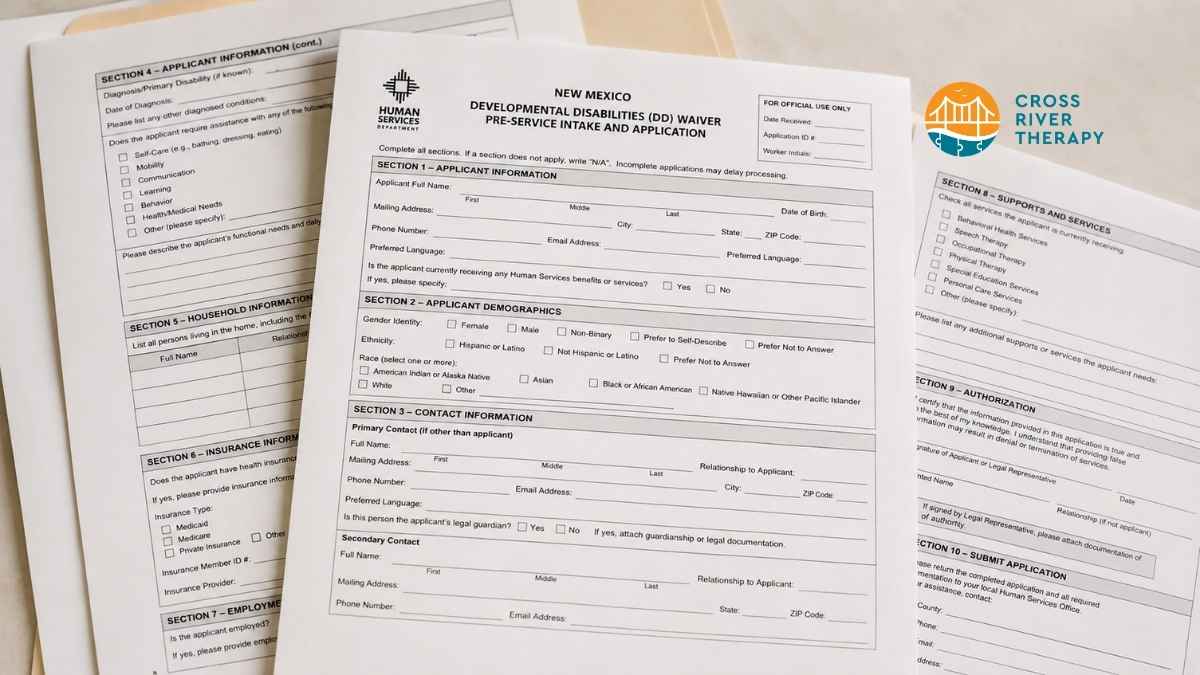
How to Apply for the New Mexico DD Waiver
Your NM DD waiver application starts with state intake. The steps cover records, submission, and enrollment.

Does Insurance Cover ABA Therapy in New Jersey?
ABA therapy insurance in New Jersey varies by plan. Learn what NJ FamilyCare covers and how to check costs.

How ABA Therapy Builds Communication for Nonverbal Children Without Forcing Speech
ABA therapy communication for nonverbal children starts with AAC, signs, and daily routines. See how kids ask, refuse, choose, and get help.

How to Start ABA Therapy in New Jersey With a Checklist
Your guide explains how to start ABA therapy in New Jersey. A first-call checklist covers records and next steps.

How to Get an Autism Evaluation in Arkansas Before Starting ABA Therapy
How to get an autism evaluation in Arkansas starts with a referral, provider choice, and key records. Use this parent checklist before ABA intake.