








How ABA Therapy Helps Children with Oppositional Defiant Disorder (ODD)
Transforming Behaviors: The Power of ABA for Children with ODD


Understanding Oppositional Defiant Disorder and the Promise of Behavioral Interventions
Oppositional Defiant Disorder (ODD) is a common behavioral condition diagnosed primarily in childhood, characterized by a persistent pattern of hostile, defiant, and disobedient behaviors towards authority figures like parents, teachers, and peers. Symptoms frequently include temper tantrums, arguing, refusing to follow instructions, blaming others, and reacting with anger or spitefulness. These behaviors, when persistent over at least six months, can significantly interfere with a child's social, academic, and family functioning. The causes of ODD are varied, involving genetic, environmental, and developmental factors such as family instability and inconsistent discipline. Diagnosis is made through clinical assessment based on behavioral criteria outlined in the DSM-5, which emphasizes the importance of behavioral observation across multiple settings. Early intervention is crucial, as untreated ODD can escalate into more severe conduct disorders, increasing the risk for later delinquency, substance abuse, and mental health issues.
Comprehensive Behavioral Treatment for ODD
What are the treatment options for ODD, including behavioral therapies like Applied Behavior Analysis (ABA)?
Children diagnosed with Oppositional Defiant Disorder (ODD) often require tailored interventions that address their specific needs and symptoms. Among the most effective treatments are behavioral therapies and parent management strategies.
Applied Behavior Analysis (ABA) is a systematic approach that modifies behaviors through reinforcement principles. ABA helps children with ODD learn to regulate their emotions, behave in socially acceptable ways, and develop essential social skills. Key ABA strategies include Discrete Trial Teaching, Naturalistic Teaching, Pivotal Response Treatment, Token Economy, and Contingent Observation. These methods involve positive reinforcement, skill-building activities, and modifying environmental influences to encourage desirable behaviors.
Equally important are parent-focused programs such as Parent Management Training (PMT) and Parent-Child Interaction Therapy (PCIT). These programs teach parents how to effectively reinforce positive behaviors, establish consistent discipline, and improve their relationship with their child. The goal is to help parents manage oppositional behaviors with strategies that reduce frustration and promote cooperation.
In addition to direct behavioral therapies, cognitive-behavioral therapy (CBT) and family-focused therapy address underlying emotional issues. CBT assists children in managing anger, expressing needs appropriately, and solving problems independently. Family therapy enhances communication and strengthens family bonds, creating a supportive environment for behavioral change.
School-based interventions are crucial for fostering positive social interactions and managing classroom behaviors. Social skills training teaches children positive communication, conflict resolution, and peer interaction strategies. Effective classroom management techniques further support children in applying learned skills in their daily environment.
Although medication is not typically prescribed solely for ODD, it may be used to treat co-occurring conditions such as ADHD or anxiety. Managing these disorders can alleviate some behavioral symptoms associated with ODD, making behavioral interventions more effective.
A comprehensive treatment plan combines these approaches—behavioral therapy, parent management, school programs, and management of co-occurring conditions. This integrated approach maximizes the chances for children with ODD to improve their behavior, develop social skills, and succeed in school and social environments.
Treatment Area Strategies and Techniques Goals Behavioral therapies ABA (Discrete Trial, Naturalistic Teaching, Token Economy, etc.) Modify behaviors, teach social skills, emotional regulation Parent management Parent Management Training, PCIT Improve parent-child interactions, reinforce positive behaviors Individual and family therapy CBT, family therapy Manage emotions, improve communication, develop problem-solving School-based programs Social skills training, classroom management strategies Support social participation, academic success Medication For co-occurring conditions like ADHD or anxiety Reduce severity of related symptoms
Addressing ODD with an integrated, multi-faceted approach allows for better behavioral outcomes and supports children in navigating social and academic challenges effectively. Early intervention and consistent application of these strategies can significantly improve a child’s overall functioning and quality of life.
What are the social, behavioral, and health-related skills that ABA can help children with ODD develop?
ABA therapy not only targets problematic behaviors but also emphasizes the development of positive social, behavioral, and personal health skills. For children with ODD, acquiring these skills is vital for successful integration into society and for their overall well-being.
Social skills training provided in ABA programs teaches children how to communicate effectively, interpret social cues, and engage in appropriate interactions with peers and adults. These skills help reduce hostility and defiant behaviors during social encounters.
Behavioral improvements include learning to regulate emotions, expressing needs in respectful ways, and following rules. Children are taught problem-solving techniques to handle frustration or anger constructively, which decreases impulsive and oppositional responses.
Personal health skills, such as self-regulation and stress management, are also promoted through ABA. These help children manage anxiety related to school transitions or social pressures.
By reinforcing positive behaviors and offering systematic skill development, ABA aims to diminish behaviors that interfere with social and academic success, fostering greater independence and healthier relationships.
Skills Developed in ABA for ODD Focus Areas Outcomes Social communication Expressing needs, understanding social cues Better peer and adult interactions Emotional regulation Managing anger, frustration, anxiety Reduced temper outbursts and defiance Behavioral self-control Following rules, impulse control Improved cooperation and compliance Personal health management Stress reduction, problem-solving Increased resilience and self-awareness
Through this comprehensive skill-building framework, ABA offers children with ODD a pathway to become more adaptable, socially responsive, and emotionally balanced individuals.
How ABA Therapy is Tailored to the Needs of Children with ODD

How does ABA therapy work in managing and treating ODD symptoms?
ABA therapy approaches Oppositional Defiant Disorder (ODD) by systematically analyzing and modifying problematic behaviors. It begins with a thorough evaluation to understand each child’s specific challenges, preferences, and environmental influences. Based on this assessment, personalized treatment plans are developed with clear, measurable goals.
The core of ABA involves using evidence-based strategies such as positive reinforcement, token economies, and naturalistic teaching methods. These techniques encourage children to develop socially acceptable behaviors, improve communication skills, and learn emotional regulation.
Children are taught to express their needs appropriately and accept instructions without resorting to defiance. The therapy also emphasizes building social skills, such as cooperation and respect, to improve peer and adult interactions.
ABA therapy's structured approach helps children understand the connection between their actions and consequences. It systematically targets reducing oppositional behaviors while promoting compliance and emotional management.
This treatment enhances children’s ability to navigate social environments, decreases disruptive actions, and supports better preparation for school and daily life responsibilities.
Individualized assessment and treatment planning
Each child receiving ABA therapy undergoes an initial detailed assessment. This process involves observing behaviors, identifying triggers, and understanding the child’s unique needs and family environment.
Following assessment, a tailored plan is created with specific benchmarks for progress. These plans involve setting realistic, incremental goals focused on reducing defnite behaviors like temper tantrums, arguing, and refusing to follow rules.
Frequent monitoring ensures the plan adapts to the child’s evolving needs, ensuring continuous progress and addressing new challenges promptly.
Goals focusing on reducing defiance and increasing compliance
Treatments aim to diminish behaviors such as arguing, defiance, and hostile outbursts. At the same time, they promote behaviors like following instructions, cooperating with peers and adults, and managing emotions.
Positive reinforcement is used consistently to encourage compliance with rules and instructions. Children learn to associate good behaviors with rewards or praise, which increases the likelihood of these behaviors occurring in the future.
By focusing on these dual goals, ABA therapy helps children develop healthier ways to express themselves and engage positively with their environment.
Involvement of family and educators in therapy
Effective management of ODD with ABA involves collaboration with family members and teachers. Training parents and educators on reinforcement techniques and consistent discipline strategies is vital.
Family therapy sessions address challenges at home, reinforce strategies learned during therapy, and promote a supportive environment. Teachers are also involved to ensure that behavioral strategies are applied consistently in school settings.
This teamwork ensures that behavior change is reinforced across different environments, leading to more sustainable improvements.
Aspect Description Additional Details Assessment Comprehensive evaluation of behaviors and environment Involves observations, interviews, and behavioral data collection Treatment Planning Personalized plan with clear goals Focuses on reducing defiance and promoting social skills Techniques Reinforcement, token economy, naturalistic teaching Evidence-based strategies tailored to each child Family & School Involvement Training and collaboration Ensures consistency across settings Expected Outcomes Reduced oppositional behaviors, improved social and emotional skills Supports school readiness and daily functioning
This tailored approach ensures that each child’s therapy addresses their specific behaviors and circumstances. It helps build necessary skills for healthier interactions, better emotional regulation, and greater success in social and academic activities.
Core Strategies in ABA Therapy for ODD

What behavioral strategies and techniques are used in ABA therapy for ODD?
Applied Behavior Analysis (ABA) therapy utilizes a comprehensive set of strategies and methods specifically designed to help children with Oppositional Defiant Disorder (ODD) develop positive behaviors and reduce defiant actions. One of the foundational techniques is positive reinforcement, which rewards desirable behaviors to encourage their repetition. For example, a child might earn praise or a small reward after following instructions or engaging in socially acceptable ways.
Contingency management is another crucial approach, involving structured consequences that are consistently applied based on the child's actions. This helps children understand the link between their behavior and the outcomes, fostering better self-control. For instance, tasks may be paired with rewards or, conversely, mild timeouts when undesirable behaviors occur.
Specialized techniques such as Timeout are used to decrease defiant or disruptive behaviors by removing the child from the reinforcing environment momentarily. Social skills training is integrated to enhance communication, improve peer interactions, and teach children how to express their needs respectfully.
ABA also incorporates specific instructional methods like Discrete Trial Teaching, Naturalistic Teaching, and Pivotal Response Treatment. Discrete Trial Teaching breaks down skills into small, teachable steps, offering clear instructions, prompts, and praise to facilitate learning. This approach is highly structured and effective for skill acquisition.
Naturalistic Teaching emphasizes learning in everyday settings, promoting spontaneous social and communication skills by embedding teaching opportunities within natural routines. Pivotal Response Treatment focuses on pivotal areas such as motivation and response to multiple cues, aiming to produce broad improvements across various behaviors.
In addition to these strategies, ABA plans emphasize consistency through clear rules and routines. Tailored behavior plans, based on thorough assessments, set measurable benchmarks to track progress. These plans incorporate positive reinforcement, environmental modifications, and activity-based learning to help children acquire necessary skills for social participation, emotional regulation, and school readiness.
Overall, ABA therapy's systematic approach harnesses these behavioral techniques to help children with ODD understand how their actions impact their environment, develop new social and emotional skills, and ultimately function more adaptively in society.
Scientific Evidence Supporting ABA for ODD

What evidence exists supporting the use of ABA therapy for treating ODD?
While there is limited direct research focusing solely on ABA therapy's effectiveness for Oppositional Defiant Disorder (ODD), a strong body of evidence supports its use through related behavioral interventions. Studies on behavioral strategies like play therapy have demonstrated notable reductions in defiant behaviors in children with ODD, with these improvements maintaining over time. These findings suggest that structured, systematic approaches can be effective in modifying challenging behaviors.
In addition, meta-analyses of Applied Behavioral Analysis (ABA) interventions designed for children with autism spectrum disorder (ASD) show medium-level improvements in areas like intellectual functioning and adaptive skills. These positive outcomes highlight ABA’s capacity to foster social, emotional, and communication skills—areas often problematic in children with ODD.
Given that ODD behaviors are largely behavioral and often involve difficulties with compliance, impulse control, and social interactions, ABA's principles of reinforcement, skill development, and behavior modification are well-suited for these challenges. The therapeutic approach’s emphasis on diligent assessment, individualized treatment plans, and measurable progress further supports its potential benefit.
While these findings underscore ABA’s promise, targeted research specifically investigating its impact on ODD behaviors remains essential. More direct studies would provide stronger, evidence-backed support for incorporating ABA into standard treatment protocols for ODD. Nevertheless, the convergence of evidence from related behavioral interventions and ABA’s success in managing other disruptive disorders indicates that ABA remains a valuable strategy in addressing ODD symptoms.
Research findings on ABA effectiveness
Study Type Population Main Outcomes Significance Play therapy research Children with behavioral issues Significant reduction in defiance Maintained over time ASD ABA meta-analyses Children with ASD Medium improvements in social and adaptive skills Demonstrates ABA’s systemic impact Behavioral interventions General child populations with conduct issues Decreased oppositional behaviors Supports ABA’s broad applicability
Comparison with other behavioral interventions
Intervention Type Approach Evidence Advantages Parent Management Training Teaching parents positive reinforcement Strong evidence Empowers parents, improves consistency Parent-Child Interaction Therapy Therapist-guided parent sessions Proven effectiveness Enhances parent-child relationship Cognitive Behavioral Therapy Teaching emotional regulation and problem-solving Supported in clinical settings Targets emotional components of ODD Social Skills Training Promoting positive peer and adult interactions Effective for improving social skills Reduces social-related behaviors ABA Therapy Systematic behavior modification Moderate to strong evidence in related disorders Customizable, comprehensive, and skill-focused
Limitations and need for further research
Despite promising indications, the direct application of ABA therapy specifically for ODD needs more robust, focused studies. Most current evidence derives from research in related fields, such as ASD and conduct disorders, where behavioral principles are similarly applied.
Limitations include variability in study designs, small sample sizes, and differences in intervention protocols, making it difficult to generalize findings universally. Furthermore, long-term outcomes and the relative effectiveness compared to other interventions are not as well-documented.
To fully establish ABA’s role for ODD treatment, future research should include large-scale randomized controlled trials that specifically target this population. Such studies would clarify optimal intervention components, dosage, and the sustainability of therapeutic gains.
In conclusion, ABA therapy’s systematic, reinforcement-driven approach offers substantial promise for managing ODD behaviors. However, continued investigation will strengthen its evidence base and refine its application for children suffering from this challenging disorder.
Contributing to Overall Development and Social Skills
How ABA therapy fosters communication and social interaction skills
Applied Behavioral Analysis (ABA) therapy plays a vital role in helping children with Oppositional Defiant Disorder (ODD) improve their communication and social interaction skills. Through structured interventions such as Discrete Trial Teaching and Naturalistic Teaching, children learn to express their needs appropriately and engage more effectively with peers and adults.
ABA techniques reinforce positive social behaviors, like sharing, taking turns, and following social cues, which are essential for healthy interactions. For example, social skills training within ABA programs encourages children to initiate conversations, respond appropriately, and interpret social signals, thereby reducing misunderstandings and conflicts.
Building emotional regulation and problem-solving abilities
Self-regulation is a core focus of ABA therapy. Children with ODD often struggle with temper control and emotional outbursts. ABA interventions help them recognize their feelings and manage impulses through activities that teach coping strategies.
By applying visual supports and implementing reinforcement for calm, controlled behavior, ABA helps children develop healthier ways to express frustration. Additionally, problem-solving skills are taught systematically, enabling children to handle conflicts or frustrations constructively, thus decreasing oppositional behaviors.
Impact on school readiness and ongoing social participation
As children with ODD acquire better social and emotional skills through ABA, they become more prepared for school. They are more likely to follow rules, cooperate with teachers, and participate in classroom activities.
Furthermore, ABA's focus on generalizing skills to real-life environments fosters ongoing social participation. Children are better equipped to navigate peer relationships, handle group activities, and adapt to school routines confidently.
How does ABA therapy contribute to managing oppositional behaviors in children with ODD?
ABA therapy contributes to managing oppositional behaviors in children with ODD by systematically reinforcing positive behaviors and teaching appropriate coping strategies. It employs evidence-based techniques such as discrete trial teaching, naturalistic teaching, and token economies to help children develop social, behavioral, and academic skills essential for better functioning.
ABA also involves strategies like monitoring rules, accepting instructions, and taking responsibility, which are critical for improving compliance and socialization. Additionally, tailored interventions—often including parent training and social skills development—enhance the child's ability to follow directions and interact positively with others. Overall, ABA provides a structured, individualized approach that addresses the core behavioral issues associated with ODD, leading to improved behavior management and better relationships.
Empowering Children for Better Outcomes
ABA therapy offers a scientifically supported, individualized approach to managing Oppositional Defiant Disorder. By systematically reinforcing positive behaviors, teaching social skills, and emotional regulation, ABA helps children develop the skills necessary for successful social participation, academic achievement, and personal growth. When combined with family involvement and school support, ABA therapy can significantly diminish defiant behaviors, foster cooperation, and improve overall quality of life. Early intervention and tailored strategies are vital, ensuring that children not only manage their behavioral challenges but also build a foundation for lifelong adaptive skills, fostering a more positive trajectory into adolescence and adulthood.
References
- ABA for School Readiness in Children with ODD - AutismCOE
- Oppositional Defiance Disorder (ODD) Therapy Colorado Springs
- Oppositional Defiant Disorder and Autism - Golden Care Therapy
- Oppositional defiant disorder: Evidence-based review of behavioral ...
- Oppositional Defiant Disorder (ODD): Symptoms & Treatment
- Managing Oppositional Defiant Disorder with ABA Therapy
- Oppositional Defiant Disorder (ODD) -Treatments & Symptoms
Recent News
Related articles

6 Arkansas Medicaid ABA Therapy Rules Families Need to Know
Arkansas Medicaid ABA therapy has age, diagnosis and approval rules. Families can check six requirements before care.

Arizona Autism Laws Every Parent Should Know Before Starting ABA Therapy
Autism laws Arizona parents should know cover ABA insurance, AHCCCS appeals, IEPs, and Section 504 rights. Check ABA coverage with Cross River.

ABA Therapist Salary in Arkansas: What BCBAs and RBTs Actually Earn in 2026
ABA therapist salary Arkansas figures compare RBT and BCBA rates, benefits, guaranteed hours, and contract terms. Explore careers at Cross River.

5 Autism Support Groups and Family Resources in New Mexico Alongside ABA Therapy
Autism support groups New Mexico families can use offer peer support, local events, and school help. Cross River can explain ABA therapy options.

Where to Get an Autism Evaluation in New Mexico Before Starting ABA Therapy
Autism evaluation New Mexico options include UNM, NMSU, FIT, and private providers. Compare providers, records, and ABA steps with Cross River.

7 North Carolina Autism Resources to Contact Before ABA Therapy Starts
Autism resources North Carolina families can call for diagnosis, early intervention, rights, and parent support. Start ABA intake with Cross River.

Does Indiana Medicaid Cover ABA Therapy? A Step-by-Step Eligibility Checklist for Parents
Medicaid ABA therapy Indiana covers eligible children under 21 with prior authorization. Your five-step coverage review can start with Cross River.
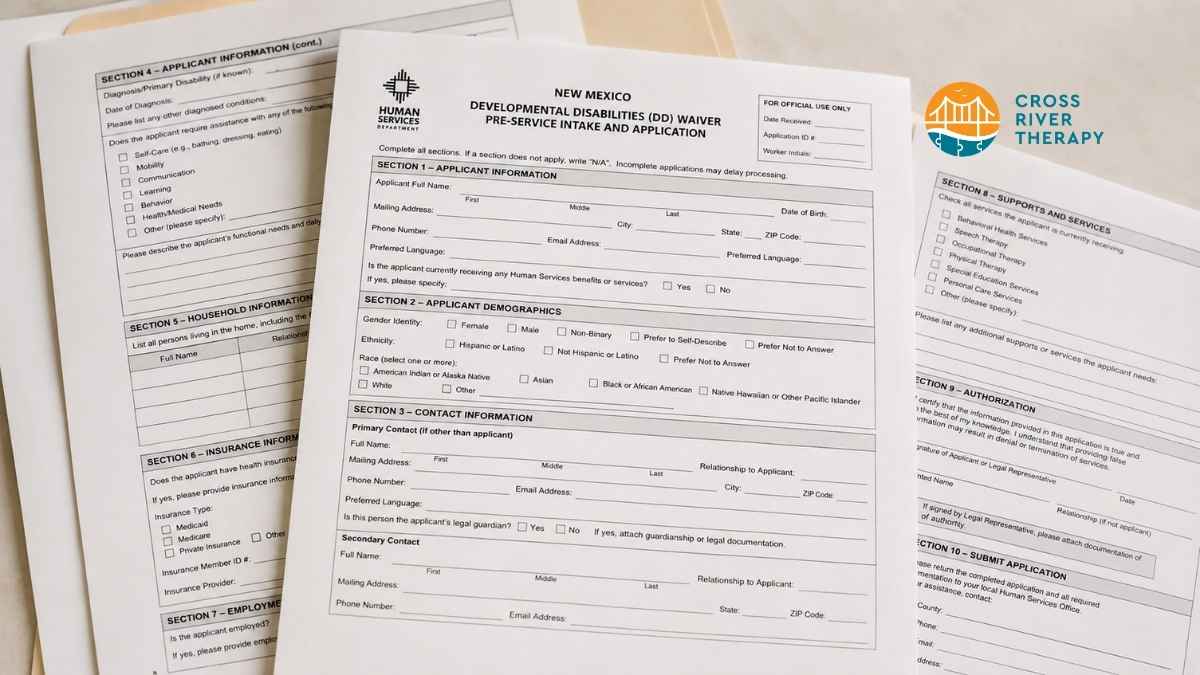
How to Apply for New Mexico’s DD Waiver While Starting ABA Therapy
Autism waiver New Mexico applications need DD Waiver records and proof of daily support needs. Your next step is to start ABA intake with Cross River.

Is ABA Therapy Covered by Insurance in New Jersey? What Every Parent Should Know
ABA therapy insurance New Jersey may cover medically necessary care based on plan type, network, and authorization. Verify benefits with Cross River.

How ABA Therapy Builds Communication for Nonverbal Children Without Forcing Speech
ABA therapy communication for nonverbal children starts with AAC, signs, and daily routines. See how kids ask, refuse, choose, and get help.

How to Start ABA Therapy in New Jersey With a First-Call Checklist
How to start ABA therapy in New Jersey begins with records, insurance details, and intake questions. Use this first-call checklist before you call.

How to Get an Autism Evaluation in Arkansas Before Starting ABA Therapy
How to get an autism evaluation in Arkansas starts with a referral, provider choice, and key records. Use this parent checklist before ABA intake.