








Is Lack Of Eye Contact An Autism Symptom?
Find out if lack of eye contact could be a symptom of autism spectrum disorder.

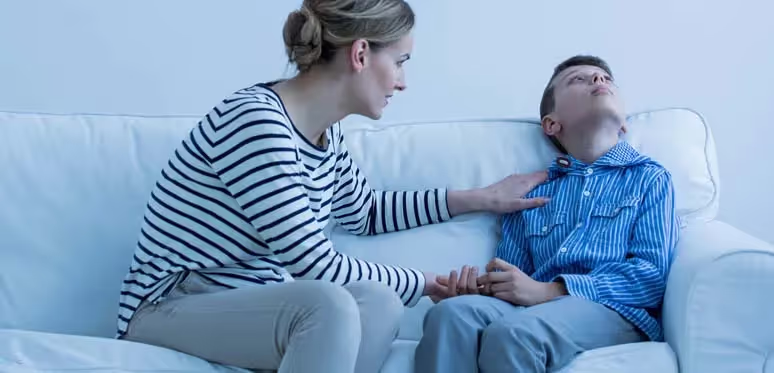
Autism & Lack Of Eye Contact - The Connection
Children with autism sometimes avoid making eye contact with other people for many reasons.
And for most of them, they in no way are linked to autism. The same can be said for some adults.
When children do it, they might dislike or have feelings of fear for the person that's trying to meet their gaze.
Other kids have problems with their hearing and aren't aware when someone wants their attention.
Still, other kids might exhibit general feelings of anxiety for timidity when in public.
Once they become familiar with a face and relax themselves, they may have no problems with eye contact.
There are some cultures in various regions where children make eye contact with strangers and others they don't know very well as odd.
It might even come across as disrespectful among some people.
However, kids with ASD usually shy away from eye contact for entirely different reasons than those described.
The research done is this hasn't satisfactorily led to any solid conclusions.
Regardless, what has been done suggests that people with ASD sometimes experience a lack of motivation in social settings. This can cause them to be disinterested in making eye contact.
Such kids may find it hard to keep their attention on speaking and zeroing in on one's eyes simultaneously.
There could exist issues with the child failing to realize that eye contact can open them up to understanding different feelings going through the person that wants their attention.
Then some autistic kids simply find it too much of an overwhelming chore to look at people.
Can You Make Eye Contact And Still Have Autism?
Yes, while many autistic people struggle to make eye contact, some are able to, so don't assume someone who identifies as being autistic won't be able to meet your gaze.
While people with autism can make eye contact, it remains a problem for lots of people with the disorder.
Based on the information that's found in the DSM, autism is described as the exhibition of different impairments, oftentimes through nonverbal behaviors.
One of these is eye gazes, posture, different facial expressions, and gestures done during social interchanges.
The inability to make eye contact is a major contributor to someone being diagnosed with ASD. Nevertheless, this on its own isn't all that's required for a diagnosis to be made. There are plenty of other signs and symptoms.
A screening to determine a diagnosis doesn't involve any blood tests. Instead, pediatricians look at the entire existing spectrum of behaviors shown in patients. From there, it's compared with what's written in the DSM-5.
Does Everyone With Autism Avoid Eye Contact?
Not everyone with autism avoids eye contact, some individuals with autism are able to make eye contact fairly easily. Not making eye contact shouldn't be entirely thought of as an immediate symptom of autism.
The DSM-5 characterized ASD as a continuing default in the ability of one to have social dialogues in numerous situations.
They often have little to no skills in sharing their ideas with other people. Nonverbal communication, including expressions made with the face, cannot be interpreted.
Understanding the complexities in relationships is incredibly difficult for the autistic. When in the company of others, this often comes across as indifferent. All of the behaviors described can be heavily impacted by problems making eye contact.
Some children can socially interact with other people while not being able to look at other people.
When this is shown with someone willing to form some level of relationship with other people, it's typically a sign that autism isn't present in such an individual.
Young babies sometimes have problems making eye contact as well, even while moving their faces in the direction of the person that's looking at them.
Still, a potential case of autism could be present when small children show no eye contact and have additional problems, like not reacting to their name being called.
Recent News
Related articles

Arizona Autism Laws Every Parent Should Know Before Starting ABA Therapy
Autism laws Arizona parents should know cover ABA insurance, AHCCCS appeals, IEPs, and Section 504 rights. Check ABA coverage with Cross River.

ABA Therapist Salary in Arkansas: What BCBAs and RBTs Actually Earn in 2026
ABA therapist salary Arkansas figures compare RBT and BCBA rates, benefits, guaranteed hours, and contract terms. Explore careers at Cross River.

5 Autism Support Groups and Family Resources in New Mexico Alongside ABA Therapy
Autism support groups New Mexico families can use offer peer support, local events, and school help. Cross River can explain ABA therapy options.

Where to Get an Autism Evaluation in New Mexico Before Starting ABA Therapy
Autism evaluation New Mexico options include UNM, NMSU, FIT, and private providers. Compare providers, records, and ABA steps with Cross River.

7 North Carolina Autism Resources to Contact Before ABA Therapy Starts
Autism resources North Carolina families can call for diagnosis, early intervention, rights, and parent support. Start ABA intake with Cross River.

Does Indiana Medicaid Cover ABA Therapy? A Step-by-Step Eligibility Checklist for Parents
Medicaid ABA therapy Indiana covers eligible children under 21 with prior authorization. Your five-step coverage review can start with Cross River.

How to Apply for New Mexico’s DD Waiver While Starting ABA Therapy
Autism waiver New Mexico applications need DD Waiver records and proof of daily support needs. Your next step is to start ABA intake with Cross River.

Is ABA Therapy Covered by Insurance in New Jersey? What Every Parent Should Know
ABA therapy insurance New Jersey may cover medically necessary care based on plan type, network, and authorization. Verify benefits with Cross River.

How ABA Therapy Builds Communication for Nonverbal Children Without Forcing Speech
ABA therapy communication for nonverbal children starts with AAC, signs, and daily routines. See how kids ask, refuse, choose, and get help.

How to Start ABA Therapy in New Jersey With a First-Call Checklist
How to start ABA therapy in New Jersey begins with records, insurance details, and intake questions. Use this first-call checklist before you call.

How to Get an Autism Evaluation in Arkansas Before Starting ABA Therapy
How to get an autism evaluation in Arkansas starts with a referral, provider choice, and key records. Use this parent checklist before ABA intake.

Center-Based vs In-Home vs School-Based ABA Therapy and How to Choose the Right Fit
Center-based, in-home, and school-based ABA therapy each fit different goals, routines, and settings. Compare options before your intake call.