








Promoting turn-taking skills in ABA therapy
Building Social Foundations: Strategies and Evidence for Turn-Taking in ABA


Why Turn-Taking Matters in Autism Interventions
Turn-taking is a vital social skill that underpins effective communication and meaningful social interactions, particularly in children with autism. Developing this skill can significantly improve peer relationships, enhance cooperation, and support broader social-emotional growth. This article explores why turn-taking is crucial, effective ABA strategies to promote it, structured activities to teach it, and the latest research findings underscoring its importance.
The Importance of Turn-Taking in Social and Developmental Growth
Why is turn-taking an important skill to develop in children with autism?
Turn-taking is a fundamental social skill that involves sharing a rhythmic exchange of actions or conversation between individuals. For children with autism, mastering this skill is crucial because it underpins many other social interactions and communication abilities.
In early development, turn-taking supports joint attention, which is the shared focus on an object or activity. This shared focus helps children connect with caregivers and peers, forming the basis for meaningful social exchanges.
Research shows that difficulties with turn-taking and joint attention are among the earliest signs of autism. These challenges can interfere with learning social cues, understanding others' feelings, and participating in reciprocal conversations.
Engaging children in structured turn-taking activities, like board games, puzzles, or role-playing, encourages patience, sharing, and cooperation. Techniques such as visual supports—cue cards or schedules—make expectations clear and help children understand when it is their turn.
Interventions like Applied Behavior Analysis (ABA) often include strategies to promote turn-taking, emphasizing reinforcement and positive praise to encourage participation. These approaches help children practice turn-taking in a safe, predictable setting, leading to better interactions with peers and adults.
Developing this skill not only improves social interactions but also boosts overall communication abilities. As children become more comfortable sharing attention and activities, they are more likely to engage in conversations, understand social norms, and build relationships.
In sum, fostering turn-taking in children with autism is a stepping stone toward broader social and emotional growth. It helps them navigate peer interactions, reduces social isolation, and supports their ongoing developmental journey.
Effective ABA Strategies for Teaching Turn-Taking

What are effective ABA strategies for teaching turn-taking skills to children with autism?
Applied Behavior Analysis (ABA) provides a range of effective methods to cultivate turn-taking in children with autism. Central to these strategies are structured, engaging activities such as turn-based games, storytelling sessions, and collaborative building tasks. These activities are carefully designed with visual supports—cue cards, timers, and social stories—that clarify expectations and facilitate understanding.
In addition to structured tasks, reinforcement plays a vital role. Praising children and offering small rewards when they successfully participate encourages ongoing practice and mastery of turn-taking behaviors. Modeling and demonstration are also essential; therapists, parents, and peers show appropriate social interactions through videos or live examples, enabling children to observe and imitate.
Prompting and shaping responses are techniques used to guide children toward desired behaviors, gradually reducing supports as their skills improve. Consistency across settings and caregivers is crucial to help children generalize their skills. Patience, along with brief, manageable waiting periods supported by visual cues, helps children develop patience and impulse control.
Activities that promote related skills—such as sharing, social perception, and recognizing social cues—further strengthen overall social communication. These holistic approaches improve interaction quality, cooperation, and communication, supporting children in building meaningful peer relationships.
Structuring Activities to Foster Turn-Taking Skills

How can activities be structured to develop turn-taking skills in children with autism?
Developing turn-taking skills in children with autism requires carefully designed activities that are engaging, predictable, and supportive. Using games and routines that are familiar and enjoyable can help children understand social expectations and participate actively.
Structured activities such as board games, puzzles, and interactive stories create natural opportunities for turn-taking. These activities often feature clear rules and guidelines, making it easy for children to follow along and know when to act or wait. Incorporating visual supports like cue cards, timers, or social scripts helps children recognize signals for their turn and transition smoothly between players.
Visual cues are especially useful in reducing uncertainty. For example, red and green cards can signal when it is a child's turn or when they should wait. Timers can also set clear limits on waiting periods, helping children tolerate longer gaps in turn-taking.
Role-playing and video modeling are additional techniques that reinforce understanding of turn-taking behaviors. Praising successful turns with positive reinforcement further encourages children to practice these social interactions. When activities are adapted to each child's development level and sensory preferences, participation becomes more meaningful and less overwhelming.
Gradually increasing waiting times and introducing polite phrases like “My turn” and “Your turn” support the development of conversational reciprocity. Consistent prompts and practice in different settings help children generalize their skills across environments, including at home, in therapy, and during social activities.
By thoughtfully structuring activities with these supports, children with autism can learn to take turns confidently, leading to improved social engagement, communication, and cooperative play.
Research Evidence and Effectiveness of ABA in Promoting Turn-Taking
 Current research highlights that ABA (Applied Behavior Analysis) interventions are highly effective in teaching turn-taking skills to children with autism. These approaches are most successful when they include systematic prompting and positive reinforcement, which guide children through desired behaviors and encourage consistent practice.
ABA programs often incorporate naturalistic and play-based methods, making activities engaging and relevant to the child's daily experiences. For instance, structured play activities like board games, puzzles, and role-playing help children practice turn-taking in a fun, supportive environment.
Visual supports such as cue cards, visual schedules, and augmentative and alternative communication (AAC) devices are used to clarify expectations and provide visual prompts for turn-taking. These tools assist children in understanding social cues and when to take their turn.
Motivation and engagement are crucial for success. ABA strategies leverage preferred items, interests, and activities to increase a child's motivation. Combining engaging tasks with reinforcement, praise, and supportive feedback encourages children to participate actively and learn social skills.
Effective ABA interventions often involve modeling, gradual skill development, and the use of timers or cues to signal when it's a child's turn. These methods not only promote reciprocity but also help children generalize skills across settings and with different people.
Overall, integrating structured ABA techniques with naturalistic, play-based, and visual supports creates a comprehensive approach that significantly improves turn-taking abilities. This foundational social skill then supports broader social communication, cooperation, and relationship building in children with autism.
Developmental Benefits of Enhancing Turn-Taking Skills
What are the developmental benefits of improving turn-taking skills in children with autism?
Improving turn-taking skills in children with autism plays a vital role in developing core social and communication abilities. When children learn to take turns, they practice sharing interests, waiting patiently, and understanding non-verbal cues like body language and facial expressions. These foundational skills are essential for engaging in meaningful peer interactions.
Structured activities such as games, puzzles, or group routines are effective ways to promote turn-taking. These activities encourage social reciprocity—the give-and-take that fosters cooperation and emotional understanding. As children practice these skills, they develop better social awareness and emotional regulation.
Research shows that engaging regularly in turn-taking activities, especially those tailored to individual preferences and abilities, can lead to increased social participation and cooperation. Interventions like social skills training and parent-led programs demonstrate that consistent practice not only improves immediate social behaviors but also reduces problematic behaviors and boosts confidence in social environments.
Through adapted techniques and supportive reinforcement, children with autism can develop stronger peer relationships. These skills form a foundation for greater social competence, helping them navigate complex social settings, join group activities, and build lasting friendships. Ultimately, fostering turn-taking abilities supports broader social-emotional growth and successful integration into various social contexts.
Fostering Skill Generalization and Social Inclusion
Developing and promoting turn-taking skills through ABA strategies not only enhances immediate social interactions but also supports broader social inclusion, cooperation, and communication. Tailored activities, consistent reinforcement, and effective modeling foster skill transfer across varied settings, including home, school, and community environments. As research continues to validate the effectiveness of structured ABA interventions, it is evident that nurturing turn-taking is crucial for laying a robust social foundation for children with autism. Emphasizing both individual skills and opportunities for social participation ensures children are better equipped to navigate complex social landscapes, promoting independence and meaningful relationships.
References
- Taking Turns | Enhancing Play & Social Skills for Autism
- Developing Social Skills Through ABA Therapy for Autism
- Defining turn taking in intervention for young children with ...
- Effective Turn-Taking Activities for Autistic Individuals -
- A Social Turn-Taking, Parent Mediated Learning ...
- Turn-Taking Games for Positive Social Skills
- Effect of social skills training on interpersonal interactions ...
- Promoting turn-taking skills in preschool children with ...
- Autism and taking turns
- Turn-Taking Games for Positive Social Skills
Recent News
Related articles

ABA Therapist Salary in Arkansas: What BCBAs and RBTs Actually Earn in 2026
ABA therapist salary Arkansas figures compare RBT and BCBA rates, benefits, guaranteed hours, and contract terms. Explore careers at Cross River.

5 Autism Support Groups and Family Resources in New Mexico Alongside ABA Therapy
Autism support groups New Mexico families can use offer peer support, local events, and school help. Cross River can explain ABA therapy options.

Where to Get an Autism Evaluation in New Mexico Before Starting ABA Therapy
Autism evaluation New Mexico options include UNM, NMSU, FIT, and private providers. Compare providers, records, and ABA steps with Cross River.

7 North Carolina Autism Resources to Contact Before ABA Therapy Starts
Autism resources North Carolina families can call for diagnosis, early intervention, rights, and parent support. Start ABA intake with Cross River.

Does Indiana Medicaid Cover ABA Therapy? A Step-by-Step Eligibility Checklist for Parents
Medicaid ABA therapy Indiana covers eligible children under 21 with prior authorization. Your five-step coverage review can start with Cross River.
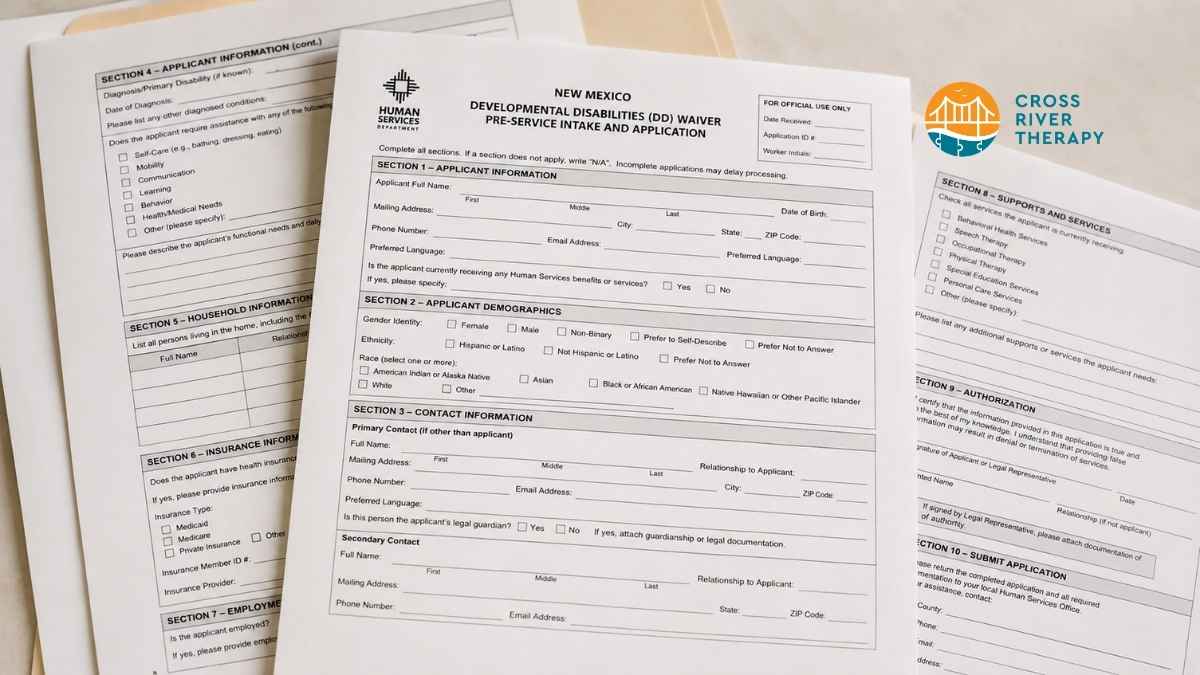
How to Apply for New Mexico’s DD Waiver While Starting ABA Therapy
Autism waiver New Mexico applications need DD Waiver records and proof of daily support needs. Your next step is to start ABA intake with Cross River.

Is ABA Therapy Covered by Insurance in New Jersey? What Every Parent Should Know
ABA therapy insurance New Jersey may cover medically necessary care based on plan type, network, and authorization. Verify benefits with Cross River.

How ABA Therapy Builds Communication for Nonverbal Children Without Forcing Speech
ABA therapy communication for nonverbal children starts with AAC, signs, and daily routines. See how kids ask, refuse, choose, and get help.

How to Start ABA Therapy in New Jersey With a First-Call Checklist
How to start ABA therapy in New Jersey begins with records, insurance details, and intake questions. Use this first-call checklist before you call.

How to Get an Autism Evaluation in Arkansas Before Starting ABA Therapy
How to get an autism evaluation in Arkansas starts with a referral, provider choice, and key records. Use this parent checklist before ABA intake.

Center-Based vs In-Home vs School-Based ABA Therapy and How to Choose the Right Fit
Center-based, in-home, and school-based ABA therapy each fit different goals, routines, and settings. Compare options before your intake call.

Early Signs of Autism: A Guide for North Carolina Parents
Early signs of autism North Carolina parents notice can include speech, play, sensory, or skill loss patterns. See what to track before screening.