








Reinforcement schedules in ABA therapy: a beginner’s guide
Mastering Reinforcement in ABA: A Practical Guide for Beginners


Understanding Reinforcement Schedules in ABA Therapy
Applied Behavior Analysis (ABA) offers a structured approach to improving behaviors and developing new skills, especially for individuals with developmental challenges such as autism. Central to ABA is the concept of reinforcement — the tools and methods used to encourage desired behaviors. This article provides a comprehensive, beginner-friendly overview of reinforcement schedules in ABA therapy, explaining how they function, their different types, and how to effectively implement them to achieve meaningful progress.
Fundamentals of Reinforcement in ABA Therapy
What are the basic principles of reinforcement in ABA therapy?
Reinforcement is a foundational concept in Applied Behavior Analysis (ABA) used to increase the likelihood of specific behaviors recurring. At its core, reinforcement involves delivering a consequence immediately after a behavior that makes it more probable to happen again in the future.
In ABA, reinforcers come in various forms. Social reinforcers include praise, smiles, or attention that acknowledge the behavior. Tangible reinforcers refer to items like toys, snacks, or certificates that a person finds motivating. Escape reinforcement helps individuals avoid or terminate an undesired demand or situation. Sensory reinforcement involves stimuli that provide tactile or visual stimulation, such as textured objects or flashing lights.
Effective reinforcement is characterized by immediacy and personalization. It must be provided right after the desired behavior occurs to be most effective. Tailoring reinforcers to an individual's preferences ensures they are motivating and meaningful. Consistency in delivering reinforcement is vital for building strong, stable behaviors.
Furthermore, reinforcement strategies should adapt over time. Variations and scaling of reinforcement help maintain motivation and prevent satiation. These approaches support skill generalization across different environments and situations. Mastery of applying reinforcement principles is essential for clinicians and caregivers aiming to promote functional, adaptive behaviors through ABA techniques.
Types of Reinforcement Schedules in ABA
What are the four main types of reinforcement schedules in ABA therapy?
In ABA therapy, reinforcement schedules are methods used to determine when and how often to reward a target behavior. The four primary types are Fixed Ratio (FR), Fixed Interval (FI), Variable Ratio (VR), and Variable Interval (VI).
Fixed Ratio schedules reward the individual after a set number of responses, encouraging repeated behavior until the target is met. For example, a child might earn a sticker after answering five questions correctly.
Fixed Interval schedules reinforce after a fixed amount of time has passed, such as giving praise every 10 minutes for staying engaged. This helps promote sustained and patient responses.
Variable Ratio schedules reward after an unpredictable number of responses, like a slot machine, motivating consistent effort because reinforcement is unpredictable.
Variable Interval schedules provide reinforcement after unpredicted time intervals, such as a surprise check for good behavior, encouraging spontaneous and ongoing responses.
Understanding these schedules allows therapists to tailor reinforcement to shape behaviors effectively, promoting persistence and adaptability in responses.
Understanding Partial and Intermittent Reinforcement
What are the types of partial reinforcement schedules used in ABA therapy?
In ABA therapy, reinforcement strategies are tailored to help establish and maintain desired behaviors. When continuous reinforcement—that is, rewarding each instance of the behavior—is used initially, it quickly encourages the behavior. However, for long-term maintenance and to prevent behaviors from extinguishing once reinforcement stops, partial or intermittent schedules are introduced.
These schedules reward behaviors less predictably but more resiliently, making the behavior more resistant to extinction. The main types include fixed ratio, variable ratio, fixed interval, and variable interval schedules.
| Schedule Type | Description | Example | Effect on Behavior |
|---|---|---|---|
| Fixed ratio (FR) | Reinforcement after a set number of responses | Reward after every 5 responses | Produces high response rates with short pauses after reinforcement |
| Variable ratio (VR) | Reinforcement after a random number of responses | Gambling machine payouts | Creates steady, high response rates and resistance to extinction |
| Fixed interval (FI) | Reinforcement after a fixed time period | Weekly paycheck | Encourages responding as the interval approaches, fostering patience |
| Variable interval (VI) | Reinforcement after unpredictable time intervals | Random pop quizzes | Promotes spontaneous, generalized responses |
These schedules support the development of behaviors that are durable over time, even without constant reinforcement.
What strategies are recommended for implementing reinforcement schedules for beginners?
Starting with simple reinforcement methods helps beginners effectively shape behavior. Continuous reinforcement is ideal at the start, where every desired behavior is rewarded. This rapid reinforcement helps establish the behavior quickly.
Once a behavior is learned, transitioning to partial schedules such as fixed ratio, variable ratio, fixed interval, or variable interval helps maintain the behavior and makes it less likely to extinguish. For example, shifting from rewarding every response to rewarding after a varying number of responses (VR schedule) helps sustain motivation.
Practical strategies include selecting reinforcers that are meaningful to the individual and monitoring progress through consistent data collection. Adjustments should be made based on ongoing observations; for example, if responses decline, increasing reinforcement frequency or changing the reinforcer might be necessary.
Gradually, reinforcement can be faded, shifting from continuous to intermittent schedules, to promote independence and generalization of skills. Patience, combined with clear, consistent expectations, ensures these strategies effectively support behavior change.
Compound Reinforcement Schedules and Behavior Modification
What are compound schedules?
In ABA therapy, reinforcement schedules are planned systems that determine how often and under what circumstances a behavior is rewarded. When these schedules combine multiple reinforcement strategies into a single framework, they are called compound schedules. These arrangements allow for more complex and nuanced behavior shaping.
Examples such as concurrent and chained schedules
Two common forms of compound schedules are concurrent and chained schedules.
- Concurrent schedules involve offering two or more reinforcement options simultaneously. For example, a child might earn praise or a small toy for completing a task, choosing between these rewards based on preferences.
- Chained schedules require completing a series of behaviors in a specific order before receiving reinforcement. For instance, brushing teeth, rinsing, and flossing in sequence before getting a reward.
These combined schedules enable behavior analysts to create more flexible and motivating interventions, encouraging a variety of behaviors and skills.
Impact on behavior shaping and generalization
Using compound schedules significantly influences how behaviors are developed and maintained. They support better shaping of complex behaviors by breaking them into smaller, manageable steps, such as in chained schedules.
Additionally, these schedules promote generalization—the ability to apply learned behaviors across different settings and situations. By varying reinforcement contingencies, individuals become more adaptable and independent.
How do reinforcement schedules fit within the overall methodology of ABA therapy?
Reinforcement schedules are fundamental to ABA’s structured approach. They are tailored to individual needs, preferences, and goals, ensuring that reinforcement is used effectively to facilitate learning.
These schedules are integrated with other ABA procedures like task analysis, prompting, and data collection. They help sustain motivation, promote skill acquisition, and support generalization.
Adjustments to reinforcement schedules—such as switching from fixed to variable schedules—are based on ongoing data and observations. This customization helps foster consistent progress and durable behavior change.
Overall, reinforcement schedules are pivotal tools that underpin the scientific and individualized nature of ABA therapy, guiding behavior modification in a positive and sustainable manner.
Role of Reinforcement Schedules in ABA Methodology

How do reinforcement schedules fit within the overall methodology of ABA therapy?
Reinforcement schedules are a vital part of ABA therapy, guiding when and how rewards are given to encourage desired behaviors. They are tailored to each individual, considering preferences, motivation levels, and specific goals. Different types of schedules—like fixed ratios or variable intervals—are used to keep the individual engaged, support skill development, and promote behaviors that can be generalized across different settings.
In practice, reinforcement schedules are embedded into a comprehensive ABA approach, which also includes assessment, prompting, shaping, and environmental adjustments. This integrated method ensures that each behavior change is supported systematically, leading to more lasting improvements. Reinforcement schedules serve as the mechanism to reinforce learning, ensuring that positive behaviors are consistently encouraged and maintained over time.
Overall, these schedules help create a predictable and motivating learning environment where every reinforcement strategically enhances the child's progress toward independence and skill mastery.
Conclusion and Practical Takeaways
How can reinforcement schedules be used to shape behavior in ABA therapy?
Reinforcement schedules are fundamental tools in ABA therapy for gradually shaping and maintaining desired behaviors. Initially, continuous reinforcement — where every correct response is rewarded — is effective for teaching new skills quickly. As behaviors become established, therapists shift to intermittent schedules, such as fixed-ratio, variable-ratio, fixed-interval, and variable-interval, which promote long-term practice and resistance to extinction.
For example, fixed-ratio schedules reinforce a set number of responses before giving a reward, encouraging consistent response patterns. Variable-ratio schedules, where the reward is unpredictable, help sustain behaviors even when reinforcement becomes less frequent. Fixed-interval and variable-interval schedules reinforce behavior after specific or unpredictable amounts of time, fostering patience and spontaneous responses.
Therapists often combine these schedules with techniques like shaping—breaking complex behaviors into small, achievable steps, and reinforcing each gradual step—to optimize learning. Adjustments are made based on ongoing data collection to ensure reinforcement continues to meet the individual’s needs and promotes generalization across settings. Differential reinforcement strategies are used to reinforce specific desirable behaviors while reducing undesired ones, often through tailored reinforcement schedules.
In summary, manipulating reinforcement schedules helps create a structured environment that efficiently promotes skill acquisition, behavior maintenance, and independence.
Empowering Progress Through Reinforcement
Understanding reinforcement schedules in ABA therapy is foundational for effective intervention. By carefully selecting and adjusting reinforcement strategies—whether continuous or intermittent—therapists, families, and caregivers can collaboratively foster meaningful and lasting behavior change. The key lies in individualizing reinforcement plans, continuously monitoring progress through data, and fading supports to promote independence. With patience, consistency, and knowledge, reinforcement schedules serve as powerful tools to enhance learning, build skills, and improve the quality of life for individuals receiving ABA therapy.
References
- A Guide to Reinforcement Schedules in ABA - Ensora Health
- ABA Therapist: Essential Beginner's Guide
- A Beginner's Guide to Applied Behavior Analysis (ABA) Therapy
- Applied Behavior Analysis - Beginner's Guide | Family Priority Blog
- [PDF] ABA-101-Handouts-The-Autism-Helper
- Exploring Compound Schedules of Reinforcement - ABA Study Guide
- B.10 Concurrent, Multiple, Mixed, and Chained Schedules
- Schedules of Reinforcement in Psychology | Types & Examples
Recent News
Related articles

ABA Therapist Salary in Arkansas: What BCBAs and RBTs Actually Earn in 2026
ABA therapist salary Arkansas figures compare RBT and BCBA rates, benefits, guaranteed hours, and contract terms. Explore careers at Cross River.

5 Autism Support Groups and Family Resources in New Mexico Alongside ABA Therapy
Autism support groups New Mexico families can use offer peer support, local events, and school help. Cross River can explain ABA therapy options.

Where to Get an Autism Evaluation in New Mexico Before Starting ABA Therapy
Autism evaluation New Mexico options include UNM, NMSU, FIT, and private providers. Compare providers, records, and ABA steps with Cross River.

7 North Carolina Autism Resources to Contact Before ABA Therapy Starts
Autism resources North Carolina families can call for diagnosis, early intervention, rights, and parent support. Start ABA intake with Cross River.

Does Indiana Medicaid Cover ABA Therapy? A Step-by-Step Eligibility Checklist for Parents
Medicaid ABA therapy Indiana covers eligible children under 21 with prior authorization. Your five-step coverage review can start with Cross River.
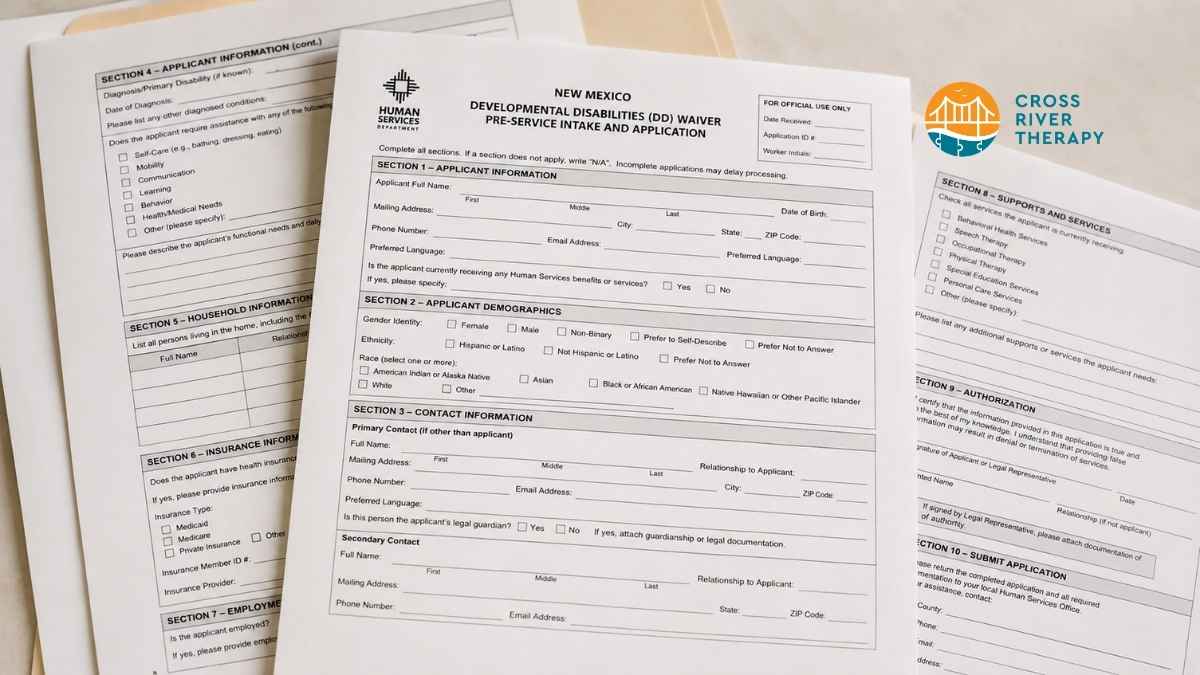
How to Apply for New Mexico’s DD Waiver While Starting ABA Therapy
Autism waiver New Mexico applications need DD Waiver records and proof of daily support needs. Your next step is to start ABA intake with Cross River.

Is ABA Therapy Covered by Insurance in New Jersey? What Every Parent Should Know
ABA therapy insurance New Jersey may cover medically necessary care based on plan type, network, and authorization. Verify benefits with Cross River.

How ABA Therapy Builds Communication for Nonverbal Children Without Forcing Speech
ABA therapy communication for nonverbal children starts with AAC, signs, and daily routines. See how kids ask, refuse, choose, and get help.

How to Start ABA Therapy in New Jersey With a First-Call Checklist
How to start ABA therapy in New Jersey begins with records, insurance details, and intake questions. Use this first-call checklist before you call.

How to Get an Autism Evaluation in Arkansas Before Starting ABA Therapy
How to get an autism evaluation in Arkansas starts with a referral, provider choice, and key records. Use this parent checklist before ABA intake.

Center-Based vs In-Home vs School-Based ABA Therapy and How to Choose the Right Fit
Center-based, in-home, and school-based ABA therapy each fit different goals, routines, and settings. Compare options before your intake call.

Early Signs of Autism: A Guide for North Carolina Parents
Early signs of autism North Carolina parents notice can include speech, play, sensory, or skill loss patterns. See what to track before screening.