








Teaching functional play skills in autistic toddlers
Unlocking Play Potential in Autism: Strategies and Insights


Understanding the Role of Functional Play in Autism Development
Functional play in child development, also known as relational play, involves children using toys and objects for their intended purposes, such as rolling a ball or pushing a toy car. It plays a crucial role in developing motor, language, and critical thinking skills fundamental to overall growth. As children progress through various developmental stages—from bonding activities with infants to collaborative and symbolic play in preschool—they build essential social interactions and problem-solving abilities. Encouraging functional play supports sensory integration and fosters a foundation for learning across developmental domains, making it a vital focus for teaching interventions in autistic toddlers.
The Stages of Play Development in Early Childhood
What is functional play in child development?
Functional play, also known as relational play, involves children using toys or objects in ways that reflect their intended purpose. For example, a child might roll a toy vehicle, wave a toy airplane, or pretend to feed a doll. This type of play helps children understand how objects are meant to be used, encouraging them to learn simple tasks and develop crucial skills like language, motor coordination, and critical thinking.
In early childhood, functional play moves through various stages. Initially, infants often bond with caregivers through simple play and explore toys through actions like mouthing or looking. As they grow, children imitate daily activities and begin to play with toys functionally between ages 1 and 1.5 years.
By age 1.5 to 2 years, children start making toys perform functions, such as pushing a car or filling a container. As they approach toddlerhood, their play becomes more complex, involving completing play scenarios like putting blocks together or using toys in combination. Between ages 2 and 3, children typically engage in group play, turn-taking, and more social interactions.
Supporting functional play development is especially important for children with autism. It provides the foundation for social skills, problem-solving, and language skills. Introducing cause-and-effect toys, modeling appropriate actions, and creating opportunities for voluntary and joyful play are effective strategies to enhance their developmental progress.
Developmental milestones for engaging in functional play
Recognizing milestones can help guide age-appropriate activities. Typical progress includes:
| Age Range | Play Milestones | Examples of Activities |
|---|---|---|
| 0-1 year | Bonding, exploring with simple toys | Feeling, mouthing, looking at toys |
| 1-1.5 years | Imitating daily functions | Pushing buttons, opening containers |
| 1.5-2 years | Making toys perform functions | Filling, pouring, pushing cars |
| 2-3 years | Completing play scenarios, engaging in group play | Building towers, role-playing, turn-taking |
| 3-4 years | Social and group play | Playing house, playing with peers |
Encouraging progression through these stages involves providing appropriate toys, modeling behaviors, and using visual supports to facilitate understanding of play sequences. This structured approach supports the child's overarching development in social, emotional, and cognitive domains.
Examples of Functional Play and Its Impact

What are examples of functional play?
Functional play involves children actively using toys and objects in ways that align with their intended purposes. For example, children might build towers with blocks to develop fine motor skills and spatial awareness, or push toy cars along a track to understand cause-and-effect relationships. Pretending to feed a doll or filling a bucket with sand are also common activities that promote language development and social understanding.
Other practical examples include swinging a bat to hit a ball, kicking or rolling a ball to practice gross motor skills, and playing with toy vehicles like matchbox cars to explore movement and mechanics. Children can also create obstacle courses with jump ropes or stack kitchen containers to enhance problem-solving skills. Engaging in pretend activities such as feeding a doll, waving a toy airplane, or putting blocks together allows children to develop their imagination, language, and social skills.
These activities are not only enjoyable but serve as foundational experiences that support development across multiple domains. They help children learn how objects work together, improve their motor coordination, and foster communication and social interactions. Overall, functional play is central to helping children reach developmental milestones and build essential life skills.
Teaching and Modeling Functional Play Skills
 Effective strategies for teaching play skills to autistic children involve a combination of modeling, visual supports, and following the child’s lead. Using visual aids like picture icons, visual schedules, and organized play areas helps children understand what to do and creates a predictable routine. For example, visual cue cards can demonstrate specific actions such as pushing a car or pretending to feed a doll, which children can imitate.
Modeling is another crucial approach. Caregivers or teachers actively demonstrate play actions—like stacking blocks or opening a toy door—to show children how to engage with toys in expected ways. Narrating actions during play, such as "You are pushing the car," encourages imitation and language development. Following the child's interests and allowing them to choose activities helps maintain motivation and supports natural learning.
Using targeted play centers or structured play boxes can focus on specific skills like turn-taking, motor imitation, or combining actions into sequences. For example, a play set with cars, figurines, and a small map allows children to practice one-step actions, and later, multi-step routines like placing characters in the vehicle and pushing it along.
Monitoring progress through data collection—such as frequency counts, interval recording, or rubrics—guides ongoing adjustments to teaching strategies. This targeted approach ensures that interventions are tailored to each child's unique needs.
In a supportive environment, adults should aim to join in play, following the child's lead and using narration instead of questions. This method promotes trust, encourages social interaction, and helps children learn functional play more effectively.
Supporting children in developing these skills not only enhances their play capabilities but also contributes to improvements in language, thinking, social, and emotional skills, creating a foundation for broader developmental gains.
Supporting Functional Play Through Interventions and Environment
 To effectively foster functional play skills in children with autism, utilizing evidence-based intervention strategies is essential. Approaches such as Applied Behavior Analysis (ABA), Pivotal Response Training (PRT), and specialized play therapy techniques have proven effective in teaching children how to play appropriately and independently.
ABA and PRT focus on systematically teaching specific behaviors through prompts, reinforcement, and consistent modeling. These methods help children understand the purpose of toys and activities, encouraging them to imitate actions and develop new play skills. Play therapy, on the other hand, creates a safe space for children to explore play at their own pace, guided by structured activities that shift their focus from problematic behaviors to expressive, functional play.
An organized, inviting play environment enhances learning. Visual supports like visual schedules, cue cards, and model prompts provide clear cues for desired play actions. These tools help children understand what to do next, reducing confusion and promoting independence.
Incorporating play into therapy sessions with structured routines enables children to practice turn-taking, sharing, and problem-solving while playing. Using a variety of toys such as pretend household objects, building blocks, figurines, and sensory bins exposes children to different activities. This diversity fosters engagement and helps identify activities they find enjoyable and motivating.
Consistent modeling by adults is critical. Demonstrating play actions, narrating behaviors, and following the child's lead encourage imitation and social interaction. Adults can also use structured play scenarios with visual supports to teach multi-step actions, like placing a character in a vehicle followed by pushing the vehicle.
Monitoring progress is vital for tailoring interventions. Data collection methods such as frequency counts, interval recording, and rubric-based assessments provide insights into a child's evolving skills. This information guides adjustments in strategies, ensuring that play activities remain engaging and beneficial.
In summary, providing a systematic, visual-rich environment combined with structured, evidence-based interventions supports autistic children in developing their functional play abilities. These practices not only enhance play skills but also improve related social, communication, and cognitive skills, laying a strong foundation for overall developmental progress.
Implementing Play Therapy and Its Benefits

What is play therapy in children with autism?
Play therapy in children with autism involves helping children engage in activities of their interest and choice to express themselves in a comfortable way, shifting their self-expression from unwanted behaviors to more non-injurious expressive behaviors. It aims to prevent or solve psychosocial difficulties and promote healthy growth and development in children with autism.
Proper evaluation of each child's individual needs is essential to determine the most suitable type of play therapy. Different approaches include child-centered play therapy, floor time, and integrated play groups, each tailored to foster social, emotional, and communication skills.
Research shows that play therapy can significantly impact brain development. It promotes neuroplasticity, which enhances neural connections critical for learning and adaptive behaviors. Additionally, it improves executive functions, social cognition, and emotional regulation, all crucial areas for children with autism.
Types of play therapy interventions used with autistic children
Various interventions support children in engaging meaningfully during play. Child-led approaches, such as floor time, encourage children to initiate and direct play activities, fostering independence and social interaction.
Integrated play groups combine children with autism and neurotypical peers, promoting social integration and skill generalization. Visual supports like cues and modeling are also commonly used to facilitate understanding and participation.
How play therapy promotes social, emotional, and cognitive development
Play therapy provides a safe environment where children can practice social interactions, develop emotional awareness, and improve cognitive skills.
Engaging in structured and unstructured play helps children learn turn-taking, sharing, and problem-solving. It also supports emotional regulation by allowing children to express feelings in a controlled, supportive context.
Studies highlight that children participating in play therapy often show increased joint attention, vocabulary development, and better emotional responses. These benefits contribute to improved behavior, communication, and social relationships.
Here’s a quick overview:
| Therapy Type | Focus | Techniques | Expected Outcomes |
|---|---|---|---|
| Child-centered play therapy | Emotional expression | Child-led activities, listening, and reflection | Improved emotional regulation and social skills |
| Floor time | Social engagement | Play activities that follow child's interests | Better joint attention and interaction |
| Group play | Social integration | Peer interaction with guided facilitation | Enhanced social importance and cooperation |
Supporting children through play therapy involves patience, consistency, and matching activities to individual interests. The use of visuals, modeling, and narration further enhances the learning experience.
Through these approaches, play therapy helps children with autism not only develop crucial life skills but also enjoy meaningful, joyful engagement in their worlds.
Advancing Play Skills and Supporting Developmental Milestones
Why is expanding play skills important in autism?
Expanding and increasing play skills play a vital role in supporting children with autism in their overall development. When children move beyond basic functional play—like pushing a toy car or pretending to feed a doll—they begin to engage in more complex, multi-step actions. These sequences, such as putting characters in a bus and then pushing it, help develop critical thinking, problem-solving, and language skills.
Teaching children to combine actions into longer routines encourages cognitive growth and gives them opportunities for more meaningful social interactions. As children master these sophisticated play sequences, they tend to show improvements in expressive language, because they learn to narrate their actions and understand others' cues.
In addition, advancing play skills supports social-emotional growth, enabling children to participate more fully in group activities and develop cooperation and turn-taking abilities. To promote these advances, strategies such as modeling, visual supports, and following the child's interests are used, making play both inviting and educational.
The relation between joint attention, functional play, and language development in typically developing children and children with autism
In typically developing children, strong connections exist between joint attention, functional play, and language development. Joint attention—the shared focus on objects or activities—is a foundation for language learning. When children engage in functional play with others, they often coordinate their attention and actions, which boosts their vocabulary and expressive language.
However, in children with autism, this link can be disrupted or follow different pathways. Children with autism may demonstrate delays in functional and pretend play and often struggle with joint attention. These challenges can affect their language acquisition, as they might not naturally connect actions with words or develop typical social routines.
Research suggests that improving functional play and joint attention in children with autism can enhance their language skills and social understanding. Interventions often focus on teaching children to engage in shared play activities, imitate actions, and use visual supports to bridge these developmental gaps. By doing so, they lay a foundation for more meaningful communication and social interaction, which are crucial for their overall growth.
| Developmental Area | Typical Milestone | Autism Spectrum Development | Strategies to Support Development |
|---|---|---|---|
| Play Formation | Playing with toys in expected ways | Delays in complex, symbolic, and sociodramatic play | Visual supports, modeling, guided play |
| Joint Attention | Sharing focus with others | Often limited or delayed | Focused attention activities, shared routines |
| Language Growth | Expanding vocabulary and using words in context | Slower acquisition; may depend on intervention | Using visuals, narrations, engaging play |
| Social Interactions | Participating in group activities | Challenges in turn-taking and sharing | Structured routines, social skills training |
Supporting these skills involves understanding individual needs, creating supportive environments, and gradually increasing complexity of play activities. This approach ensures children with autism develop essential communication, social, and cognitive skills needed for their age and abilities.
Research and Evidence on Play Interventions in Autism
 Numerous studies support the positive impact of targeted play interventions for children with autism. For example, research using video modeling shows that children often increase spontaneous play requests and social communication skills following observation of appropriate play behaviors. Pivotal response training (PRT), based on applied behavior analysis, effectively teaches essential behaviors like turn-taking and verbal exchanges, leading to improved engagement and social interaction. Structured play therapies, including child-led and floor-time approaches, demonstrate that systematic and personalized support can significantly elevate the level of functional play among autistic children.
Compared to typically developing peers, children with autism tend to exhibit less elaborated forms of functional play, especially in complex or symbolic play scenarios. Observational studies in natural settings reveal that children with autism may have delays in pretend and imitative play, often engaging in repetitive or stereotyped behaviors instead.
Research involving detailed play behavior analysis has categorized functional play into broader groups such as interacting with objects, self, or the environment, with subcategories illuminating specific areas of difficulty. This detailed understanding helps in designing effective interventions tailored to individual needs.
In summary, systematic and evidence-based play therapies improve not only play skills but also broader developmental domains like language, cognition, and social-emotional skills. Continued research underscores the importance of early, targeted intervention and the use of visual supports and modeling to facilitate growth in play abilities for children with autism.
Fostering a Playful Path to Development
Supporting autistic toddlers in developing functional play skills requires a comprehensive, evidence-based approach that combines structured interventions, visual supports, modeling, and environmental organization. Recognizing the importance of progressing from simple explorative behaviors to complex, multi-step play facilitates improvements across social, communication, and cognitive domains. Incorporating play therapy techniques, promoting peer interactions, and tailoring activities to individual interests make learning engaging and meaningful. As research continues to reveal effective strategies, caregivers and practitioners can confidently build a foundation that encourages joyful, purposeful play—crucial for supporting children’s overall growth and independence.
References
- Functional Play and Autism - Autism Little Learners
- Play and autistic children - Raising Children Network
- Play therapy in children with autism: Its role, implications, and ...
- Teaching Play Skills - The Autism Helper
- Play And Learn: Functional Play & Autism - Autism Little Learners
- [PDF] REFEREED ARTICLE Teaching Play Skills to Children with Autism
- The Relation between Functional Play and Other Forms of ...
Recent News
Related articles

6 Tour Checks for Center-Based ABA Therapy in Arkansas
Center-based ABA therapy in Arkansas varies by provider. A tour helps parents check staff, safety, and progress.

How to Start In-Home ABA Therapy in Arkansas in 6 Steps
In-home ABA therapy in Arkansas begins with intake and a care plan. The steps explain records and the assessment.

6 Arkansas Medicaid ABA Therapy Rules Families Need to Know
Arkansas Medicaid ABA therapy has age, diagnosis and approval rules. Families can check six requirements before care.

Arizona Autism Laws for ABA Coverage and School Rights
Arizona autism laws for ABA coverage vary by plan. Families can check insurance, appeal options, and school rights.

ABA Therapist Salary in Arkansas for RBTs and BCBAs
Compare ABA therapist salary in Arkansas by role. See how paid hours and benefits affect earnings before applying.

5 Autism Support Groups and Family Resources in New Mexico
Autism support groups in New Mexico connect families. Local resources offer events, parent support, and school help.

Where to Get an Autism Evaluation in New Mexico
Autism evaluation options in New Mexico include UNM and NMSU. Age and referral details help parents prepare.

7 North Carolina Autism Resources to Contact Before ABA Therapy Starts
Autism resources North Carolina families can call for diagnosis, early intervention, rights, and parent support. Start ABA intake with Cross River.

Does Indiana Medicaid Cover ABA Therapy? A Parent Checklist
Indiana Medicaid ABA therapy may cover care for eligible children. The checklist covers coaching and renewals.
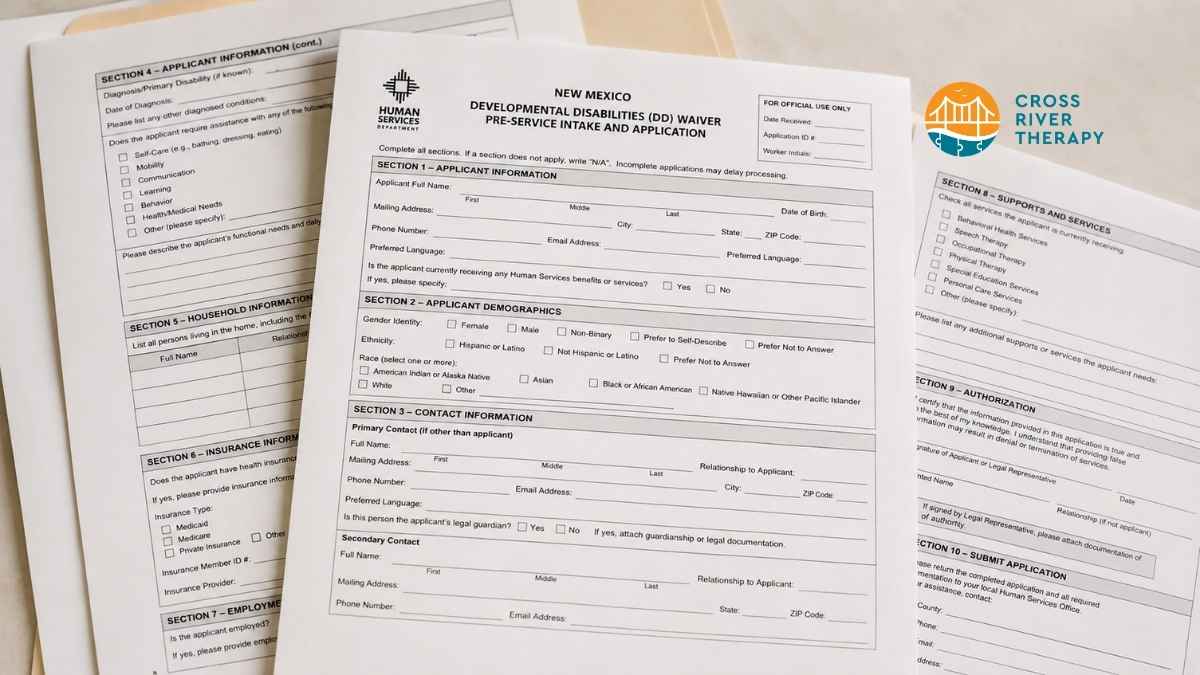
How to Apply for the New Mexico DD Waiver
Your NM DD waiver application starts with state intake. The steps cover records, submission, and enrollment.

Does Insurance Cover ABA Therapy in New Jersey?
ABA therapy insurance in New Jersey varies by plan. Learn what NJ FamilyCare covers and how to check costs.

How ABA Therapy Builds Communication for Nonverbal Children Without Forcing Speech
ABA therapy communication for nonverbal children starts with AAC, signs, and daily routines. See how kids ask, refuse, choose, and get help.