








The Benefits of Group ABA Therapy
Transforming Autism Support Through Group ABA Therapy


Harnessing the Power of Collective Learning in Autism Interventions
Group Applied Behavior Analysis (ABA) therapy has emerged as a vital approach in supporting children with autism spectrum disorder (ASD). By facilitating social interactions, fostering skill development, and providing a supportive environment, group ABA therapy offers distinct advantages over individual sessions. This article explores the multifaceted benefits of group ABA therapy, emphasizing its role in enhancing social skills, emotional regulation, confidence, and independence in children with ASD.
Understanding the Dynamics of Group ABA Therapy

What is group ABA therapy?
Group-based Applied Behavior Analysis (ABA) is a structured therapeutic approach designed to help children and youth with autism develop essential social skills through interactions with peers. It takes place in a setting where children participate together, engaging in planned activities aimed at fostering social connections, emotional regulation, and personal growth.
These sessions often include discussions, hands-on exercises, role plays, and games, making learning engaging and relevant. Tailored to the individual needs of each child, group ABA sessions are structured to promote meaningful participation, learning, and social development.
Participants are carefully matched based on factors such as age, current skills, and personal goals. This ensures each child receives instruction that is appropriate and meaningful, maximizing the benefit of the activities. Facilitators observe and analyze each child's responses during sample sessions, helping families understand how the program can best support their child's growth.
How does it differ from individual therapy?
While traditional ABA therapy often involves one-on-one sessions, group ABA introduces children to social environments where they can practice skills in real time among peers. This collective setting emphasizes collaborative problem-solving, teamwork, and social interaction, which are difficult to replicate in individual sessions.
In group therapy, children not only learn skills but also observe and imitate their peers, enhancing their social understanding and confidence. This environment better mirrors real-world scenarios where social cues, sharing, and cooperation are essential.
Additionally, group sessions often incorporate specific activities such as making and sharing meals, playing board games, or participating in interest-driven pursuits like storytelling and mindfulness exercises. These activities help children apply skills learned in a social context, laying the groundwork for more natural interactions.
The scientific basis of ABA as a treatment for ASD
ABA is an evidence-based approach grounded in the science of learning and behavior. It is recognized as a highly effective treatment for children with Autism Spectrum Disorder (ASD), supported by organizations like the US Surgeon General and the American Psychological Association.
The core principles involve understanding antecedents (what happens before a behavior) and consequences (what happens after), to modify behaviors intentionally. Positive reinforcement, where desirable behaviors are rewarded, encourages children to repeat beneficial behaviors such as communication, social skills, and daily living activities.
Research consistently demonstrates that early and intensive ABA interventions (typically 25-40 hours weekly over 1-3 years) can significantly improve outcomes, including language development, social competence, academic skills, and daily living abilities.
Advantages of group design in ABA
Group designs in ABA offer several important benefits that enhance the understanding and application of therapeutic techniques. These designs allow researchers and clinicians to evaluate how intervention effects work across diverse populations, increasing confidence that results are applicable beyond individual cases.
By including comparison groups or randomization, group designs help mitigate threats to validity such as maturation or history effects, providing a more robust assessment of an intervention’s effectiveness. These methods enable the evaluation of variations in responses among participants, which can inform adjustments to better fit individual needs.
Overall, group-based ABA studies help identify what approaches work best on a larger scale, supporting the implementation of successful practices in many settings.
Aspect Description Additional Insights What is it? Structured program for peers with autism to practice social skills Uses activities like games, role-playing, and peer interactions How does it differ from individual therapy? Focuses on peer interactions and social environment Emphasizes teamwork, social cues, and real-time feedback Scientific basis Based on behavioral learning principles Supported by extensive research and professional organizations Benefits Develops social skills, emotional regulation, and confidence Promotes generalization of skills across settings Suitable activities Group games, storytelling, mindfulness, role play Tailored to age, skills, and goals of participants
Understanding how group ABA works and its scientific foundation helps clarify its importance in supporting children with autism. It combines evidence-based strategies with social learning opportunities, making it a powerful approach for fostering lasting developmental gains.
Social Skills Development and Peer Interaction
How does group ABA promote social skills?
Group-based ABA therapy creates an environment where children with autism can practice essential social skills in real-time with peers. This setting encourages collaborative activities, such as playing games, sharing meals, or engaging in role-play, which are designed to improve communication, cooperation, and emotional regulation. The structured nature of these groups ensures that each child receives tailored support based on their age, skills, and goals. Techniques like discussions, hands-on activities, and games make learning engaging and effective.
By actively participating in group tasks, children learn to interpret social cues, take turns, and share, fostering a sense of belonging and confidence. Instructions are often complemented with positive reinforcement, encouraging children to repeat desirable behaviors. Over time, these interactions help children build friendships, develop empathy, and improve their ability to navigate social situations both within therapy and in everyday life.
The significance of peer interaction in therapy
Peer interaction is vital for social development, especially for children with autism. Engaging with peers allows children to observe and mimic social behaviors in a natural context, which is often more impactful than one-on-one activities. Regular interaction with peers helps children learn social norms, enhance their communication skills, and develop emotional understanding.
Participating in group activities reduces feelings of loneliness and boosts self-esteem. It provides a safe space for children to experiment with different social strategies and receive immediate feedback from both peers and facilitators. As they progress, these interactions translate into better social adaptiveness outside the therapy setting.
Activities that facilitate social learning in groups
Several activities are used in group ABA sessions to promote social skills development:
Activity Type Description Benefits Structured Play Games like board games or turn-taking activities Teaches patience, sharing, and cooperation Role-Playing Acting out social scenarios Enhances understanding of social cues and emotional responses Group Discussions Guided conversations on feelings or experiences Improves expressive language and empathy Collaborative Tasks Building projects or group storytelling Fosters teamwork and problem-solving Interest-Driven Activities Making snacks or exploring hobbies together Builds rapport and social engagement
These activities are designed to be engaging and tailored to the developmental level of each child. Facilitators observe children’s interactions, provide guidance, and suggest personalized strategies for social growth.
Why is group therapy effective for children with autism?
Group therapy is effective because it offers a supportive environment for practicing social skills, which are crucial for children's overall development. The presence of peers allows children to learn by observing others, participate in shared experiences, and receive immediate feedback. Structured group activities promote understanding of social rules, improve nonverbal communication, and boost emotional regulation.
Therapists guide children through targeted interventions, helping them build trust and learn to navigate social complexities. Additionally, group settings help reduce anxiety by fostering a sense of belonging, which encourages children to participate more actively. As children become more comfortable, the skills they acquire translate into greater confidence and better social integration in everyday life.
Overall, the combination of peer interaction, tailored activities, and professional guidance makes group ABA a highly effective approach for advancing social competence in children with autism.
Skill Development and Functional Life Skills

What are the benefits of group therapy?
Group-based ABA therapy offers a range of advantages that significantly support children's development. Participating in group settings allows children and youth with autism to practice social skills with peers in real-time, which is crucial for building meaningful connections and friendships.
One key benefit of group therapy is that it promotes collaborative problem-solving and teamwork. These skills are vital for everyday interactions and help children navigate social environments more effectively.
Participants are carefully matched based on age, skills, and goals. This personalized approach ensures that each child receives tailored instruction, making the learning process more relevant and impactful.
To help families and children understand what to expect, sample group sessions are organized. During these sessions, facilitators observe children and recommend the most suitable groups to meet their individual needs.
Learning methods in group ABA include engaging activities such as discussions, hands-on tasks, role plays, and games. These methods make learning enjoyable and help improve clinical outcomes by actively involving children in the process.
Some of the new group offerings by organizations like Kinark include 'Hangout with Friends,' 'Exploring Feelings,' and 'AIM Explorers.' These programs are designed to develop students' social skills, emotional regulation, and personal values.
'Hangout with Friends' emphasizes practicing social skills through activities such as making and sharing meals, playing board games, and participating in interest-driven tasks. This setting encourages natural social interactions.
'Exploring Feelings' focuses on helping children identify and express their feelings. It also teaches coping strategies and enhances emotional regulation through guided discussions and interactive exercises.
'AIM Explorers' uniquely combines mindfulness training, Acceptance and Commitment Therapy (ACT), and ABA principles. It uses storytelling, stuffed animals, and board games to teach emotional regulation and decision-making.
According to recent surveys, caregivers report high satisfaction with group ABA programs. Every participant's caregiver observed improvements in skills, the application of learned behaviors, and overall program success.
Research supports that ABA therapy, especially when early and intensive, can dramatically enhance social skills, communication, and language abilities. These improvements prepare children for real-world challenges by developing essential self-care and behavioral management skills.
Moreover, ABA's flexible and individualized framework allows for tailored strategies based on thorough assessments, ensuring that each child’s unique needs are addressed.
By participating in group activities, children learn to navigate social cues, share, take turns, and work cooperatively. These interactions foster confidence and a sense of belonging.
Effective social skills targeted through group ABA include communication, cooperative play, teamwork, emotional regulation, and empathy. Engaging in structured play, social role-plays, and collaborative tasks helps solidify these skills.
Parents are encouraged to reinforce these skills at home by recreating group activities, encouraging cooperation, and applying positive reinforcement strategies. Reflecting on these experiences helps deepen understanding and promotes ongoing growth.
Overall, group-based ABA provides a structured, supportive environment where children can enhance their social and life skills, ultimately improving their everyday functioning and quality of life.
How do group sessions promote daily living skills?
Group settings are designed to mimic real-world scenarios, making them ideal for practicing daily life skills. Children learn routines such as dressing, using the bathroom, and food-related tasks in a social context that encourages peer interaction.
Activities like making meals or grocery shopping during group sessions teach practical skills while fostering independence and self-confidence. These experiences also help children understand social norms and turn-taking in everyday activities.
The role of tailored activities and assessments
Assessments are an essential part of designing effective group ABA programs. They help identify each child's current abilities, strengths, and areas needing development.
Based on thorough assessments, facilitators select activities that are best suited to support individual goals. Customization ensures that the learning experience is relevant and engaging.
Tailored activities include social simulations, problem-solving tasks, and emotional regulation exercises that reflect a child's specific needs and interests.
This personalized approach enhances motivation, accelerates skill acquisition, and promotes generalization of learned behaviors into everyday routines.
Aspect Description Additional Details Social Skills Practice sharing, turn-taking, and communication Looping back with parents for reinforcement Emotional Regulation Identifying and managing feelings Using guided discussions and interactive tools Daily Living Skills Dressing, self-care, food-related skills Simulated real-life tasks in group context Assessment & Customization Personalized program design Based on initial and ongoing evaluations
By focusing on these tailored, practical activities, group ABA programs equip children with essential skills for successful daily living and social integration. This comprehensive approach supports their overall development and fosters greater independence.
The Role of Fun and Engaging Activities in Learning
What are some activities like role plays, games, and group projects?
In group-based ABA sessions, a variety of enjoyable and interactive methods are used to teach social skills and emotional regulation. These include role-playing scenarios that mimic real-life interactions, board games and interests-based activities that promote sharing and turn-taking, and collaborative group projects that foster teamwork. For example, children might role-play making friends or sharing feelings, while working together on a craft or a game.
These activities are designed to make learning both fun and meaningful. They create a natural environment where children can practice skills in context, rather than in isolated drills. This approach encourages active participation and helps children feel more engaged in the learning process.
How do these activities improve learning outcomes?
Engaging activities in group ABA settings contribute to better learning by increasing motivation and attention. When children find activities enjoyable, they are more likely to participate actively and retain what they learn.
For example, games that involve social interactions teach children how to communicate effectively, share, and cooperate. Role plays help children practice social cues and emotional expressions in a safe setting, which boosts confidence. Group projects promote collaboration and problem-solving skills, equipping children with tools to navigate social situations outside of therapy.
Moreover, these activities develop critical skills like patience, listening, and empathy. As children practice these skills consistently, they tend to generalize them to real-world settings, leading to more successful social interactions.
Examples of engaging social skill activities
Activity Name Description Skills Developed "Hangout with Friends" Social gatherings involving meals, games, and interest-based activities Sharing, turn-taking, conversational skills, joint attention "Exploring Feelings" Guided discussions and interactive activities about emotions Emotional labeling, expressing feelings, coping strategies "AIM Explorers" Combining mindfulness, storytelling, and decision-making games Emotional regulation, mindfulness, problem-solving Role-playing scenarios Acting out social situations to practice responses Communication, social cues, empathy Cooperative board games Playing games that require teamwork and strategy Cooperation, patience, strategic thinking
These activities are structured yet flexible, allowing children to practice and refine essential social skills in a lively, supportive environment. Parents and educators are encouraged to incorporate similar activities at home and in community settings, reinforcing skills learned during therapy.
Why do group activities enhance social development?
Participation in group activities helps children learn to navigate social cues like body language, facial expressions, and tone of voice. It encourages sharing ideas, taking turns, and cooperating with others, which are fundamental for building friendships.
Children gain confidence as they succeed in social settings, which can reduce anxiety and promote a sense of belonging. This social practice is vital for their overall development, preparing them for real-world interactions.
Social Skills Targeted Activities Used Benefits Communication Role plays, group discussions Improved expressive and receptive language Cooperation Group projects, team games Enhanced teamwork and patience Emotional Regulation Mindfulness activities, exploring feelings Better coping strategies and emotional control Empathy Storytelling, role reversal Increased understanding of others’ perspectives
Overall, the engaging nature of these activities makes learning social skills enjoyable and effective, leading to long-lasting positive outcomes for children with autism.
Building Confidence and Independence Through Shared Experiences
How does participation in group activities foster confidence?
Engaging in group-based ABA sessions provides children with autism a safe and structured environment to practice social skills with peers. Through activities like games that require turn-taking, role-playing scenarios, and collaborative projects, children learn how to communicate effectively, share, and work together. Each successful interaction builds their confidence, making social settings less intimidating over time.
Watching peers succeed and receiving positive reinforcement from facilitators can boost a child's self-esteem. As they observe their own progress and feel accepted by others, children develop a stronger sense of self-worth. This process turns social practice into a supportive journey toward greater self-assurance.
Why is social and emotional growth important?
Participating in group activities helps children with autism develop crucial social skills, such as understanding social cues, expressing emotions, and practicing empathy. Programs like 'Exploring Feelings' include guided discussions and interactive exercises that enable children to identify, express, and regulate their emotions better.
Enhanced emotional regulation allows children to navigate daily challenges more effectively and reduces frustration or anxiety. These skills also nurture resilience and help children establish friendships, which are vital for their long-term social well-being.
How does group participation support independence and self-esteem?
By engaging in shared experiences, children learn to rely on themselves while also collaborating with others. Tasks like preparing snacks during 'Hangout with Friends' or making decisions in group games foster independence. As children gain mastery over social interactions and daily routines, their confidence in managing themselves grows.
Feelings of success and belonging derived from group participation contribute significantly to self-esteem. When children recognize their abilities to interact and participate meaningfully, they feel more capable and motivated to try new things, which encourages greater independence.
Aspect of Development Examples in Group Settings Impact on Child’s Growth Social Skills Sharing, turn-taking, cooperation Greater social confidence and connections Emotional Skills Recognizing and expressing feelings Better emotional regulation and resilience Independence Making choices, managing routines Increased self-reliance and autonomy Self-Esteem Celebrating achievements, peer acceptance Enhanced confidence and motivation
How can parents reinforce learning at home?
Parents play a vital role in extending the benefits of group-based ABA therapy. Reinforcing social skills through role-play, encouraging cooperation during household activities, and providing positive feedback help solidify new skills.
Creating opportunities for children to practice what they've learned in a familiar environment supports ongoing growth. Discussing group experiences and celebrating successes with children nurtures their self-esteem and motivates continued development.
Engagement in shared activities—such as cooking together or playing structured games—mirrors the social interactions practiced in therapy. This consistent reinforcement helps children transfer skills from the therapeutic setting to everyday life, fostering independence and confidence.
By actively participating in their child's social learning journey, families can significantly impact their child's development toward a confident and independent future.
Empowering Children with Autism Through Collective Support
Group ABA therapy stands out as a dynamic, engaging, and evidence-based approach for supporting children with autism. By incorporating social skills practice, skill development activities, and emotional regulation strategies within a group setting, children gain confidence, independence, and essential life skills. The structured activities foster meaningful peer interactions, reduce feelings of isolation, and promote a sense of belonging. With the added benefits of cost-effectiveness and enhanced generalization of skills, group ABA therapy represents a comprehensive method to improve long-term outcomes for children with ASD. As research continues to affirm its efficacy, it becomes an indispensable component of early and ongoing intervention strategies, helping children flourish socially, emotionally, and behaviorally.
References
- Embracing the Benefits of Group-Based ABA Services
- 6 Life-Changing Benefits of ABA Therapy for Children with Autism
- Building Social Skills Through Group ABA Activities
- Applied Behavior Analysis (ABA) | Autism Speaks
- Group Therapy vs Individual Therapy: Uses, Benefits & Effectiveness
- National Helpline for Mental Health, Drug, Alcohol Issues | SAMHSA
- Therapy For Substance Abuse Treatment
- Family Therapy for Substance Use Disorders and Addiction Recovery
- Cognitive-Behavioral Therapy (CBT) for Substance Use Disorder
- Efficacy of group social skills interventions for youth with autism ...
Recent News
Related articles

6 Arkansas Medicaid ABA Therapy Rules Families Need to Know
Arkansas Medicaid ABA therapy has age, diagnosis and approval rules. Families can check six requirements before care.

Arizona Autism Laws for ABA Coverage and School Rights
Arizona autism laws for ABA coverage vary by plan. Families can check insurance, appeal options, and school rights.

ABA Therapist Salary in Arkansas for RBTs and BCBAs
Compare ABA therapist salary in Arkansas by role. See how paid hours and benefits affect earnings before applying.

5 Autism Support Groups and Family Resources in New Mexico
Autism support groups in New Mexico connect families. Local resources offer events, parent support, and school help.

Where to Get an Autism Evaluation in New Mexico
Autism evaluation options in New Mexico include UNM and NMSU. Age and referral details help parents prepare.

7 North Carolina Autism Resources to Contact Before ABA Therapy Starts
Autism resources North Carolina families can call for diagnosis, early intervention, rights, and parent support. Start ABA intake with Cross River.

Does Indiana Medicaid Cover ABA Therapy? A Parent Checklist
Indiana Medicaid ABA therapy may cover care for eligible children. The checklist covers coaching and renewals.
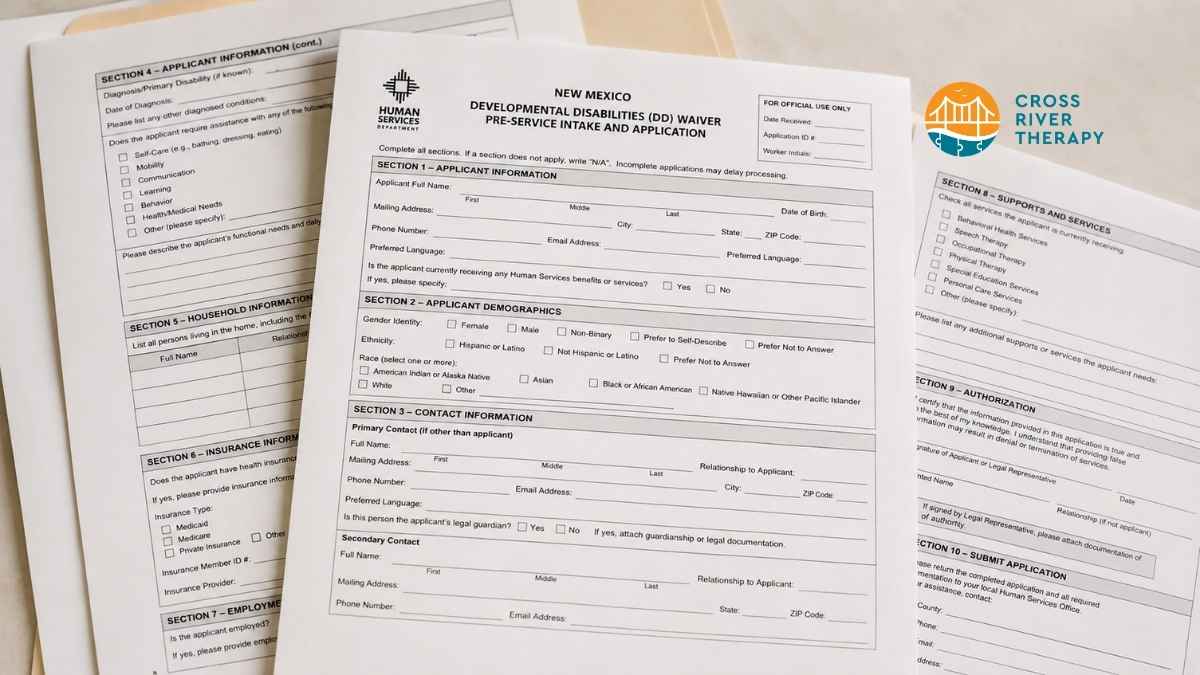
How to Apply for the New Mexico DD Waiver
Your NM DD waiver application starts with state intake. The steps cover records, submission, and enrollment.

Does Insurance Cover ABA Therapy in New Jersey?
ABA therapy insurance in New Jersey varies by plan. Learn what NJ FamilyCare covers and how to check costs.

How ABA Therapy Builds Communication for Nonverbal Children Without Forcing Speech
ABA therapy communication for nonverbal children starts with AAC, signs, and daily routines. See how kids ask, refuse, choose, and get help.

How to Start ABA Therapy in New Jersey With a Checklist
Your guide explains how to start ABA therapy in New Jersey. A first-call checklist covers records and next steps.

How to Get an Autism Evaluation in Arkansas Before Starting ABA Therapy
How to get an autism evaluation in Arkansas starts with a referral, provider choice, and key records. Use this parent checklist before ABA intake.