








The Role of Token Economies in At-Home ABA Therapy Programs
Enhancing Behavior Change through Tokens in Home-Based ABA


Understanding Token Economies in ABA
Token economies have become a cornerstone of Applied Behavior Analysis (ABA), especially in home therapy settings designed for children with autism and other neurodevelopmental conditions. These structured reinforcement systems are not just about rewarding positive behaviors; they are about fostering skills like patience, self-control, and independence. By systematically reinforcing desired actions through the use of tokens, practitioners can effectively encourage lasting behavioral change.
Implementing Token Economies at Home

Define Target Behaviors
To launch a token economy at home, begin by identifying specific target behaviors you want to encourage. This could include tasks like completing homework, using polite language, or helping with household chores. Clearly defined behaviors not only guide children but also provide a framework for consistency in reinforcement.
Create Tokens
Next, decide on the type of tokens you’ll use. Tokens can be anything from stickers and chips to points in a chart. The choice should resonate with the child, ensuring they feel motivated to earn them. Additionally, the tokens must be visually engaging to help the child recognize progress.
Establish Backup Reinforcers
Establish a menu of backup reinforcers that children can earn by exchanging their tokens. These could range from extra screen time to a favorite toy or activity. Ensure that the backup reinforcers are meaningful to the child, as this will increase their motivation to engage in the target behaviors.
Involve the Child
Finally, actively involve the child in the setup and operation of the token economy. Discuss the target behaviors, how they can earn tokens, and what they can exchange them for. This collaborative approach fosters ownership and makes it more likely they will engage positively with the system.
Token Economy Overview
To summarize, an effective token economy consists of three main components:
Component Description Importance Target Behaviors Specific actions that will earn tokens. Provides clarity in expectations. Tokens The visual symbols of achievement (stickers, points). Motivates children towards goals. Backup Reinforcers Items or privileges that can be traded for tokens. Enhances engagement and interest.
Implementing a token economy requires patience and consistency, but significantly contributes to positive behavior reinforcement in your home.
The Mechanics of Token Economies

Tokens as Secondary Reinforcers
In the context of Applied Behavior Analysis (ABA) therapy, tokens play a crucial role as secondary reinforcers. They are tangible items, such as stickers or chips, that children earn in exchange for displaying specific, targeted behaviors. This tangible recognition helps kids visualize their progress and motivates them to engage in positive actions. As tokens accumulate, they can later be exchanged for backup reinforcers like toys or activities that the child desires, enhancing the overall effectiveness of the reinforcement strategy.
Pairing Tokens with Backup Reinforcers
The success of a token economy heavily relies on the pairing of tokens with backup reinforcers. During the initial conditioning phase, tokens must be linked to valuable rewards, establishing their worth in the eyes of the child. Behavior Analysts typically define a menu of backup reinforcers that may include rewards such as breaks from instruction, edible treats, or leisure activities. This approach not only reinforces the desired behaviors but also ensures that the system remains engaging and motivating for the child.
Visual Token Boards
Visual aids, such as token boards, are essential in implementing effective token economies. These boards provide a visual representation of the tokens earned and the progress made towards earning backup reinforcers. By seeing their tokens accumulate, children can develop a sense of accomplishment, which aids in building self-esteem. This method not only clarifies expectations but also enhances the learning experience, allowing children to feel more involved and in control of their reinforcement journey.
Overall, the structured use of tokens in ABA therapy demonstrates significant potential in promoting behavior change and skill development.
Purposes and Benefits of Token Economies

What is the primary purpose of a token economy?
The primary purpose of a token economy is to provide a structured reinforcement strategy that encourages the increase of desirable behaviors while decreasing unwanted ones. In this system, individuals earn tokens as a reward for exhibiting specific target behaviors, which can later be exchanged for meaningful items or privileges, effectively serving as a form of currency.
Structure of reinforcement
Key components of a token economy include:
- Tokens: Any collectible item such as stickers or chips that participants earn.
- Target Behaviors: Clearly defined actions or skills participants are encouraged to exhibit.
- Backup Reinforcers: Meaningful items or activities that participants can exchange their tokens for.
Encouraging desirable behaviors
By offering immediate feedback in the form of tokens, token economies enhance motivation and engagement. They effectively promote consistent behavior management, making them beneficial in various contexts like schools and therapeutic settings.
Role of immediate feedback
Immediate feedback through token earning allows learners to visualize their progress and reinforces positive actions promptly. This structured method not only cultivates desirable skills—ranging from academic to social—but also fosters a sense of autonomy as children earn rewards based on their efforts.
Overall, successful implementation of token economies hinges on careful planning to ensure that target behaviors are well-defined, tokens are appealing, and backup reinforcers hold intrinsic value for the individuals involved.
Integrating ABA Principles in Token Economies

What are the seven dimensions of ABA as they relate to a token economy?
The seven dimensions of Applied Behavior Analysis (ABA) are essential in the design and implementation of token economies. Each dimension contributes uniquely to ensuring effectiveness and consistency in behavior reinforcement strategies.
- Applied: This dimension emphasizes that the interventions must concentrate on socially significant behaviors. For example, increasing positive behaviors in educational settings is crucial for fostering an engaging learning environment.
- Behavioral: The focus here is on observable and measurable actions. Tracking specific behaviors allows practitioners to precisely assess the impact of the token economy over time.
- Analytic: Data plays a crucial role in evaluating the effectiveness of a token economy. Continuous monitoring allows analysts to determine if the intervention is successful in fostering behavioral changes.
- Technological: This involves providing a clear, detailed explanation of how the token economy is structured and administered, making it replicable across different environments.
- Conceptually Systematic: The token economy must be rooted in established behavioral principles, ensuring that all practices align with ABA theory and best practices.
- Effective: It’s important that the token economy leads to significant behavioral changes, ensuring that outcomes are meaningful for children’s development.
- Generality: The behaviors reinforced through token economies should be maintainable across various settings and situations, highlighting the importance of versatility in reinforcement strategies.
Systematic approach to implementing token economies
A systematic and structured approach is vital for the effective application of token economies. Behavior Analysts begin by defining specific target behaviors, which aids in creating clarity and focus for all involved. They also prepare a range of tokens, such as stickers or chips, to serve as tangible motivators.
Additionally, establishing a menu of backup reinforcers is crucial. These can include candies, breaks from work, or enjoyable activities. This menu enhances the attractiveness of engaging in the desired behaviors, as children can work towards rewards that genuinely interest them.
Using data for efficacy
Monitoring the progress of a token economy through data collection is a fundamental practice. By regularly analyzing behavioral outcomes and the effectiveness of tokens as reinforcers, practitioners can make informed adjustments to the system.
For example, if certain tokens fail to motivate, the data may indicate the need to revise the list of backup reinforcers. Having this data-centric approach ensures that token economies not only motivate but also enhance children’s learning and development in a meaningful way.
Challenges and Ethical Considerations
What are some challenges of using a token system in naturalistic interventions?
Implementing a token system in naturalistic interventions presents several challenges.
Maintaining consistency is one of the primary hurdles. In dynamic environments, it can be tough to ensure that tokens are used uniformly by different team members. Inconsistent application may lead to confusion for the child, undermining the effectiveness of the reinforcement strategy.
Ensuring meaningful rewards is also a significant concern. Children’s interests can change rapidly, so the rewards tied to tokens must be regularly evaluated. What motivates a child today might not have the same effect tomorrow. It's vital to keep the reinforcement options fresh and exciting to maintain engagement.
Effectively adapting to individual needs is another challenge. Introducing and teaching the token system requires careful planning and flexibility. Children may require unique adjustments to the token economy to align it with their preferences and learning styles. This adaptation process can complicate the implementation and requires ongoing communication among team members.
Finally, there is variability in children’s responses to different types of reinforcement. This inconsistency makes it challenging to apply traditional token economy principles uniformly. A successful implementation strategy must be adaptable to each child’s unique behavioral patterns and preferences.
ChallengeDescriptionImpact Maintaining consistency Difficulty in uniform token application across environments Confusion and loss of reinforcement effectiveness Ensuring meaningful rewards Changing interests lead to ineffectual reinforcement Reduced motivation and engagement Adapting to individual needs Requires careful planning and flexibility Complicates engagement and implementation efforts
Maximizing Benefits of Token Economies
Token economies, when carefully implemented and consistently monitored, offer a proven strategy for reinforcing positive behavior in home-based ABA therapy programs. As these systems promote a clear and structured approach to learning, they empower children by facilitating autonomy and boosting confidence. By understanding and addressing the potential challenges and ensuring ethical practices, caregivers and practitioners can enhance their effectiveness, contributing to positive developmental outcomes for children engaged in ABA therapy.
References
- Token Economy: Examples and Applications in ABA
- Token Economy ABA – Systems & Uses in Therapy - CentralReach
- How to Implement a Token Economy in ABA Therapy
- Common Practices used to Establish and Implement Token ...
- The Power of Token Economies - How to ABA
- How to Implement & Use Token Boards - How to ABA
- Using Token Systems in ABA for Kids - ABATherapistJobs.com
- The Power of Token Economies - How to ABA
Recent News
Related articles

6 Arkansas Medicaid ABA Therapy Rules Families Need to Know
Arkansas Medicaid ABA therapy has age, diagnosis and approval rules. Families can check six requirements before care.

Arizona Autism Laws Every Parent Should Know Before Starting ABA Therapy
Autism laws Arizona parents should know cover ABA insurance, AHCCCS appeals, IEPs, and Section 504 rights. Check ABA coverage with Cross River.

ABA Therapist Salary in Arkansas: What BCBAs and RBTs Actually Earn in 2026
ABA therapist salary Arkansas figures compare RBT and BCBA rates, benefits, guaranteed hours, and contract terms. Explore careers at Cross River.

5 Autism Support Groups and Family Resources in New Mexico Alongside ABA Therapy
Autism support groups New Mexico families can use offer peer support, local events, and school help. Cross River can explain ABA therapy options.

Where to Get an Autism Evaluation in New Mexico Before Starting ABA Therapy
Autism evaluation New Mexico options include UNM, NMSU, FIT, and private providers. Compare providers, records, and ABA steps with Cross River.

7 North Carolina Autism Resources to Contact Before ABA Therapy Starts
Autism resources North Carolina families can call for diagnosis, early intervention, rights, and parent support. Start ABA intake with Cross River.

Does Indiana Medicaid Cover ABA Therapy? A Step-by-Step Eligibility Checklist for Parents
Medicaid ABA therapy Indiana covers eligible children under 21 with prior authorization. Your five-step coverage review can start with Cross River.
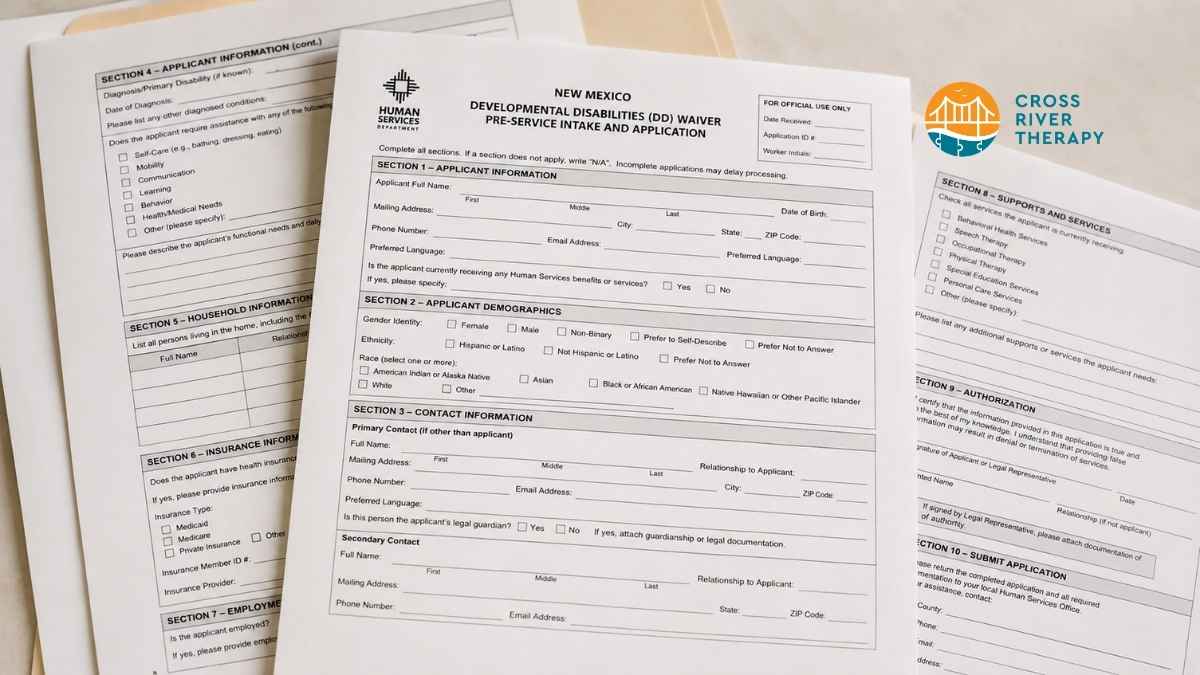
How to Apply for New Mexico’s DD Waiver While Starting ABA Therapy
Autism waiver New Mexico applications need DD Waiver records and proof of daily support needs. Your next step is to start ABA intake with Cross River.

Is ABA Therapy Covered by Insurance in New Jersey? What Every Parent Should Know
ABA therapy insurance New Jersey may cover medically necessary care based on plan type, network, and authorization. Verify benefits with Cross River.

How ABA Therapy Builds Communication for Nonverbal Children Without Forcing Speech
ABA therapy communication for nonverbal children starts with AAC, signs, and daily routines. See how kids ask, refuse, choose, and get help.

How to Start ABA Therapy in New Jersey With a First-Call Checklist
How to start ABA therapy in New Jersey begins with records, insurance details, and intake questions. Use this first-call checklist before you call.

How to Get an Autism Evaluation in Arkansas Before Starting ABA Therapy
How to get an autism evaluation in Arkansas starts with a referral, provider choice, and key records. Use this parent checklist before ABA intake.