








The role of token economies in behavior support plans
Harnessing Incentives: The Power of Token Economies in Behavioral Interventions


Understanding the Fundamentals of Token Economies in Behavior Support
Token economies are a widely utilized reinforcement strategy within applied behavior analysis (ABA) that have demonstrated significant effectiveness in both clinical and educational settings. Rooted in operant conditioning principles, these systems leverage tokens or points as conditioned reinforcers, which serve to modify and sustain desirable behaviors among diverse populations, including children with developmental disabilities and individuals with autism. This article explores the components, implementation, benefits, and theoretical underpinnings of token economies, highlighting their critical role in shaping positive behavior change.
Core Components and Structural Elements of Token Economies

What is a token economy and how is it used in behavior support plans?
A token economy is a system used within behavior analysis to promote desired behaviors by awarding tokens—small, tangible symbols such as stars, coins, or stickers—that individuals earn when they exhibit specific target behaviors. These tokens act as conditioned reinforcers, meaning their value is established through association with primary reinforcers like food or privileges. The tokens can later be exchanged for backup reinforcers, such as toys, snacks, or activities, which are highly motivating for the individual.
This approach is widely applied in various settings, including schools, mental health facilities, and therapeutic programs. It helps to shape behavior, encourage engagement, and reinforce learning by providing immediate and visible feedback. The system requires clear guidelines, consistency, and a structured process for earning and exchanging tokens, making it an effective method for behavior support plans.
Despite its many benefits, practitioners should be cautious about over-relying on external rewards, which can diminish intrinsic motivation over time. Proper implementation and gradual transition to natural reinforcement are crucial for long-term success.
What are the components and structure of a token economy system?
A typical token economy system includes three major components: target behaviors, tokens as conditioned reinforcers, and backup reinforcers for exchange. Each part plays a vital role in the system’s effectiveness.
Target Behaviors: These are specific actions or skills that are the focus of the intervention. They should be clear, measurable, and appropriate for the individual’s developmental level.
Tokens: These tangible symbols can be coins, stickers, or points, which individuals earn immediately after demonstrating target behaviors. They are conditioned reinforcers because their value is established through consistent pairing with primary or other secondary reinforcers.
Backup Reinforcers: These are the preferred items, privileges, or activities that tokens can be exchanged for once a certain number is accumulated. Examples include a small toy, extra recess time, or a favorite snack.
Exchange Protocols: The system specifies when and how tokens are exchanged, often using schedules such as fixed ratio or interval reinforcement.
Fading Strategies: Over time, the goal is to reduce dependency on tokens by gradually increasing natural reinforcers and reinforcing internal motivation.
Display and Monitoring: Visual aids like token boards or charts help track progress and maintain clarity.
How are token economies implemented in practice?
Implementation begins with identifying the target behaviors relevant to the individual’s needs. After selecting tokens that are meaningful and motivating—including conducting preference assessments—the practitioner establishes specific criteria for earning tokens.
A visual or physical system, such as a token board, helps reinforce behaviors clearly and consistently. The schedule for earning tokens can be fixed (e.g., one token per behavior occurrence) or variable, depending on goals.
Backup reinforcers are also identified based on individual preferences; these are kept accessible and are often limited outside the reinforcement sessions to maintain their high value.
During execution, reinforcement consistency is crucial. Staff should deliver tokens immediately following appropriate behavior, and the exchange process should be straightforward and frequent enough to motivate continued effort.
Monitoring progress allows for data collection and adjustments as needed. Once behaviors are established or the goal is achieved, strategies such as fading or increasing natural reinforcers help transition away from reliance on tokens.
What are the benefits of using token economies in behavior management?
Token economies are highly effective in increasing desirable behaviors and reducing unwanted ones by providing immediate, tangible rewards for positive actions. Their visual and systematic nature stimulates motivation and engagement, especially in individuals with developmental disabilities or behavioral challenges.
They are adaptable to individual needs, allowing adjustments in the types of tokens, reinforcement schedules, and reinforcement choices. As a form of generalized conditioned reinforcement, tokens can be used across different settings and times, promoting consistency.
When implemented correctly, they support skill development, promote delayed gratification, and aid in behavior maintenance. Furthermore, they help create a structured environment where behavioral expectations are clear, assisting both learners and caregivers.
What are common strategies and best practices when developing a token economy system?
Developing an effective token economy involves several best practices:
- Define Target Behaviors Clearly: Use observable and measurable behaviors.
- Select Meaningful Tokens: Choose tokens that are motivating and easy to deliver, such as stickers or digital points.
- Identify Reinforcers Through Preference Assessments: Find backup items that are highly preferred.
- Create a Consistent Schedule: Decide on earning and exchange routines, like fixed or variable schedules.
- Limit the Number of Reinforcement Targets: Focus on a manageable set of behaviors to avoid confusion.
- Use Visual Aids: Charts, token boards, and tally sheets enhance clarity.
- Monitor and Adjust Regularly: Collect data to evaluate progress and make necessary modifications.
- Plan for Fading: Develop strategies to gradually reduce token use and promote intrinsic motivation and natural reinforcement.
What is the theoretical background and evidence supporting the use of token economies?
The foundation of token economies is rooted in operant conditioning, a behavioral theory developed by B.F. Skinner. Empirical research demonstrates that tokens act as conditioned reinforcers because they acquire value through their association with primary reinforcers like food or social approval.
Laboratory studies with animals and extensive applied research—including in classrooms, hospitals, and clinics—show that token systems effectively modify behaviors. They utilize reinforcement schedules like fixed ratio or interval to maintain behavior change.
Research indicates that tokens can be generalized across settings and behavior domains, supporting their versatility.
Overall, a substantial body of evidence affirms that token economies are grounded in sound behavioral principles and are effective tools for behavior management when implemented systematically.
Maximizing Long-Term Success with Token Economies
While token economies are potent tools for behavior modification, their success hinges on thoughtful implementation and strategic fading. Emphasizing natural reinforcers, reducing dependency, and ensuring consistency across staff and settings are essential for long-lasting behavioral change. Collaborating with behavior analysts and following evidence-based guidelines can further enhance system effectiveness, ultimately fostering sustainable development of desirable habits that align with individualized goals.
References
- The Power of Token Economies - How to ABA
- Use Token Economies to Provide Positive Reinforcement and ...
- Common Practices used to Establish and Implement Token ...
- Token Economy Study: Smith et al. (1988)
- How to Use Token Economies for Lasting Behavior Change
- Token Economies: How to Use Them Effectively in ABA
- Token Economy | EBSCO Research Starters
Recent News
Related articles

6 Arkansas Medicaid ABA Therapy Rules Families Need to Know
Arkansas Medicaid ABA therapy has age, diagnosis and approval rules. Families can check six requirements before care.

Arizona Autism Laws for ABA Coverage and School Rights
Arizona autism laws for ABA coverage vary by plan. Families can check insurance, appeal options, and school rights.

ABA Therapist Salary in Arkansas for RBTs and BCBAs
Compare ABA therapist salary in Arkansas by role. See how paid hours and benefits affect earnings before applying.

5 Autism Support Groups and Family Resources in New Mexico
Autism support groups in New Mexico connect families. Local resources offer events, parent support, and school help.

Where to Get an Autism Evaluation in New Mexico
Autism evaluation options in New Mexico include UNM and NMSU. Age and referral details help parents prepare.

7 North Carolina Autism Resources to Contact Before ABA Therapy Starts
Autism resources North Carolina families can call for diagnosis, early intervention, rights, and parent support. Start ABA intake with Cross River.

Does Indiana Medicaid Cover ABA Therapy? A Parent Checklist
Indiana Medicaid ABA therapy may cover care for eligible children. The checklist covers coaching and renewals.
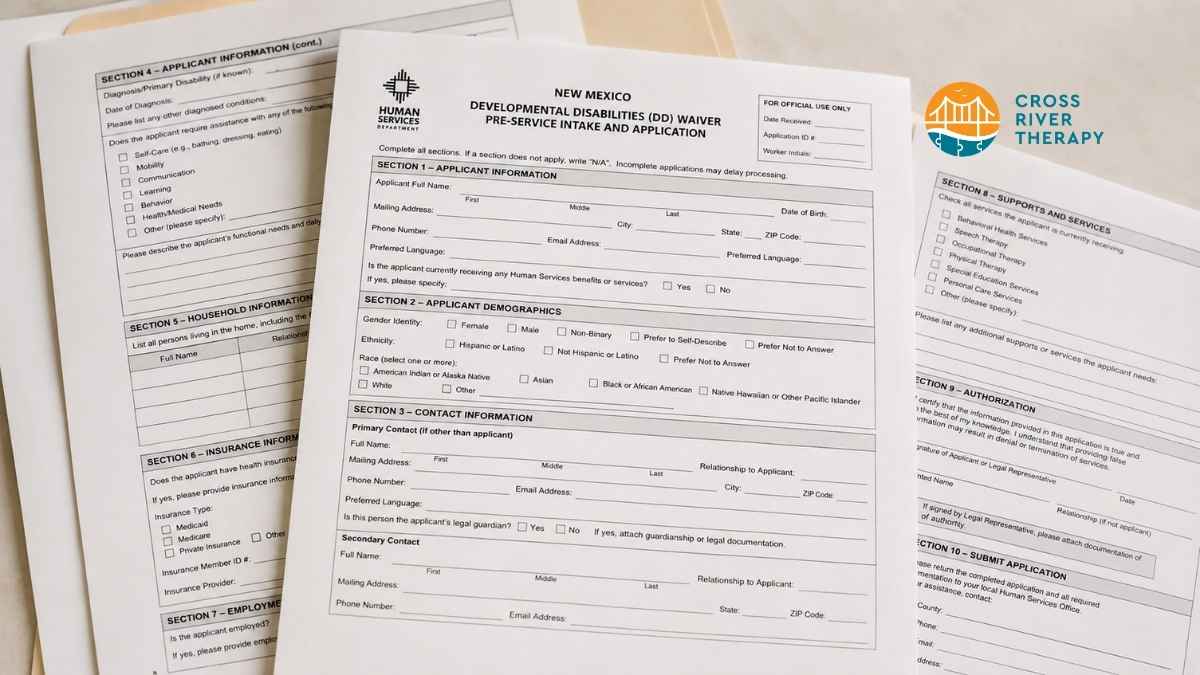
How to Apply for the New Mexico DD Waiver
Your NM DD waiver application starts with state intake. The steps cover records, submission, and enrollment.

Does Insurance Cover ABA Therapy in New Jersey?
ABA therapy insurance in New Jersey varies by plan. Learn what NJ FamilyCare covers and how to check costs.

How ABA Therapy Builds Communication for Nonverbal Children Without Forcing Speech
ABA therapy communication for nonverbal children starts with AAC, signs, and daily routines. See how kids ask, refuse, choose, and get help.

How to Start ABA Therapy in New Jersey With a Checklist
Your guide explains how to start ABA therapy in New Jersey. A first-call checklist covers records and next steps.

How to Get an Autism Evaluation in Arkansas Before Starting ABA Therapy
How to get an autism evaluation in Arkansas starts with a referral, provider choice, and key records. Use this parent checklist before ABA intake.