








Understanding Autism Learning Styles
Exploring the Diverse Learning Styles in Autism


Introduction to Autism and Learning Styles
Autism spectrum disorder (ASD) presents unique challenges and opportunities in the educational landscape. Understanding how learning styles—namely visual, auditory, and kinesthetic—affect autistic individuals is essential in crafting effective teaching strategies that cater to their specific needs. This narrative aims to explore these learning styles, the implications for educational methods, and how educators and parents can support autistic learners.
Fundamentals of Learning Styles and Their Impact
What are the main learning styles?
Learning styles refer to the different ways individuals prefer to understand and retain information. The four predominant learning styles, as defined by the VARK model, are Visual, Auditory, Read/Write, and Kinesthetic.
- Visual Learners benefit from diagrams, images, and visual aids like charts and videos to grasp complex concepts. They often think in pictures and can retain information better when it's presented visually.
- Auditory Learners thrive on verbal discussions, lectures, and listening to audiobooks. They often remember information better when it’s conveyed through sound, which includes instructions given orally.
- Read/Write Learners excel through reading and writing activities, preferring to take notes or engage with text-based materials.
- Kinesthetic Learners engage best through hands-on experiences, requiring movement and physical interaction with the material to enhance their learning process.
By understanding these styles, educators can tailor their teaching strategies to better meet the unique needs of their students.
Prevalence of learning styles among autistic students
Many autistic students often display a distinct preference for one primary learning style. For instance, research indicates that visual learning is particularly effective for many individuals on the autism spectrum, who benefit from the use of visual aids such as charts and diagrams. However, it’s essential to recognize that learning preferences among autistic learners can vary significantly.
Impact of learning styles on education
Using effective teaching methods aligned with a student’s preferred learning style has a profound impact on educational outcomes. When educators incorporate visual, auditory, and kinesthetic elements into their lessons, they increase engagement and retention in learning activities. Tailoring educational approaches enables autistic learners to process information more effectively and reduces obstacles to understanding, ultimately fostering a more supportive learning environment.
Learning Preferences in Autistic Individuals
What learning styles are common among autistic students?
Common learning styles among autistic students include visual, auditory, and kinesthetic styles.
Visual Learning: Many autistic learners prefer visual styles, where they process information better through visual aids like charts, pictures, and videos. For example, visual learners often benefit from structured visual schedules, which help them grasp abstract concepts and improve memory retention.
Auditory Learning: Auditory learners thrive in environments rich with sounds, preferring to listen to spoken instructions and engage in discussions. They may excel in settings where auditory input is combined with other learning methods to enhance comprehension.
Kinesthetic Learning: Kinesthetic learners are known for their hands-on approach, where movement and physical engagement enhance their learning experiences. Activities such as crafts, building projects, and role-playing allow these learners to connect with information more effectively.
Recognizing each child's primary learning style becomes essential for tailoring educational approaches. By aligning teaching methods with these preferences, educators can significantly enhance learning outcomes. Incorporating a variety of teaching techniques that address all three styles can also support the diverse learning needs in an autistic classroom.
Understanding the Learning Theory of Autism
What is the learning theory of autism?
The learning theory of autism, especially the atypical learning theory, highlights two distinct approaches: lookup table (LUT) learning and interpolation (INT) learning. Autistic individuals often lean towards LUT learning, which focuses on precisely memorizing experiences without extracting broader patterns. In contrast, neurotypical individuals tend to use INT learning, which enables them to generalize from their experiences.
This fundamental distinction sheds light on various autistic behaviors, including sensory overload, restricted interests, and difficulties in social interactions. LUT learners excel in tasks that require precise, localized knowledge, such as rote memorization. However, they may struggle in situations that necessitate adaptability and broader context understanding.
Research supports this theory, showing that individuals with autism demonstrate strong abilities in localized tasks but face challenges in complex scenarios that demand generalization. Recent findings have also indicated no significant deficits in predictive processing in autistic learners, reinforcing the idea that cognitive differences should be viewed as variations in preferences rather than deficits in capabilities.
Exploration of LUT vs. INT learning
The contrast between LUT and INT learning plays a pivotal role in shaping the educational strategies tailored to support autistic learners. Recognizing that many may not naturally generalize information can guide educators in providing structured and explicit learning experiences. Understanding this can ultimately foster engagement and improve educational outcomes, illustrating the importance of individualized approaches in teaching.
Characteristics of Autistic Learners
What are the learning characteristics of autistic students?
Autistic students present a diverse array of learning characteristics influenced by their unique cognitive profiles. They often exhibit challenges in social communication, such as difficulty making eye contact, initiating joint attention, and engaging in reciprocal conversation. This can lead to misunderstandings and communication breakdowns, particularly in mixed groups of autistic and neurotypical individuals.
In terms of language, many autistic individuals may experience delayed vocabulary development and have difficulties grasping abstract concepts. Some may engage in echolalia, where they repeat phrases or conversations heard previously, reflecting their distinct speech patterns. Despite these challenges, many students with ASD excel in rote memory tasks. However, they can struggle with working memory and organizational skills essential for academic success.
Sensory processing differences are prevalent among autistic learners; they may become overwhelmed by bright lights, loud noises, or crowded environments. This can significantly impact their ability to concentrate and participate in classroom activities. Furthermore, executive functioning challenges often complicate task initiation and management, necessitating structured routines and clear expectations.
Understanding these attributes is vital for educators and parents to create effective learning environments tailored to the needs of autistic individuals, allowing them to leverage their strengths while supporting their challenges.
Effective Educational Strategies for Autistic Learners
How can educators support autistic students in learning?
Educators can support autistic students in learning by fostering a calm and structured classroom environment. This approach promotes appropriate behavior and significantly reduces anxiety. Understanding each student's unique preferences and needs through individualized 'About Me' sheets allows teachers to tailor learning strategies accordingly.
Strategies to Enhance Learning
One effective strategy includes the use of visual schedules, which help clarify daily routines and expectations. Providing clear, concrete instructions further aids comprehension and allows students to process information more effectively. By incorporating visual aids, such as charts and diagrams, educators can boost engagement for those who learn best visually.
Encouraging Social Skills
Involving students in group activities and implementing buddy systems can promote social skill development and acceptance. Such interactions provide opportunities for autistic students to navigate social environments positively, supporting their growth and integration.
Supporting Sensory Needs
Creating sensory-friendly spaces in the classroom is crucial for helping students manage sensory overload. Tools like fidget toys, noise-canceling headphones, and designated quiet areas encourage focus and comfort, leading to an overall boost in engagement and learning outcomes.
The Role of Individualized Education
Ultimately, recognizing that each autistic learner is unique is essential. Individualized Education Plans (IEPs) can be tailored to meet the specific learning styles—be it visual, auditory, or kinesthetic—of each student, ensuring that educators provide the best possible support in their academic journeys.
Enhancing Educational Experiences with Tailored Strategies
What strategies can enhance learning experiences for autistic children?
To enhance learning experiences for autistic children, it's crucial to identify their preferred learning styles, which may include visual, auditory, kinesthetic, or reading/writing approaches. Tailoring instruction to these preferences can improve engagement and comprehension.
- Visual Learners: These individuals benefit from diagrams, charts, and other visual aids that help simplify complex topics and enhance memory retention. For example, using visual schedules can provide clarity and structure in their learning environment.
- Auditory Learners: These students thrive when information is delivered through sound. They may excel in activities like discussions and storytelling. Strategies such as using audiobooks or peer group discussions are effective in supporting their learning process.
- Kinesthetic Learners: These learners engage best through hands-on activities. Incorporating movement, such as through educational games, experiments, or tactile learning, allows them to connect concepts through real-world experiences.
Incorporating diverse teaching methods is essential. For instance, employing techniques like video modeling, graphic organizers, and assistive devices can cater to the various strengths and needs of autistic individuals. Ultimately, individualized education strategies that reflect each child's unique learning style lead to better academic outcomes and reduced classroom challenges.
Conclusion
Understanding and implementing strategies that cater to the diverse learning styles of autistic individuals can transform educational experiences, leading to more effective learning outcomes. By embracing the uniqueness of each learner and employing individualized strategies, parents and educators can greatly enhance the educational journey for autistic children. Such approaches not only foster academic success but also promote personal growth and improved social interactions.
References
- Learning Styles & Autism
- The Learning Styles of Children with Autism Spectrum Disorder
- A Learning-Style Theory for Understanding Autistic Behaviors - PMC
- Autism and Learning - What You Need to Know - Harkla
- Learning Styles Fact Sheet - Pathfinders for Autism
- How Different Learning Styles Impact Autistic Students - Mansfield Hall
- Learning Styles of Children with Autism Spectrum Disorder (ASD)
- The Learning Styles of Autism - Deron School
Recent News
Related articles

6 Arkansas Medicaid ABA Therapy Rules Families Need to Know
Arkansas Medicaid ABA therapy has age, diagnosis and approval rules. Families can check six requirements before care.

Arizona Autism Laws Every Parent Should Know Before Starting ABA Therapy
Autism laws Arizona parents should know cover ABA insurance, AHCCCS appeals, IEPs, and Section 504 rights. Check ABA coverage with Cross River.

ABA Therapist Salary in Arkansas: What BCBAs and RBTs Actually Earn in 2026
ABA therapist salary Arkansas figures compare RBT and BCBA rates, benefits, guaranteed hours, and contract terms. Explore careers at Cross River.

5 Autism Support Groups and Family Resources in New Mexico Alongside ABA Therapy
Autism support groups New Mexico families can use offer peer support, local events, and school help. Cross River can explain ABA therapy options.

Where to Get an Autism Evaluation in New Mexico Before Starting ABA Therapy
Autism evaluation New Mexico options include UNM, NMSU, FIT, and private providers. Compare providers, records, and ABA steps with Cross River.

7 North Carolina Autism Resources to Contact Before ABA Therapy Starts
Autism resources North Carolina families can call for diagnosis, early intervention, rights, and parent support. Start ABA intake with Cross River.

Does Indiana Medicaid Cover ABA Therapy? A Step-by-Step Eligibility Checklist for Parents
Medicaid ABA therapy Indiana covers eligible children under 21 with prior authorization. Your five-step coverage review can start with Cross River.
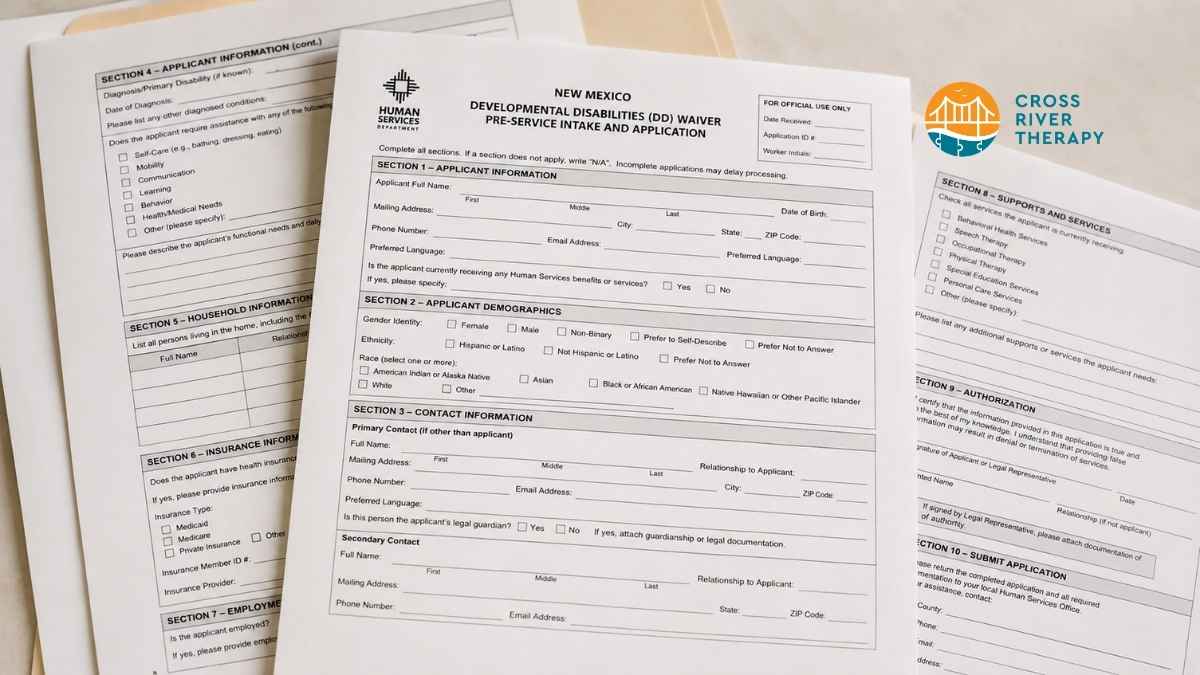
How to Apply for New Mexico’s DD Waiver While Starting ABA Therapy
Autism waiver New Mexico applications need DD Waiver records and proof of daily support needs. Your next step is to start ABA intake with Cross River.

Is ABA Therapy Covered by Insurance in New Jersey? What Every Parent Should Know
ABA therapy insurance New Jersey may cover medically necessary care based on plan type, network, and authorization. Verify benefits with Cross River.

How ABA Therapy Builds Communication for Nonverbal Children Without Forcing Speech
ABA therapy communication for nonverbal children starts with AAC, signs, and daily routines. See how kids ask, refuse, choose, and get help.

How to Start ABA Therapy in New Jersey With a First-Call Checklist
How to start ABA therapy in New Jersey begins with records, insurance details, and intake questions. Use this first-call checklist before you call.

How to Get an Autism Evaluation in Arkansas Before Starting ABA Therapy
How to get an autism evaluation in Arkansas starts with a referral, provider choice, and key records. Use this parent checklist before ABA intake.