








Understanding the ABCs of behavior in ABA therapy
Decoding Behavior through the ABCs in ABA Therapy


A Fundamental Framework for Behavior Analysis
Applied Behavior Analysis (ABA) is a proven, scientific approach that utilizes the ABC model—Antecedent, Behavior, and Consequence—to understand and influence behavior. This article explores how this model functions as the cornerstone of behavior analysis, supporting individuals, especially children with autism, in developing essential skills and managing challenging behaviors. By delving into core principles, methods of data collection, and practical examples, readers will gain comprehensive insights into the mechanisms that drive positive behavioral change.
Core Principles of Behavior Analysis in ABA Therapy
What are the core principles of behavior analysis in ABA therapy?
The foundation of ABA therapy rests on a set of scientific principles that focus on understanding and influencing behavior through environmental interactions. Central to this approach is the concept of reinforcement, which can be positive or negative, used to encourage desirable behaviors. Positive reinforcement involves rewarding a behavior to increase its likelihood, such as giving praise or a small reward when a child successfully completes a task. Negative reinforcement, on the other hand, removes an unpleasant stimulus after a behavior, like reducing a task after a child's consistent effort.
While reinforcement promotes positive change, punishment can decrease undesirable behaviors. However, in ABA practice, punishment is used cautiously due to potential negative side effects. Therapists carefully evaluate whether and how to implement punitive measures, favoring reinforcement-based strategies whenever possible.
In addition to reinforcement and punishment, ABA employs techniques such as shaping, prompting, fading, and task analysis. Shaping involves reinforcing successive approximations of a target behavior, gradually guiding the individual towards the desired skill. Prompting provides cues or assistance to encourage correct responses, which are systematically faded to foster independence. Task analysis breaks complex skills into smaller, manageable components, making learning more accessible.
Data collection and analysis play a vital role in ABA. Practitioners meticulously record behavior patterns using checklists and observation notes. This data helps identify triggers, monitor progress, and adjust interventions for maximum effectiveness.
Another crucial aspect is the generalization of skills. Teaching is designed to ensure that learned behaviors transfer across different settings, people, and situations, promoting adaptive functioning in daily life.
Finally, ABA emphasizes individualized intervention plans. Each program is tailored based on comprehensive assessments and ongoing data, ensuring the strategies meet the unique needs of the individual. Licensed professionals such as Board-Certified Behavior Analysts (BCBAs) oversee and refine these plans to optimize outcomes.
| Principle | Description | Example |
|---|---|---|
| Reinforcement | Increases desired behaviors | Praising a child for sharing toys |
| Punishment | Decreases undesired behaviors | Time-out for tantrums |
| Shaping | Reinforcing successive steps towards a goal | Teaching handwriting by reinforcing each stroke |
| Prompting | Providing cues to assist learning | Hand-over-hand guidance during dressing |
| Fading | Gradually reducing prompts | Slowly removing physical assistance |
| Task Analysis | Breaking skills into steps | Teaching brushing teeth step-by-step |
| Data Collection | Tracking behaviors | Recording frequency of tantrums |
| Generalization | Applying skills broadly | Using social skills learned at therapy in school |
| Individualized Plans | Custom strategies for each person | Tailored communication goals for a non-verbal child |
ABA's core principles form a comprehensive framework that facilitates meaningful behavioral change. By systematically applying these strategies, practitioners can help individuals develop essential skills and reduce problematic behaviors, leading to improved quality of life and greater independence.
The ABCs Model: A Foundation for Behavior Analysis
What is the ABCs model in behavior analysis?
The ABCs model is a simple yet powerful tool used in behavior analysis to understand and change behaviors. It stands for Antecedents, Behaviors, and Consequences. This model helps practitioners and parents analyze what happens before, during, and after a behavior to see why it occurs and how it can be influenced.
In practice, the model looks at three main components:
- Antecedent: What occurs right before the behavior? This can include requests, environmental changes, or specific stimuli.
- Behavior: The actual action performed by the individual, which can be talking, crying, or any observable response.
- Consequence: What follows the behavior? This might be praise, a warning, or even ignoring the behavior.
By examining these parts, professionals and caregivers can identify triggers and reinforcements that maintain or reduce certain behaviors.
Role of antecedents, behaviors, and consequences
Understanding each element of the ABCs is crucial for effective behavior management. Antecedents set the stage for the behavior, often acting as triggers. For example, a child may tantrum when told "no" (the antecedent).
The behavior itself is what we observe happening—such as a child throwing objects or yelling. This is the action that needs to be understood and, if necessary, modified.
The consequences are what happen after the behavior and play a critical role in future behaviors. If a child's tantrum results in desired items being handed over, this consequence reinforces the tantrum as a way to get what they want.
Positive reinforcement occurs when the outcome encourages the behavior to repeat, like praise or rewards. Conversely, negative outcomes or ignoring behaviors can discourage them.
Guiding principle for behavior modification
The core idea behind the ABC model is that behaviors are influenced by their environment, especially what happens directly before and after the behavior.
Interventions using this model aim to change antecedents or consequences to promote desired behaviors. For instance, if a child yells to gain attention, caregivers can modify the antecedent by teaching alternative ways to ask for attention.
Similarly, changing consequences—such as providing praise for quiet responses—can increase positive behaviors.
This model helps tailor strategies that are personalized, practical, and effective for long-term change.
Identifying patterns through ABC data
Collecting ABC data involves observing and recording what happens before, during, and after a behavior. This can be done through simple checklists or notes.
For example, a therapist might note that a child bites when asked to do homework (antecedent), bites during the activity (behavior), and then is ignored (consequence). Repeating this over time helps to spot patterns.
These patterns reveal the function of behaviors—whether they are to gain attention, escape a task, or obtain a preferred item—which guides planning interventions.
Here’s a simplified table to summarize these components:
| Component | Description | Example |
|---|---|---|
| Antecedent | What happens before the behavior; triggers it | Being told "no" to a request |
| Behavior | The observable action | Child yelling loudly |
| Consequence | What happens afterward; reinforcement or punishment | Parent gives attention to stop yelling |
Understanding and applying the ABC model plays a vital role in behavior analysis, guiding effective intervention strategies and improving outcomes for individuals with behavioral challenges.
Examples and Application of the ABCs Model
The ABC model in ABA therapy is a practical framework used to understand and modify behaviors by analyzing three core components: Antecedent, Behavior, and Consequence. Recognizing common examples of these components can greatly enhance intervention strategies.
Common antecedents, behaviors, and consequences can range widely depending on the situation. Antecedents are events or stimuli that occur before a behavior, acting as triggers. For instance, a teacher giving a directive, such as “Please sit down,” or a sudden loud noise nearby serve as antecedents. Behaviors are the observable responses to these antecedents. They can be as simple as a child raising their hand to answer or as complex as a child throwing a tantrum when frustrated. Consequences follow behaviors and influence their future occurrence. Positive consequences, like praise or a reward, reinforce desirable behaviors, while negative consequences, such as a time-out or ignoring, aim to reduce unwanted behaviors.
Real-world scenarios demonstrating ABC analysis are abundant in both school and home settings. Suppose a child is denied access to a toy (antecedent), leading to a tantrum (behavior). The parent might then comfort the child or simply ignore the tantrum (consequence). Depending on the response, this can either reinforce or discourage that tantrum behavior. In a classroom, an instructor’s prompt to start an activity (antecedent) might result in a student beginning work (behavior). If the student is praised or rewarded afterward (consequence), they are more likely to respond similarly in the future. Collecting this ABC data systematically allows caregivers and professionals to identify patterns and develop targeted strategies.
Use in behavior management and intervention planning involves modifying antecedents and consequences to shape behaviors positively. For example, if a child tends to act out when asked to do chores, changing the antecedent by providing a clear, step-by-step instruction can make compliance more likely. After the behavior, providing a reinforcement like praise or a preferred activity increases the chance of the positive behavior recurring. Conversely, withholding reinforcement for negative behavior (extinction) can decrease its frequency over time.
The table below summarizes typical examples of ABC components in real settings:
| Scenario | Antecedent | Behavior | Consequence | Purpose |
|---|---|---|---|---|
| Child refuses to eat vegetables | Parent asks to eat vegetables | Child pushes plate away | Parent verbally prompts again or ignores | To teach and reinforce acceptance of healthy foods |
| Student completes a test successfully | Teacher offers encouragement and a timer | Student hands in test | Teacher praises or grades the work positively | To reinforce effort and task completion |
| Child hits sibling in anger | Sibling takes toy without asking | Child hits sibling | Parent intervenes with time-out or redirects | To decrease aggressive actions |
Understanding the ABC model’s practical applications allows therapists, parents, and educators to strategically intervene, promoting positive behaviors and reducing challenging ones. By observing and recording patterns, and then systematically adjusting antecedents and consequences, behavioral changes are more effectively achieved. Consistent use of this model is essential for long-term success and skill development, especially in children with autism.
For further insights and real-life examples, searching for
The Role of Data Collection and Analysis in ABA
What are some effective methods for data collection in ABA?
In Applied Behavior Analysis (ABA), collecting accurate and detailed data is essential to understanding behavior and measuring progress. There are various methods used depending on the behavior and setting.
Continuous Data Collection: This approach involves recording every instance of a behavior during a specified period. Common techniques include:
- Frequency Counting: Tallying how often a behavior occurs.
- Rate Recording: Counting behaviors per unit of time.
- Duration Recording: Measuring how long a behavior lasts.
- Latency Recording: Timing the interval between an antecedent and the behavior.
Discontinuous Data Collection: These methods sample behaviors at specific times or intervals, which can be more practical for less frequent behaviors or longer observation periods. Techniques include:
- Interval Recording: Dividing observation time into intervals, recording whether the behavior occurs in each.
- Time Sampling: Observing at predetermined moments or intervals.
- ABC Data Collection: Documenting antecedents, behaviors, and consequences to analyze the function of behaviors.
Task Analysis and Scatterplot Analysis:
- Task Analysis breaks complex behaviors into smaller, manageable steps, making it easier to track progress in skill acquisition.
- Scatterplot Analysis visually displays behavioral data over days or months, helping identify patterns, trends, and environmental influences.
How does real-time data differ from summarized data?
Real-time data collection involves recording information immediately as behaviors happen. This method provides highly accurate and detailed insights, enabling prompt adjustments to intervention strategies.
Summarized data is compiled after observation periods, offering an overview of behavior over time. While it may lack the granularity of real-time data, summarized data is valuable for long-term trend analysis and reporting.
Choosing between these approaches depends on the behavior's frequency, the setting, and the goals of intervention. For example, high-frequency behaviors benefit from real-time data, while lower-frequency behaviors can be effectively monitored with summarized records.
Why is accurate data vital in ABA decision-making?
Accurate data forms the backbone of effective ABA therapy. It allows practitioners to determine if interventions are producing intended results or if adjustments are necessary.
Reliable data helps in constructing functional behavior assessments (FBA) by pinpointing the antecedents, triggers, and reinforcers maintaining behaviors. This understanding informs tailored intervention plans.
Data also guides progress monitoring, ensuring that goals are realistic and therapies are effective. Without precise data, ineffective strategies might continue, or progress could go unnoticed.
Consistent recording mitigates bias, ensures objectivity, and provides evidence to support the continuation or modification of interventions. It also facilitates communication with families, schools, and other team members.
How do digital tools and software enhance data collection?
Advances in technology have introduced numerous digital tools and software that streamline ABA data collection and analysis. These tools offer several benefits:
- Automation: Automate data recording to reduce human error.
- Real-Time Feedback: Provide instant visualizations like graphs and charts for immediate review.
- Portability: Mobile applications allow data collection in various environments without paper forms.
- Efficiency: Simplify the process, saving time during observations.
- Data Integration: Combine data from multiple sources to gain comprehensive insights.
- Remote Monitoring: Enable practitioners to oversee sessions remotely via internet-connected devices.
Examples of such tools include specialized ABA data collection apps, digital timers, and cloud-based platforms that facilitate collaborative analysis.
Overview of Data Collection Methods in ABA
| Method | Description | Best For | Additional Notes |
|---|---|---|---|
| Frequency Counting | Counts how often a behavior occurs | High-frequency behaviors | Provides clear quantitative data |
| Duration Recording | Measures how long a behavior lasts | Behaviors with variable length | Useful for behaviors like tantrums or screen time |
| Latency Recording | Times the delay between a prompt and the behavior | Response time measurement | Helps evaluate prompt dependency |
| Interval Recording | Records whether a behavior occurs within set intervals | Moderate to high-frequency behaviors | Can be partial (record if occurs at all in interval) or whole ( |
| Time Sampling | Observes behavior at specific moments | Less frequent behaviors | Simplifies data collection |
| ABC Data Collection | Tracks antecedents, behaviors, and consequences | Function-based analysis | Critical for understanding why behaviors happen |
| Scatterplot Analysis | Visual tool for identifying behavioral patterns over time | Trend identification | Useful for observing environmental influences |
Tools and Software for Data Collection
| Tool/Software | Features | Advantages | Suitable For |
|---|---|---|---|
| ABC Data Collection Apps | Capture ABC data via smartphones or tablets | Increased accuracy and speed | Settings with mobile access |
| Cloud-Based Data Platforms | Centralize and share data among team members | Collaboration and storage | Multi-disciplinary teams |
| Graphing and Analysis Software | Create visual representations of data trends | Easy interpretation of results | Ongoing progress tracking |
In conclusion, multiple data collection methods and digital tools significantly enhance the precision and efficiency of ABA therapy. Accurate data supports informed decision-making, ultimately leading to better outcomes for learners.
Reinforcement and Punishment: Fundamental Tools in ABA
Why is understanding reinforcement and punishment important in ABA?
In Applied Behavior Analysis (ABA), reinforcement and punishment are the main methods used to bring about behavioral change. They enable practitioners to systematically increase desirable behaviors and decrease unwanted ones. Knowing how to apply these techniques properly can lead to more effective and ethical interventions.
Reinforcement involves providing a stimulus or removing an existing one to encourage a behavior to happen more often. For example, giving praise after a child shares toys reinforces sharing behavior. On the other hand, punishment aims to discourage certain behaviors by introducing an aversive consequence or removing a preferred stimulus.
There are different types of reinforcement and punishment, each suited to specific situations. Choosing the right method requires understanding the behavior's context and the individual’s preferences. Consistency in application is essential; inconsistent reinforcement or punishment can confuse the learner and reduce the effectiveness of intervention.
Applying reinforcement and punishment ethically involves careful assessment to prevent negative side effects. Reinforcement should be used to promote positive experiences, motivating individuals toward learning new skills. Punishment, if used, should be applied cautiously, ensuring it is proportionate and minimally intrusive.
Overall, knowing when and how to use reinforcement and punishment ensures that ABA interventions promote lasting, positive behavior changes. This understanding helps practitioners design personalized strategies aligned with ethical practices, ultimately improving quality of life for individuals with autism.
Types of reinforcement and punishment
| Type of Reinforcement | Definition | Example | Effect |
|---|---|---|---|
| Positive Reinforcement | Adding a desirable stimulus to increase behavior | Giving extra playtime after cleaning room | Encourages repetition of the behavior |
| Negative Reinforcement | Removing an aversive stimulus to increase behavior | Stopping loud noise when a task is completed | Boosts behavior to avoid unpleasant stimuli |
| Type of Punishment | Definition | Example | Effect |
|---|---|---|---|
| Positive Punishment | Adding an aversive stimulus to decrease behavior | Giving a timeout after hitting | Reduces likelihood of behavior |
| Negative Punishment | Removing a preferred stimulus to reduce behavior | Taking away toy after tantrum | Lessening the chance of recurrence |
Applying reinforcement and punishment in real life
Practitioners and parents can effectively use reinforcement and punishment outside clinical settings. They monitor behaviors, identify triggers (antecedents), and then decide on the appropriate consequence. For example, if a child completes homework (behavior), praise or a small reward (positive reinforcement) can motivate future task completion.
Similarly, if undesirable behavior occurs, a consequence like a brief pause or loss of privilege (negative punishment) can discourage it. It is important that consequences are immediate and consistent for the best results.
In practicing reinforcement and punishment, ethical considerations are paramount. These include respecting individual dignity, avoiding coercion, ensuring that consequences are appropriate and not harmful, and continually monitoring effects to prevent adverse outcomes.
Behavior interventions guided by reinforcement and punishment
| Strategy | Purpose | Application | Expected Outcome |
|---|---|---|---|
| Positive reinforcement | Increase desired behaviors | Praise, rewards, or privileges after desired actions | Skill acquisition and motivation |
| Negative reinforcement | Increase behaviors to escape or avoid stimuli | Removing discomfort when asking for help | Promotes independence and communication |
| Positive punishment | Decrease unwanted behaviors | Timeout following disruptive behavior | Behavioral suppression, if used carefully |
| Negative punishment | Reduce behaviors by removing stimuli | Taking away toys after tantrums | Less frequent negative behaviors |
This systematic approach ensures that behavior strategies are tailored to individual needs while remaining aligned with ethical standards. Consistent application, ongoing assessment, and collaboration with caregivers are vital for success.
Supporting Learning and Implementing ABA Strategies at Home and School
What role do caregivers and educators play in applying the ABC model?
Caregivers and educators are essential in implementing the ABC model to support children's behavior. They observe and identify the antecedents that trigger behaviors, record the behaviors themselves, and note the consequences that follow. By understanding these components, they can adjust environmental factors and reinforcement strategies to encourage positive behaviors. Their consistent efforts are vital to create structured routines and predictable responses, which help children learn new skills and manage challenging behaviors.
How can ABA techniques be adapted for use at home?
Adapting ABA strategies at home involves simple but effective steps. Parents can start by observing their child's behavior, noting what happens before and after an action. They can then modify antecedents—such as offering choices or setting clear expectations—and implement positive reinforcement, like praise or rewards, for desired behaviors.
For example, if a child throws a tantrum when asked to do homework, a parent might modify the antecedent by providing a comfortable workspace, and follow up with praise or a small reward for completing the task. Consistency across caregivers and daily routines helps reinforce learning and creates a stable environment for behavior modification.
Why is consistency and ongoing monitoring important?
Consistency ensures that children receive clear, predictable responses to their behavior, which helps them understand expectations. Regular monitoring through data collection allows caregivers and educators to track progress, identify patterns, and adjust strategies as needed.
Ongoing assessment helps identify whether certain antecedents or consequences are effective or need tweaking. It also supports early identification of new challenges, ensuring interventions remain tailored and effective over time. This continuous process fosters meaningful, long-lasting behavior change.
How can professionals and families collaborate effectively?
Collaboration between professionals, families, and educators is crucial for successful ABA implementation. Behavior analysts or therapists often provide guidance, training, and ongoing support, helping families understand how to apply ABA principles effectively.
Open communication allows for the sharing of observations, progress data, and concerns. Team meetings foster collaboration on behavior plans and ensure consistency across home, school, and therapy settings.
Involving families in the development and adjustment of intervention strategies promotes empowerment and ensures the child's needs are addressed comprehensively. Together, this partnership strengthens the child's learning and behavioral outcomes.
| Aspect | Role | Details |
|---|---|---|
| Caregivers & Educators | Observers and Implementers | Record antecedents, behaviors, and consequences; modify environment |
| Adapting ABA | Home Strategies | Use visual aids, reinforcement, consistent routines |
| Consistency & Monitoring | Data Collection | Track progress; adjust plans based on data |
| Collaboration | Unified Approach | Regular communication with professionals; shared goals |
For visual aids and detailed explanations, resources like the BACB and Vanderbilt University’s IRIS Center provide diagrams and training modules. These educational tools help clarify how the ABCs model guides behavior analysis and intervention design.
The Power of Understanding Behavior for Lasting Change
By comprehending the ABCs of behavior—antecedents, behaviors, and consequences—practitioners, caregivers, and educators can create more effective, personalized interventions that foster positive development. The ABC model serves as a practical guide for analyzing behavior patterns, collecting meaningful data, and implementing strategies grounded in scientific principles. Ultimately, understanding and applying these core concepts of ABA unlocks the potential for meaningful, sustainable behavioral progress in individuals with autism and other developmental challenges.
References
- Breaking Down the ABCs of Behavior in ABA Therapy
- The Science of ABA: Understanding the Principles of Behavior ...
- ABCs of Behavioral Support in 2021 - Autism Research Institute
- The A-B-Cs of ABA Therapy: Understanding the Foundation of ...
- Mastering Behavior in ABA - The ABCs for Positive Change
- ABA | Early Intervention | Tracking the “ABCs” of Behavior
- [PDF] ABC (Antecedent-Behavior-Consequence) Model - Indiana
- The ABC's of ABA - Ally Behavior Centers
- The ABCs of Behavior and Understanding It - ABA Journey
Recent News
Related articles

ABA Therapist Salary in Arkansas: What BCBAs and RBTs Actually Earn in 2026
ABA therapist salary Arkansas figures compare RBT and BCBA rates, benefits, guaranteed hours, and contract terms. Explore careers at Cross River.

5 Autism Support Groups and Family Resources in New Mexico Alongside ABA Therapy
Autism support groups New Mexico families can use offer peer support, local events, and school help. Cross River can explain ABA therapy options.

Where to Get an Autism Evaluation in New Mexico Before Starting ABA Therapy
Autism evaluation New Mexico options include UNM, NMSU, FIT, and private providers. Compare providers, records, and ABA steps with Cross River.

7 North Carolina Autism Resources to Contact Before ABA Therapy Starts
Autism resources North Carolina families can call for diagnosis, early intervention, rights, and parent support. Start ABA intake with Cross River.

Does Indiana Medicaid Cover ABA Therapy? A Step-by-Step Eligibility Checklist for Parents
Medicaid ABA therapy Indiana covers eligible children under 21 with prior authorization. Your five-step coverage review can start with Cross River.
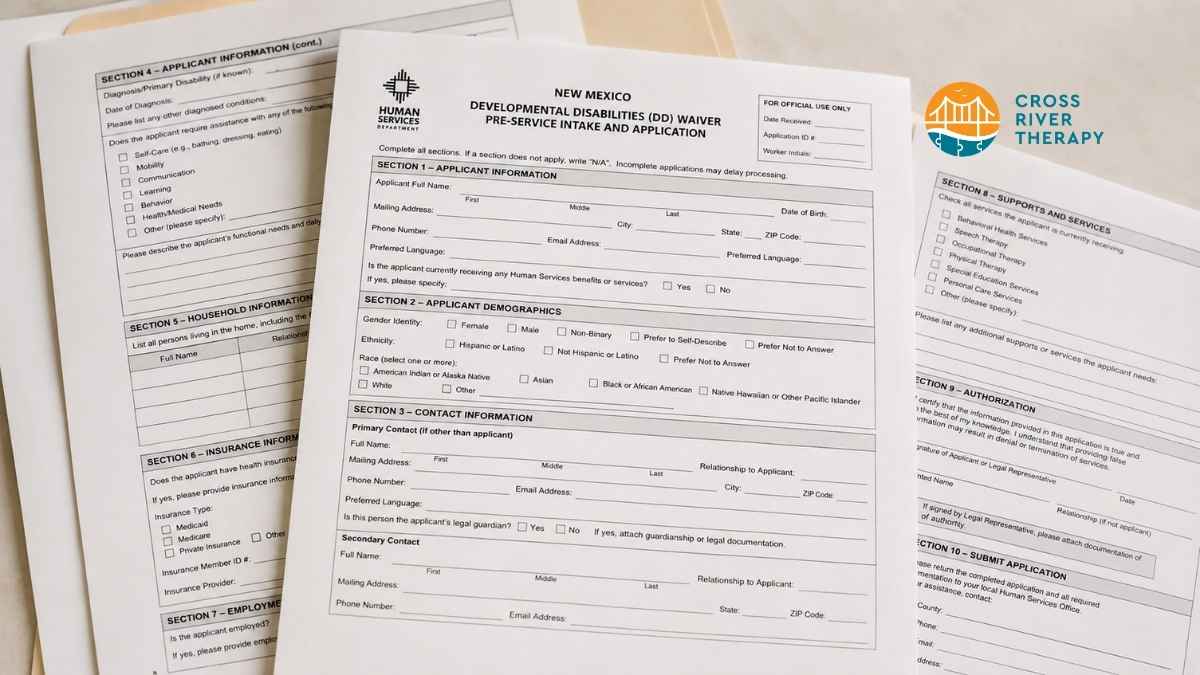
How to Apply for New Mexico’s DD Waiver While Starting ABA Therapy
Autism waiver New Mexico applications need DD Waiver records and proof of daily support needs. Your next step is to start ABA intake with Cross River.

Is ABA Therapy Covered by Insurance in New Jersey? What Every Parent Should Know
ABA therapy insurance New Jersey may cover medically necessary care based on plan type, network, and authorization. Verify benefits with Cross River.

How ABA Therapy Builds Communication for Nonverbal Children Without Forcing Speech
ABA therapy communication for nonverbal children starts with AAC, signs, and daily routines. See how kids ask, refuse, choose, and get help.

How to Start ABA Therapy in New Jersey With a First-Call Checklist
How to start ABA therapy in New Jersey begins with records, insurance details, and intake questions. Use this first-call checklist before you call.

How to Get an Autism Evaluation in Arkansas Before Starting ABA Therapy
How to get an autism evaluation in Arkansas starts with a referral, provider choice, and key records. Use this parent checklist before ABA intake.

Center-Based vs In-Home vs School-Based ABA Therapy and How to Choose the Right Fit
Center-based, in-home, and school-based ABA therapy each fit different goals, routines, and settings. Compare options before your intake call.

Early Signs of Autism: A Guide for North Carolina Parents
Early signs of autism North Carolina parents notice can include speech, play, sensory, or skill loss patterns. See what to track before screening.