








Using token reinforcement systems in ABA
Enhancing Behavioral Change with Token Economies in ABA


Understanding the Foundation of Token Reinforcement in ABA
Token reinforcement systems are a cornerstone of applied behavior analysis (ABA), providing a structured and effective way to foster desired behaviors across various settings. This article explores the operational principles, implementation strategies, theoretical underpinnings, empirical support, and practical applications of token reinforcement systems within ABA to promote sustainable behavior change.
Defining Token Reinforcement Systems in ABA

What is a token reinforcement system in ABA and how does it operate?
A token reinforcement system in Applied Behavior Analysis (ABA) is a structured approach used to encourage and strengthen desired behaviors through a system of tokens. These tokens are symbols or objects—such as stickers, stars, or chips—that represent points earned when an individual demonstrates specific target behaviors. Once accumulated, tokens can be exchanged for backup reinforcers like snacks, privileges, or preferred activities.
The operation of a token system relies heavily on operant conditioning principles. First, individuals receive immediate tokens following their behavior, which provides quick feedback and helps establish an association between the behavior and its consequences. This immediate reinforcement is crucial for effective learning, especially in populations like children with autism or other developmental challenges.
Tokens serve as conditioned reinforcers because they gain their value through pairing with primary or secondary reinforcers. For instance, a child may earn a star (token) for completing homework, which can later be exchanged for a treat or extra playtime—these are the backup reinforcers. The system’s visual nature and clear expectations increase motivation, promote engagement, and facilitate skill development.
Implementation involves several steps: identifying target behaviors, selecting appropriate tokens, designing a menu of backup reinforcers, and establishing consistent procedures for tokens delivery and exchange. When correctly applied, token systems can organize complex behavior sequences, influence motivation over extended periods, and help bridge the delay between behavior and reinforcement.
Overall, token reinforcement systems offer a flexible, effective tool for behavior management. They can be tailored to various environments—from classrooms to therapy sessions—and foster long-term behavior change through systematic reinforcement and reinforcement scheduling.
Implementing Token Economies: Practical Strategies and Best Practices

What are the key steps and practical considerations for implementing a token reinforcement system in ABA therapy?
Implementing a token economy requires a structured plan that ensures its effectiveness and ethical application. First, define clear target behaviors that you want to increase or decrease. These might include specific social skills, compliance with tasks, or adaptive behaviors.
Next, select tokens that are meaningful and motivating for the individual. Common tokens include stickers, poker chips, or points on a board. These tokens are conditioned reinforcers, meaning they gain value through pairing with preferred items or activities.
A crucial step involves establishing a menu of backup reinforcers—desired items or privileges that tokens can be exchanged for. To identify appropriate reinforcers, conduct preference assessments and observe which items are highly valued by the individual.
Once tokens and backup reinforcers are chosen, practitioners set up procedures for token conditioning and exchange. Token conditioning involves pairing tokens with backup reinforcers, establishing their conditioned reinforcing value through consistent pairing, and training individuals on how and when to earn them.
The exchange process is also defined clearly, with rules about how many tokens are needed to access specific reinforcers, and schedule parameters such as the rate of token production and exchange opportunities.
Training all staff and caregivers involved is vital for consistency. Use visual aids, like token boards, to demonstrate procedures and expectations.
Continuous monitoring helps identify when the system needs adjustment. During implementation, schedule thinning—gradually increasing the number of tokens needed for reinforcement or decreasing exchange opportunities—to promote independence and natural reinforcement.
Furthermore, maintaining simplicity, fairness, and transparency ensures the system remains motivating and ethical. Regularly assess preferences and system impact to fine-tune the process and sustain long-term behavior change.
Overall, thoughtful planning, collaborative implementation, and ongoing evaluation are essential for a successful token economy in ABA therapy.
Underlying Principles and Theoretical Foundations
What is the theoretical basis for using token reinforcement systems in ABA?
Token reinforcement systems in Applied Behavior Analysis (ABA) are grounded in the core principles of operant conditioning, a behavioral theory introduced by B.F. Skinner. At its essence, operant conditioning explains how behavior is influenced by its consequences; behaviors followed by reinforcing stimuli are more likely to recur.
In token economies, tokens serve as conditioned reinforcers. Unlike primary reinforcers such as food or water, tokens derive their reinforcing value through their association with these unconditioned stimuli. For example, a child might earn stickers (tokens) for completing homework, which can later be exchanged for tangible rewards like snacks or privileges. This pairing creates stimulus-stimulus relations, wherein tokens become meaningful through their link to primary reinforcers.
Systematically, token reinforcement involves structured schedules of reinforcement and response chains. Behavior patterns are maintained and extended through carefully designed contingencies, such as fixed or variable ratio schedules of token production, and through behavioral chaining, which links simple responses into more complex sequences. Tokens signal imminent reinforcement, acting as discriminative stimuli that evoke target behaviors.
When tokens are lost or withheld as a response cost, they can function as conditioned punishers, reducing unwanted behaviors. This dual role of tokens as reinforcers and punishers underscores their versatility.
Furthermore, token systems are influenced by behavioral economic models—a framework analyzing how economic variables like demand, unit price, and reinforcement delay shape choices. Tokens act as a form of generalized reinforcer, increasing their utility when paired with multiple rewards, thereby bridging delays between behavior and the ultimate reinforcement.
In sum, token reinforcement integrates stimulus-stimulus relations, contingency management, and economic principles, forming a comprehensive foundation for behavior modification strategies that are adaptable, efficient, and applicable across various settings and populations.
Research Evidence Supporting Token Systems in Behavior Change and Autism Interventions
What evidence supports the effectiveness of token reinforcement systems in behavior change, particularly in autism treatment?
Extensive research has demonstrated that token reinforcement systems are highly effective in promoting behavior change, especially within autism interventions. Historical studies from as far back as the 1930s have established that tokens act as conditioned reinforcers. These tokens, when paired with primary reinforcers such as food or water, become valuable signals that reinforce desired behaviors and help in acquiring new skills.
In contemporary clinical practice, structured token systems—often called token economies—have proved successful in increasing communication, social interactions, and daily living skills for individuals with autism. By influencing response patterns through predetermined schedules of reinforcement, these systems support motivation and behavior maintenance.
Research also highlights that tokens serve multiple functions. They act as discriminative stimuli, signaling proximity to reinforcement, and can evoke behaviors directed towards earning tokens. Moreover, tokens are particularly useful in bridging long delays between behavior and actual reinforcement, which is often a challenge in natural settings. This bridging capability helps sustain motivation over extended periods.
Controlled studies and real-world applications have consistently shown that well-implemented token reinforcement procedures can produce meaningful and lasting behavior change. They offer a practical, versatile tool in both laboratory research and applied behavior analysis, making them instrumental in treatment programs for individuals with autism.
In summary, both foundational experiments and recent studies provide strong evidence that token systems are a cornerstone of effective behavior modification and autism treatment, enabling skill development and promoting adaptive behaviors efficiently and reliably.
Applications Across Settings and Promoting Behavioral Maintenance
 Token reinforcement systems are highly versatile tools within applied behavior analysis (ABA) that can be implemented across a broad spectrum of settings. These include homes, where parents can reinforce daily responsibilities and social behaviors; schools, where teachers promote academic skills and classroom conduct; clinics, for therapeutic interventions targeting communication, self-help, or social skills; and community environments such as summer camps, inpatient programs, and natural settings.
These systems are adaptable to various behaviors and learners, making them effective for individuals with diverse needs and developmental levels. By selecting appropriate tokens, target behaviors, and backup reinforcers, practitioners can tailor interventions to specific goals. The immediacy and visual nature of token reinforcement help motivate learners, providing ongoing feedback that supports consistent behavior change.
Supporting long-term behavior maintenance involves strategic fading of the tokens and smooth transition to natural reinforcers. Techniques include gradually increasing the response requirements before removing tokens and pairing token-based praise with naturally occurring rewards. Incorporating meaningful, naturally available reinforcers helps foster internal motivation and the generalization of skills outside the structured reinforcement system.
Effective management of behavioral sustainability also hinges on collaboration among stakeholders such as caregivers, educators, and therapists. Regular monitoring ensures that reinforcement strategies are adjusted as needed to maintain effectiveness and address challenges. By systematically fading reinforcement and promoting independence, token systems can lead to sustained behavior change, equipping learners with the skills to continue functioning adaptively without reliance on external tokens.
Summary and Best Practices for Token Economies in ABA
Token reinforcement systems are a powerful, evidence-based approach to promoting and maintaining adaptive behaviors across diverse contexts in ABA. Their success hinges on careful planning, consistent implementation, and thoughtful fading strategies to ensure behaviors are sustained naturally over time. By integrating behavioral principles and ongoing stakeholder engagement, practitioners can maximize the efficacy of token economies for skill development, motivation, and long-term behavior change.
References
- TOKEN REINFORCEMENT: A REVIEW AND ANALYSIS
- The Power of Token Economies: A Comprehensive Guide ...
- Reinforcement Systems
- Common Practices used to Establish and Implement Token ...
- Token Economy ABA – Systems & Uses in Therapy
- Using Token Boards and Reward Systems at Home
- How to Use Token Economies for Lasting Behavior Change
- "Evaluation of a Token Reinforcement System for ...
- Programming response maintenance after withdrawing ...
- Common Practices used to Establish and Implement Token ...
Recent News
Related articles

5 Autism Support Groups and Family Resources in New Mexico Alongside ABA Therapy
Autism support groups New Mexico families can use offer peer support, local events, and school help. Cross River can explain ABA therapy options.

Where to Get an Autism Evaluation in New Mexico Before Starting ABA Therapy
Autism evaluation New Mexico options include UNM, NMSU, FIT, and private providers. Compare providers, records, and ABA steps with Cross River.

7 North Carolina Autism Resources to Contact Before ABA Therapy Starts
Autism resources North Carolina families can call for diagnosis, early intervention, rights, and parent support. Start ABA intake with Cross River.

Does Indiana Medicaid Cover ABA Therapy? A Step-by-Step Eligibility Checklist for Parents
Medicaid ABA therapy Indiana covers eligible children under 21 with prior authorization. Your five-step coverage review can start with Cross River.
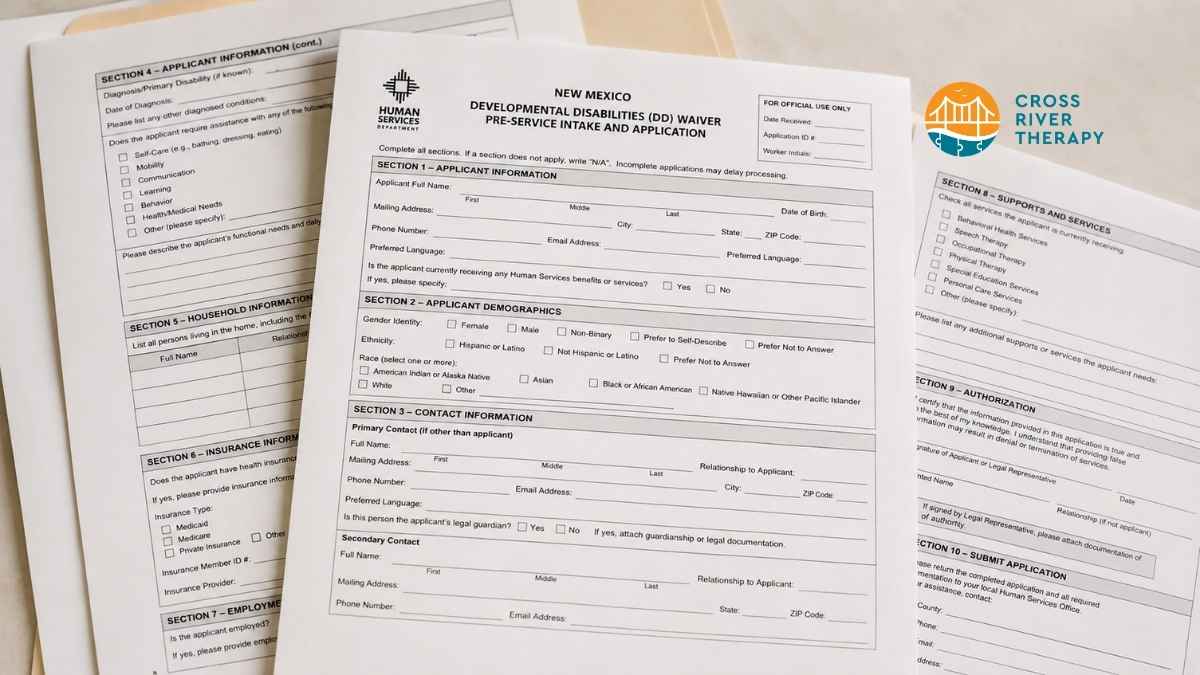
How to Apply for New Mexico’s DD Waiver While Starting ABA Therapy
Autism waiver New Mexico applications need DD Waiver records and proof of daily support needs. Your next step is to start ABA intake with Cross River.

Is ABA Therapy Covered by Insurance in New Jersey? What Every Parent Should Know
ABA therapy insurance New Jersey may cover medically necessary care based on plan type, network, and authorization. Verify benefits with Cross River.

How ABA Therapy Builds Communication for Nonverbal Children Without Forcing Speech
ABA therapy communication for nonverbal children starts with AAC, signs, and daily routines. See how kids ask, refuse, choose, and get help.

How to Start ABA Therapy in New Jersey With a First-Call Checklist
How to start ABA therapy in New Jersey begins with records, insurance details, and intake questions. Use this first-call checklist before you call.

How to Get an Autism Evaluation in Arkansas Before Starting ABA Therapy
How to get an autism evaluation in Arkansas starts with a referral, provider choice, and key records. Use this parent checklist before ABA intake.

Center-Based vs In-Home vs School-Based ABA Therapy and How to Choose the Right Fit
Center-based, in-home, and school-based ABA therapy each fit different goals, routines, and settings. Compare options before your intake call.

Early Signs of Autism: A Guide for North Carolina Parents
Early signs of autism North Carolina parents notice can include speech, play, sensory, or skill loss patterns. See what to track before screening.

Early Intervention ABA Therapy in Albuquerque, NM: Why Starting Early Matters
Early intervention ABA therapy in Albuquerque, NM helps toddlers practice communication, play, and routines. Spot signs and care options sooner.