








Using Visual Aids in Autism
Enhancing Engagement and Understanding in Autism Spectrum Disorder


Introduction to Visual Supports in Autism
Visual aids are fundamental tools in supporting individuals with autism, leveraging their strong visual processing strengths to facilitate understanding, communication, and independence. These supports are adaptable across settings such as homes, schools, and clinics, helping prevent anxiety and sensory overload through structure and predictability. As a permanent part of many routines, visual aids empower children and adults on the spectrum to navigate daily life with greater confidence and clarity.
The Role of Visual Aids in Autism Support
What is the role of visual aids in supporting individuals with autism?
Visual aids are essential tools that cater to the learning preferences of many individuals on the autism spectrum, who tend to process visual information more effectively than auditory input. These supports include picture schedules, choice boards, emotion charts, and visual cues that make routines, expectations, and social cues clearer and more accessible.
By providing visual representations, these aids help individuals understand and anticipate daily activities, which can be particularly beneficial for those with language delays or difficulties. Visual supports also foster independence by enabling children and adults to complete tasks on their own without constant prompts.
In addition, visual aids significantly reduce feelings of confusion, frustration, and anxiety. They create predictability in routines and environments, helping the individual navigate social and daily situations more confidently. This structure not only supports comprehension but also helps reduce sensory overload by organizing information visually.
In educational settings and at home, visual supports promote active participation and improve communication. They serve as a constant reference point that visually illustrates what needs to be done, what has been completed, and what comes next, making transitions easier and more predictable.
Overall, visual aids empower individuals with autism by enhancing their understanding of their environment, supporting effective communication, and fostering independence. Evidence-based and widely supported in clinical guidelines, these tools are a cornerstone of comprehensive autism support strategies.
Types of Visual Supports Widely Used in Autism Interventions
What are the different types of visual supports used in autism interventions?
Visual supports play a crucial role in autism interventions by providing clear, visual cues that help individuals understand routines, express needs, and reduce anxiety. These supports come in various forms and are tailored to meet each person's unique communication style and developmental level.
Among the most common visual supports are visual schedules and checklists. These tools break down daily routines into manageable steps, giving individuals a visual sequence of activities such as morning routines, classroom tasks, or vocational activities. Visual schedules often include pictures, symbols, or words that make it easier to anticipate what comes next, fostering independence.
Social stories are another vital type of visual support. They are short, pictorial narratives that help explain social situations, expectations, and appropriate responses. These stories are especially helpful for navigating transitions or challenging social scenarios.
The Picture Exchange Communication System (PECS) is a well-known AAC (augmentative and alternative communication) tool that uses picture cards to support communication, especially for children who are nonverbal.
Choice boards are visual menus presenting two or more options, allowing individuals to express preferences, make decisions, or communicate preferences about activities, items, or responses.
In addition to these, visual cues like cue cards or visual boundaries help in behavioral management and organization.
Various formats are employed to create these supports:
- Photographs: Realistic images of objects or people for familiarity.
- Symbols and pictograms: Simplified or standardized images representing concepts.
- Objects: Actual items used as tangible supports, especially for pre-verbal children.
- Written words: For individuals who can read or are developing literacy skills.
Environmental arrangements, such as visual boundaries and cue cards, help organize space and reduce sensory overload. For example, visual labels on bins or rooms clarify function, while cue cards remind individuals of expected behaviors.
Overall, these visual supports serve as visual references across settings, strengthening understanding, independence, and communication for individuals on the autism spectrum. Their strategic use throughout daily routines promotes a calm, predictable environment, ultimately supporting better learning and social engagement.
Effective Strategies for Implementing Visual Supports in Autism Support and Education
What strategies are effective for implementing visual supports in autism support and education?
Implementing visual supports successfully involves several practical strategies that cater to individual needs. The first step is to assess each person’s developmental level, communication style, and preferences. This allows caregivers and educators to choose visuals that are most meaningful, such as objects for pre-verbal children or picture symbols for those who understand images better.
Starting with simple, clear visuals is essential. Use basic images, symbols, or objects that the individual can easily recognize and understand. For example, a picture of a toothbrush for toothbrushing or a schedule of daily activities can foster familiarity.
Consistency plays a crucial role. Visual supports should be used regularly in the same context to help build understanding and routine. As the individual progresses or ages, visuals can be gradually expanded or modified to introduce more complex concepts or additional routines.
Visuals can include a variety of formats, such as pictures, photograph cards, mini-objects, or written words. Combining these supports helps address different learning styles and enhances comprehension.
Using appropriate tools like specialized software programs—including Boardmaker or SymWriter—or printable templates makes creating customized visuals straightforward and cost-effective. These tools enable quick adjustments, additions, or removals, ensuring support remains relevant.
Involving individuals and their families or caregivers in the design process is vital. This participatory approach encourages ownership and boosts motivation. When children understand and trust their visual supports, they are more likely to use them independently.
In summary, effective implementation hinges on careful assessment, starting with simplicity, maintaining consistency, adapting over time, and utilizing accessible tools for customization. These strategies promote a predictable environment that reduces anxiety and fosters independence in children with autism.
How Visual Aids Can Enhance Communication for Individuals with Autism
How can visual aids be used to enhance communication with individuals with autism?
Visual supports are powerful tools for improving communication among people with autism. They provide clear, concrete visual representations of ideas, routines, and social cues, making abstract concepts more accessible. By using items such as pictures, symbols, objects, and written words, these aids help bridge communication gaps caused by language difficulties. For example, visual schedules outline daily routines, reducing uncertainty and anxiety.
Choice boards and social stories are additional supports that promote understanding and predictability, encouraging independence and reducing frustration. Customizing visual aids based on the individual's developmental level and preferences ensures they are effective and engaging. These supports are utilized across settings—at home, in school, and in therapy—to foster meaningful interactions and enhance comprehension.
Overall, integrating well-designed visual tools creates a structured, predictable environment. This approach not only supports understanding but also encourages active participation, making communication more accessible and less stressful for individuals on the autism spectrum.
Resources and Practical Examples of Visual Supports for Children with Autism
Are there resources or examples of visual supports suitable for children with autism?
Yes, there are many accessible resources and practical examples designed to support children with autism. Visual supports include items like objects, photographs, pictorial symbols, daily schedules, mini-schedules, and choice boards. These tools help children improve understanding, facilitate communication, and decrease anxiety associated with routines or transitions.
Organizations such as Autism Speaks and the Indiana Resource Center for Autism offer a variety of visual support resources. For example, visual schedules can be customized to show daily activities, while First-Then Boards visually motivate children by illustrating what they need to do first and what comes next.
Practical resources are also available for specific needs like medical appointments, social events, and behavior management strategies. Many of these supports are printable or digital, with templates readily available online.
Organizations like Children’s National Hospital and the Autism Treatment Network provide free printable materials and guidance on creating visual supports tailored to individual needs. These include visual schedules, communication boards, and social stories in multiple languages.
Research-backed and easy to make at home, these visual supports foster independence and active participation. They are also designed to be durable and portable, suitable for various environments including home, school, and community settings.
In summary, numerous resources exist to help families and educators implement visual supports. From ready-made printed materials to adaptable digital tools, these supports can be tailored to different ages and developmental levels, making them an essential part of supporting children with autism.
Research Evidence Supporting the Use of Visual Supports in Autism

What does research say about the effectiveness of visual supports in autism interventions?
Scientific studies strongly support the use of visual supports as a core component of autism intervention strategies. Data from numerous research articles and reviews indicate that visual supports significantly boost communication, improve behavior, and increase participation for individuals on the spectrum.
A comprehensive review of 34 research studies demonstrated that visual tools such as picture schedules, social stories, and timers help children and adults understand routines and expectations more clearly. These supports make transitions easier, reduce anxiety, and foster independence.
Research by educators and clinicians shows that visual supports are especially effective for visual learners—an important consideration, given that many with autism process information better through images than words. They assist in developing speech and motor skills and encourage on-task behavior.
Clinical guidelines for autism recommend ongoing use and adaptation of visual supports as individuals grow, emphasizing their role in creating predictable environments. The evidence underscores that tailored visual supports lead to better engagement, communication, and overall skill development.
In summary, scientific findings affirm that employing personalized visual aids within interventions leads to meaningful improvements in daily functioning and learning outcomes for people on the autism spectrum.
Conclusion: Harnessing the Power of Visual Supports
Visual supports are an essential component of autism intervention strategies, enabling better understanding, reducing anxiety, and promoting independence across a range of settings. The diversity of visual tools—from schedules and communication boards to social stories—makes them adaptable to individual needs and developmental levels. Supported by extensive research, clinical guidelines, and practical resources, visual aids help bridge communication gaps, support behavior management, and foster active participation. As awareness and technology advance, the accessibility and customization of visual supports continue to improve, making them an invaluable asset in enhancing the lives of individuals with autism and their families.
References
- Visual supports for autism: a step by step guide
- ATN/AIR-P Visual Supports and Autism
- Visual supports at home and in the community for individuals with ...
- Visual Supports » Center for Autism and Related Disabilities »
- Visual Strategies for Students with Autism - n2y Blog
- Visual Supports for Autism: What are the Benefits?
- How Do Visual Supports Help People With Autism? - Optometrists.org
- Visual Supports - Autism Toolbox
- [PDF] Using Visuals to Support Communication
Recent News
Related articles

6 Arkansas Medicaid ABA Therapy Rules Families Need to Know
Arkansas Medicaid ABA therapy has age, diagnosis and approval rules. Families can check six requirements before care.

Arizona Autism Laws Every Parent Should Know Before Starting ABA Therapy
Autism laws Arizona parents should know cover ABA insurance, AHCCCS appeals, IEPs, and Section 504 rights. Check ABA coverage with Cross River.

ABA Therapist Salary in Arkansas: What BCBAs and RBTs Actually Earn in 2026
ABA therapist salary Arkansas figures compare RBT and BCBA rates, benefits, guaranteed hours, and contract terms. Explore careers at Cross River.

5 Autism Support Groups and Family Resources in New Mexico Alongside ABA Therapy
Autism support groups New Mexico families can use offer peer support, local events, and school help. Cross River can explain ABA therapy options.

Where to Get an Autism Evaluation in New Mexico Before Starting ABA Therapy
Autism evaluation New Mexico options include UNM, NMSU, FIT, and private providers. Compare providers, records, and ABA steps with Cross River.

7 North Carolina Autism Resources to Contact Before ABA Therapy Starts
Autism resources North Carolina families can call for diagnosis, early intervention, rights, and parent support. Start ABA intake with Cross River.

Does Indiana Medicaid Cover ABA Therapy? A Step-by-Step Eligibility Checklist for Parents
Medicaid ABA therapy Indiana covers eligible children under 21 with prior authorization. Your five-step coverage review can start with Cross River.
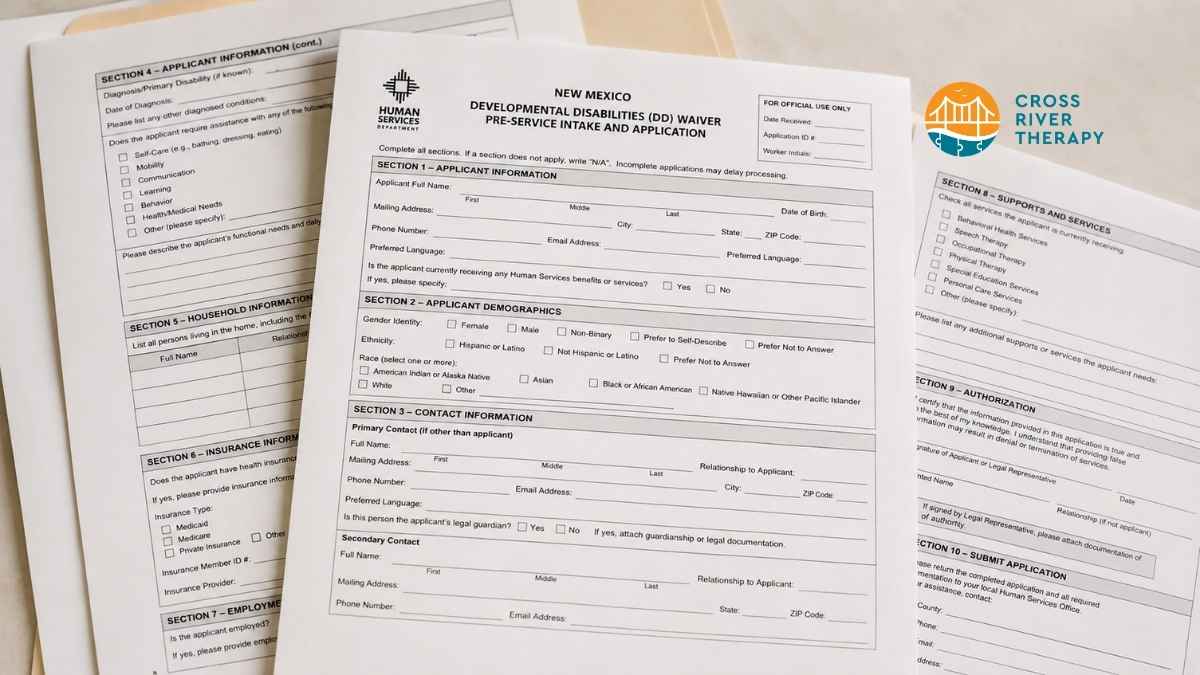
How to Apply for New Mexico’s DD Waiver While Starting ABA Therapy
Autism waiver New Mexico applications need DD Waiver records and proof of daily support needs. Your next step is to start ABA intake with Cross River.

Is ABA Therapy Covered by Insurance in New Jersey? What Every Parent Should Know
ABA therapy insurance New Jersey may cover medically necessary care based on plan type, network, and authorization. Verify benefits with Cross River.

How ABA Therapy Builds Communication for Nonverbal Children Without Forcing Speech
ABA therapy communication for nonverbal children starts with AAC, signs, and daily routines. See how kids ask, refuse, choose, and get help.

How to Start ABA Therapy in New Jersey With a First-Call Checklist
How to start ABA therapy in New Jersey begins with records, insurance details, and intake questions. Use this first-call checklist before you call.

How to Get an Autism Evaluation in Arkansas Before Starting ABA Therapy
How to get an autism evaluation in Arkansas starts with a referral, provider choice, and key records. Use this parent checklist before ABA intake.