








Why generalization planning is part of every ABA goal
Ensuring Skills Translate: The Crucial Role of Generalization in ABA Therapy


Understanding Generalization in Autism Therapy
Applied Behavior Analysis (ABA) therapy is a cornerstone intervention for children with autism spectrum disorder (ASD), focused on teaching critical skills. However, learning a skill in therapy settings is only part of the challenge. For meaningful progress, these skills must be consistently performed in various real-life environments. This article explores why planning for generalization is essential in every ABA goal and how it ensures therapy success beyond controlled settings.
What is ABA Therapy and Its Benefits for Individuals with Autism?
Understanding Applied Behavior Analysis (ABA) Therapy
Applied Behavior Analysis (ABA) is a scientifically validated therapy that focuses on improving socially significant behaviors in individuals with autism. It uses learning principles such as positive reinforcement and prompting to encourage desired behaviors like communication, social interaction, and self-care skills.
How Does ABA Benefit Individuals with Autism?
ABA helps children develop essential skills for everyday life across settings such as home, school, and community. The therapy targets improvements in language, socialization, and daily living abilities, aiming for greater independence. ABA’s personalized treatment plans address each child's unique needs, reducing challenging behaviors while promoting positive ones.
Techniques Used in ABA
Therapists use clear, data-driven methods including consistent positive reinforcement and systematic prompting with gradual fading. Natural environment training is employed so skills learned in therapy apply to real-life situations. Parental involvement and ongoing progress monitoring ensure interventions remain effective and meaningful.
Delivery Settings and Approaches
ABA is typically delivered one-on-one by trained therapists but may also involve group sessions and family training. It is adaptable to various environments such as the child's home, schools, or community spaces to maximize skill generalization.
Scientific Evidence Supporting ABA
Decades of research demonstrate that ABA can significantly improve intellectual functioning, communication, and adaptive skills in children with autism. When started early and tailored appropriately, ABA increases the likelihood of children integrating into mainstream educational settings and leading more independent lives.
| Aspect | Description | Importance |
|---|---|---|
| Therapy Focus | Social, communication, daily living skills | Promotes independence |
| Techniques | Positive reinforcement, prompting, natural environment training | Facilitates real-life application |
| Settings | Home, school, community | Encourages generalization across contexts |
| Research Backing | Extensive scientific support | Validates ABA as effective intervention |
Who Are the Professionals Behind ABA Therapy?

Who provides ABA therapy and what qualifications do these professionals typically have?
ABA therapy is delivered by a range of professionals, each bringing specific expertise to the intervention process. At the forefront are Board Certified Behavior Analysts (BCBAs), who hold graduate-level credentials and are responsible for designing, overseeing, and modifying individualized treatment plans. Some highly experienced clinicians, known as BCBAs-D, have doctoral degrees, enabling them to exercise greater autonomy in clinical decision-making and program oversight.
Supporting BCBAs are Registered Behavior Technicians (RBTs) and paraprofessionals. RBTs are certified through competency assessments and provide direct, one-on-one therapy to children under the supervision of a BCBA. These trained technicians implement intervention strategies according to prescribed protocols but do not develop treatment plans themselves. Paraprofessionals or behavior therapists may assist in delivering therapy sessions, sometimes with only a high school diploma, but always under the guidance of certified professionals.
Other practitioners can include Board Certified Assistant Behavior Analysts (BCaBAs), who typically hold undergraduate degrees and work under BCBA supervision. In some regions or programs, licensed clinicians from disciplines such as psychology or speech-language pathology may contribute complementary expertise.
Importance of multidisciplinary collaboration and qualifications
Delivering effective ABA therapy requires collaboration among a multidisciplinary team. Qualified professionals coordinate to ensure comprehensive care tailored to each child’s unique needs. Credentialing, supervision, and ongoing professional development help maintain high standards, ensuring interventions are scientifically grounded and ethically administered.
In summary, ABA therapy involves a knowledgeable team of certified experts and trained support staff working synergistically. This structured professional hierarchy ensures that children with autism receive individualized, evidence-based interventions designed to promote meaningful skill acquisition and generalization across settings.
Crafting an Individualized ABA Therapy Program

How is an ABA therapy program developed and tailored to an individual with autism?
Developing an ABA therapy program begins with a comprehensive assessment conducted by a Board-Certified Behavior Analyst (BCBA). This assessment evaluates the child’s strengths and challenges through direct observations, structured interviews with parents, and sometimes standardized assessments. The goal is to gather detailed information about the child's developmental needs in areas such as communication, social skills, daily living abilities, and behavior.
Personalized, measurable goals are then set collaboratively with family members, ensuring relevance to the child's natural environments and real-life situations. These goals focus on enhancing communication, social interaction, self-care, and reducing problematic behaviors, all while aiming to promote the maintenance and generalization of learned skills.
Data collection plays a central role throughout therapy. Therapists use tools like frequency counts, checklists, and direct observations to monitor progress during sessions. This data-driven approach allows for ongoing adjustments to the treatment plan, tailoring interventions to evolving needs and ensuring that objectives remain meaningful and achievable.
Family involvement is integral, with caregivers receiving training to support skill generalization at home and in community settings. The program actively incorporates strategies aimed at transferring skills across different people, stimuli, and environments, reflecting the overall ABA emphasis on planning for generalization rather than assuming it will occur automatically.
By consistently analyzing data and collaborating with families, BCBAs ensure the therapy remains responsive and individualized, promoting better outcomes and helping children apply their skills broadly to enhance independence and quality of life.
Behavioral Techniques Driving Skill Acquisition in ABA
What behavioral techniques are commonly used in ABA therapy to help individuals with autism?
Applied Behavior Analysis (ABA) therapy employs several behavioral techniques designed to foster skill development and reduce challenging behaviors in individuals with autism. One foundational technique is positive reinforcement, which strengthens desired behaviors by providing rewarding consequences, encouraging their repetition.
Another important approach is prompting and fading, where initial guidance helps initiate the target behavior and is gradually reduced over time, promoting independence. For teaching specific skills, Discrete Trial Training (DTT) is commonly used; it involves breaking down skills into small, structured steps and delivering clear instructions and responses.
Behavior chaining divides complex tasks into sequential, manageable actions, enabling learners to master multi-step activities.
To teach new behaviors by example, modeling and video modeling provide demonstrations for imitation, which is particularly effective for children with autism. When addressing unwanted behaviors, techniques such as extinction (withholding reinforcement) and redirection (shifting focus to appropriate alternatives) are applied to reduce those behaviors.
Lastly, script fading assists in developing social communication skills by gradually reducing dependence on scripted language or prompts, helping the individual communicate more naturally.
Together, these methods form a data-driven, individualized treatment plan that enhances learning across social, communicative, and everyday functional domains, ensuring measurable progress and skill generalization.
The Challenge of Generalization in Autism
What is Generalization and Why Is It Important?
Generalization refers to the ability to perform learned behaviors across different settings, with various people, and using different materials beyond the original training environment. It is essential in Applied Behavior Analysis (ABA) therapy, especially for children with autism spectrum disorder (ASD), because it ensures that skills taught in therapy become functional in everyday life. Without generalization, skills remain context-bound and have limited practical use.
Why Do Children with Autism Struggle to Generalize Skills?
Children with autism often face challenges in generalizing skills due to characteristics like insistence on sameness and stimulus overselectivity. Insistence on sameness leads to resistance to change in routines or environments, while stimulus overselectivity involves focusing on a limited range of stimuli, missing broader cues that indicate when to use learned behaviors. Additionally, a lack of motivation in unfamiliar settings can further hinder generalization.
Risks of Context-Bound Skills
When generalization does not occur, skills learned in therapy may only appear within that controlled setting. This context-bound learning means that children might not independently apply communication or social skills in natural environments such as home, school, or community. This limitation reduces the effectiveness of therapy and can impede overall development.
Impact on Independence and Social Integration
Without effective generalization, children with autism may struggle to function independently and engage socially across different environments. The inability to transfer skills hampers their day-to-day interactions and decreases opportunities for meaningful participation, ultimately affecting their quality of life and social integration.
Types of Generalization and Their Roles in ABA Goals
What Is Stimulus Generalization Across Different Environments and Materials?
Stimulus generalization occurs when a child performs a learned behavior in various settings, with different materials, and around different people, not just the original training environment. For example, if a child learns to communicate "thank you" during therapy, stimulus generalization ensures they use this phrase at home, school, or community settings. This variety in location and materials helps the skill become functional and applicable throughout daily life.
What Is Response Generalization and How Does It Work?
Response generalization refers to a person showing new, untrained behaviors that serve the same function as those taught. For example, if a child has been taught to request help verbally, they might also begin to use gestures to ask for help without direct teaching. This expands practical behavior beyond the exact responses originally taught, increasing flexibility and adaptability.
How Does Response Maintenance Support Skill Retention Over Time?
Response maintenance means continuing to perform a trained behavior even after therapy sessions end. For children with autism, consistent practice ensures that skills like self-care or social interactions do not fade but become part of lasting behavior. Maintenance is crucial to independence and ongoing quality of life.
What Is Setting or Maintenance Generalization?
Setting generalization involves transferring skills learned in one location or context to others. For instance, a child practicing sharing toys in therapy should also share naturally at home or on the playground. This broadens the usefulness of skills and supports better social integration.
How Do These Types Work Together to Support Functional Skill Use?
Together, these generalization types ensure that skills learned in therapy are usable in real life. Stimulus generalization provides varied contexts, response generalization allows flexible behavior, and maintenance guarantees long-term retention. Setting generalization ties the skills to multiple environments. Planning for all these aspects helps ABA therapy achieve its goal: empowering children with autism to apply their skills broadly, improving independence and quality of life.
Systematic Strategies to Promote Generalization in ABA
Training Sufficient Exemplars to Increase Variability
Teaching children with autism multiple examples of a skill helps them apply learned behaviors across different settings and situations. Using varied stimuli ensures they don't associate a skill with just one specific context but learn to generalize it effectively.
Programming Common Stimuli from Natural Environments
Incorporating elements from the child's everyday environment into therapy sessions—such as familiar objects or people—boosts the likelihood that skills will transfer. For example, practicing eating skills using the child's usual utensils improves applicability at home.
Training Loosely by Varying Nonessential Elements During Instruction
ABA practitioners vary aspects like location, tone of voice, clothing, or reinforcers during teaching. This flexibility trains children to tolerate differences and respond appropriately in diverse real-world contexts, making generalization smoother.
Mediating Generalization Through People or Objects
Using specific people (e.g., parents or teachers) or objects integral to a child's daily life acts as bridges for transferring skills. These mediators help children link therapy experiences with natural settings.
Teaching Response Variability to Foster New Behaviors
Encouraging children to produce novel yet functionally equivalent responses allows them to adapt skills creatively according to different circumstances. This flexibility supports broader behavior application.
Involving Multiple Caregivers and Using Natural Reinforcement
Engaging caregivers across environments ensures consistency and reinforcement that reflect everyday life. Applying natural reinforcers—like praise from family members—helps maintain skills beyond therapy sessions.
Systematic execution of these strategies within ABA fosters skill generalization, enabling children with autism to independently use learned behaviors across various settings, people, and situations.
Planning Generalization as an Integral Part of Every ABA Goal
Why Is Proactive Assessment Important in ABA Generalization?
To ensure skills learned in therapy are truly functional, it is essential to identify all relevant behaviors, settings, stimuli, and people that a child interacts with in their natural environment. This upfront assessment guides what skills need to be taught and where, ensuring therapy does not happen in isolation but reflects real-life demands.
How Can Generalization Be Embedded From the Start?
Generalization should be integrated into every ABA goal, rather than assumed to happen automatically. This means designing goals that encompass a variety of settings and prompts, training with multiple exemplars, and programming natural contingencies like common stimuli. This approach helps bridge therapy and real life seamlessly.
What Role Do Prompts and Reinforcers Play?
Using consistent prompts across different people and settings supports smoother skill transfer. Additionally, natural reinforcers—rewards that naturally occur in daily environments—are prioritized over artificial ones. Gradually fading extrinsic rewards helps children learn to recruit their own reinforcement, promoting independence.
How Is Generalization Effectiveness Measured?
Collecting data across multiple settings—including home, school, and community—is critical. This involves direct observation, parent and teacher reports, and structured checklists. Baseline data before training and follow-up checks after therapy help confirm that new skills are maintained and transferred broadly.
How Does This Plan Translate to Daily Life?
By systematically including generalization strategies in every intervention, children with autism are better able to apply learned skills beyond therapeutic sessions. They gain the ability to use social communication, self-care, and adaptive behaviors at home, school, and in community settings, leading to enhanced independence and quality of life.
Assessing and Ensuring the Longevity of Learnt Skills
Collecting Baseline and Post-Teaching Data Across Multiple Settings
To effectively assess whether skills learned during ABA therapy are sustainable, it is important to collect data before and after teaching across various relevant settings. Baseline data gathered from environments such as home, school, or community reveal the learner’s initial ability. Comparing this with post-teaching data helps determine whether the child can generalize the skill beyond the training context.
Using Parent and Teacher Reports and Checklists
In addition to direct observations, feedback from parents and teachers provides vital insight into how well skills transfer to everyday life. Functional skills checklists filled out by caregivers complement observational data and highlight areas that may need targeted generalization efforts.
Gradual Fading of Extrinsic Rewards to Natural Contingencies
Maintaining behaviour beyond therapy requires shifting from extrinsic reinforcement provided by therapists to natural reinforcers found in the child's daily environment. A gradual fading of prompts and rewards ensures that skills are motivated by naturally occurring consequences, promoting long-term independence.
Teaching Self-Management and Reinforcement Recruitment
Teaching children with ASD how to self-manage behaviours and recruit their own reinforcement encourages autonomy. These strategies support the learner in maintaining skills without continuous external prompts, thus enhancing the likelihood of skill generalization and maintenance.
Importance of Maintenance for Long-Term Independence
Continued performance of learned behaviours after intervention ends is crucial for the child’s functional independence across settings. Maintenance supports successful integration into natural environments like school and community, ultimately improving quality of life.
Why Generalization Planning Enhances Life Beyond Therapy

Connecting Therapy Skills to Meaningful Everyday Situations
Generalization in ABA therapy ensures that children with autism spectrum disorder (ASD) can apply the skills learned during intervention beyond the clinical setting. By teaching skills across diverse settings, stimuli, and people, generalization helps children perform meaningful behaviors at home, school, or in community environments. This connection to real-life situations makes therapy outcomes practical and relevant.
Supporting Independence and Improved Quality of Life
When skills are maintained and generalized, children gain abilities that support independence in daily living and self-care. ABA therapy emphasizes planning for maintenance and transfer so that behaviors are sustained after intervention ends. This lasting behavioral change reduces reliance on intensive therapy, enhances functional abilities, and ultimately improves the child’s and family's quality of life.
Promoting Social Integration and Participation in Natural Environments
Generalization also fosters social participation by enabling skills such as communication and social interaction to occur naturally with different people and in varying contexts. Involving multiple caregivers and settings during therapy encourages smooth transfer of skills, supporting inclusion in mainstream classes, community activities, and family life.
The Critical Role of Generalization for Lasting Behavioral Change
Generalization is not an automatic process but a planned and ongoing one that requires systematic programming. Techniques like training with varied exemplars, programming common stimuli, and using natural reinforcers ensure that behavior change persists over time. Without this foresight, therapeutic gains risk being limited to clinical settings alone.
Generalization as a Therapeutic and Practical Imperative
Overall, generalization underpins the ultimate goal of ABA therapy: helping children with ASD successfully navigate their environments with confidence and competence. By embedding generalization into treatment plans and measuring skill transfer, therapists promote meaningful, lasting benefits that extend far beyond therapy sessions.
Generalization: The Bridge Between Therapy and Real Life
Generalization planning is not simply an optional add-on in ABA therapy—it is fundamental to ensuring that the skills acquired in controlled settings are effectively transferred and maintained in the natural environments where individuals live, learn, and interact. When therapy goals systematically incorporate generalization, children with autism are better equipped for social integration, independence, and an improved quality of life. ABA's structured, evidence-based approach, combined with proactive generalization strategies and comprehensive assessment, makes it the gold standard for supporting meaningful, enduring change.
References
- (PDF) Generalization and Maintenance
- The Role Of Generalization Training In ABA
- Unit 1: ABA-Based Guide to Early Intervention Services for ...
- Unpacking the Significance of Generalization in ABA
- Improving the Generalization of Skills in Learners with Autism
- Assessing and Promoting Generalization
- The effectiveness of applied behavior analysis program ...
- The effectiveness of applied behavior analytic interventions ...
Recent News
Related articles

5 Autism Support Groups and Family Resources in New Mexico Alongside ABA Therapy
Autism support groups New Mexico families can use offer peer support, local events, and school help. Cross River can explain ABA therapy options.

Where to Get an Autism Evaluation in New Mexico Before Starting ABA Therapy
Autism evaluation New Mexico options include UNM, NMSU, FIT, and private providers. Compare providers, records, and ABA steps with Cross River.

7 North Carolina Autism Resources to Contact Before ABA Therapy Starts
Autism resources North Carolina families can call for diagnosis, early intervention, rights, and parent support. Start ABA intake with Cross River.

Does Indiana Medicaid Cover ABA Therapy? A Step-by-Step Eligibility Checklist for Parents
Medicaid ABA therapy Indiana covers eligible children under 21 with prior authorization. Your five-step coverage review can start with Cross River.
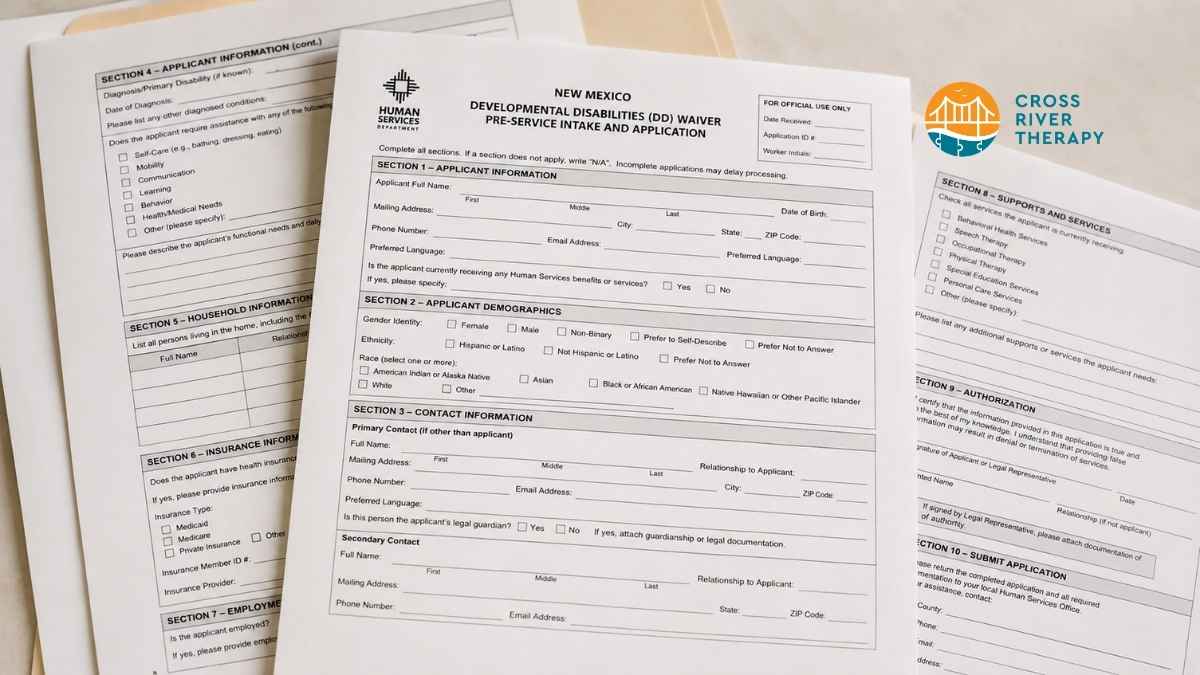
How to Apply for New Mexico’s DD Waiver While Starting ABA Therapy
Autism waiver New Mexico applications need DD Waiver records and proof of daily support needs. Your next step is to start ABA intake with Cross River.

Is ABA Therapy Covered by Insurance in New Jersey? What Every Parent Should Know
ABA therapy insurance New Jersey may cover medically necessary care based on plan type, network, and authorization. Verify benefits with Cross River.

How ABA Therapy Builds Communication for Nonverbal Children Without Forcing Speech
ABA therapy communication for nonverbal children starts with AAC, signs, and daily routines. See how kids ask, refuse, choose, and get help.

How to Start ABA Therapy in New Jersey With a First-Call Checklist
How to start ABA therapy in New Jersey begins with records, insurance details, and intake questions. Use this first-call checklist before you call.

How to Get an Autism Evaluation in Arkansas Before Starting ABA Therapy
How to get an autism evaluation in Arkansas starts with a referral, provider choice, and key records. Use this parent checklist before ABA intake.

Center-Based vs In-Home vs School-Based ABA Therapy and How to Choose the Right Fit
Center-based, in-home, and school-based ABA therapy each fit different goals, routines, and settings. Compare options before your intake call.

Early Signs of Autism: A Guide for North Carolina Parents
Early signs of autism North Carolina parents notice can include speech, play, sensory, or skill loss patterns. See what to track before screening.

Early Intervention ABA Therapy in Albuquerque, NM: Why Starting Early Matters
Early intervention ABA therapy in Albuquerque, NM helps toddlers practice communication, play, and routines. Spot signs and care options sooner.