






How ABA Therapy Builds Communication for Nonverbal Children Without Forcing Speech
ABA therapy communication for nonverbal children starts with AAC, signs, and daily routines. See how kids ask, refuse, choose, and get help.


Key Points:
- ABA therapy communication for nonverbal children builds reliable ways to request, refuse, choose, and ask for help before speech.
- Therapists may use gestures, pictures, signs, AAC devices, sounds, or words during daily routines.
- Progress can mean earlier signals, fewer prompts, less frustration, and more people understanding the child.
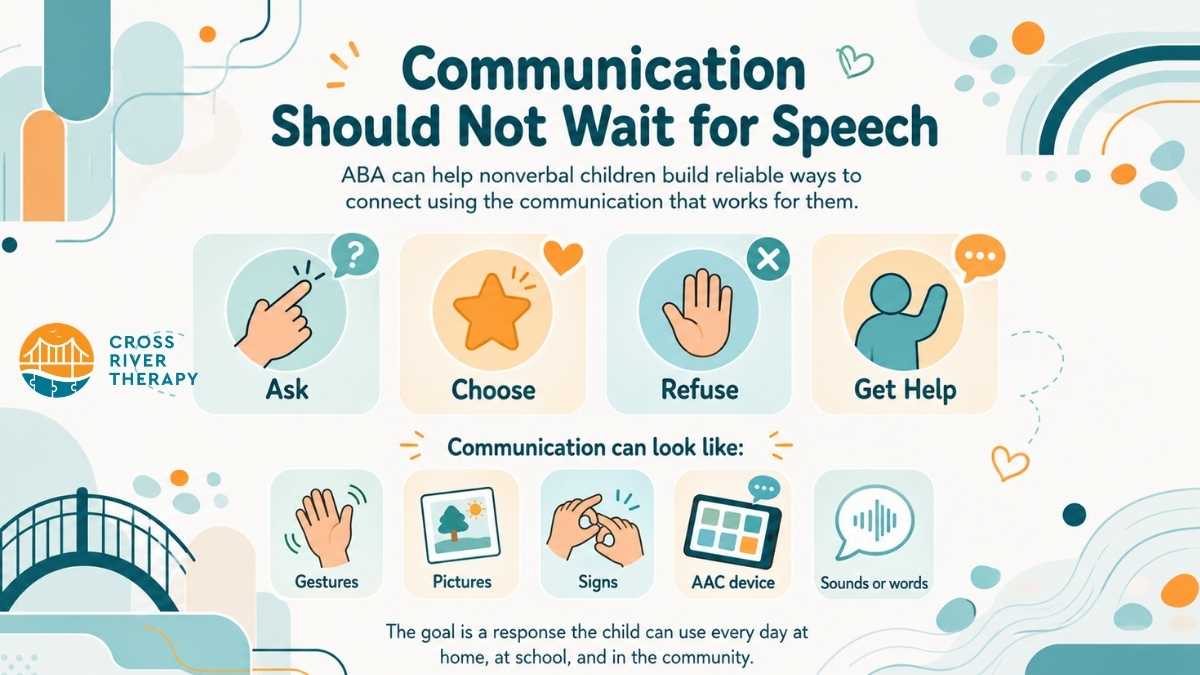
When your child does not talk, you might feel intense pressure to force speech. That is completely normal. However, effective ABA therapy communication for nonverbal children focuses on reliable communication first. A child may learn to request, reject, ask for help, choose, or show discomfort through gestures, pictures, signs, a device, sounds, or words.
Augmentative and alternative communication, or AAC, can include those methods. AAC does not stop talking or slow language growth. Words may still grow, but they are not the only outcome.
What ABA Therapy Communication for Nonverbal Children Should Aim to Build
Communication means a child has a way to affect their world. A point, card, sound, sign, or device tap can say “go,” “juice,” “help,” or “stop.” ABA therapy services can build communication through speech, but speech is one form, not the only form.
A strong behavior goal helps a child express basic needs. It gives them a way to say no and ask for help. The Centers for Disease Control and Prevention describes applied behavior analysis as a behavioral treatment. This treatment can improve various skills and track progress systematically over time. When a child points, they are communicating successfully. The same is true when they hand you a card or press a button on a device.
How Therapists Find the Communication a Child Already Uses
ABA for a Nonverbal Child: What to Expect During Assessment
Before teaching starts, the therapist watches how the child already communicates. Many children may pull an adult toward the fridge, drop near a hard task, reach for a toy, cry at loud sounds, or grab what they want.
The team looks at what happens before and after each behavior. The main question is: what is the child trying to access or avoid? Functional Communication Training, or FCT, starts by identifying the purpose of a behavior, then teaching a replacement communication response.
Assessment may include questions like:
- How does the child ask for food?
- How do they ask for toys?
- What do they do when something hurts?
- What communication works with parents?
- What tools has the child tried?

How ABA Helps Nonverbal Kids Communicate in Daily Routines
In-home ABA therapy can make communication easier to see during meals, play, dressing, school prep, cleanup, and transitions. Each routine gives the child a reason to communicate. The therapist does not need to turn every moment into a drill.
The therapist reinforces the response right away. That teaches the child, “This signal works.” The replacement response should also be easier than crying, grabbing, or dropping.
Examples may include:
- The child hands a picture card to request bubbles.
- The child taps “break” on a device before leaving the table.
- The child points to a snack instead of crying at the cabinet.
- The child signs “help” when a toy is stuck.
FCT can use verbal requests, signs, picture exchanges, voice-output devices, pointing, and other forms of communication.

Why AAC Does Not Mean the Team Has Given Up on Speech
What Parents Should Know About ABA Therapy Communication for Nonverbal Children
Many parents of children with nonverbal autism worry that a picture system or device will make speech less likely. Research does not support this.
AAC means all the ways someone communicates besides talking. It can include gestures, pictures, writing, tablets, facial expressions, and speech-generating devices. The American Speech-Language-Hearing Association notes that children do not need to reach a certain age, test score, or milestone before AAC can help. It also says AAC does not stop talking or slow language development.
A review from the National Center for Biotechnology Information Bookshelf evaluated this topic. It found that AAC did not impede speech production in children with autism. AAC gives the child a way to communicate now, while speech may continue to grow.
How Speech Can Be Supported Without Making Speech the Only Goal
ABA can reinforce vocal sounds, word attempts, and spoken words when the child uses them. A therapist may honor a sound for “more” by providing the requested item.
The team should not ignore a valid AAC response just to wait for speech. A child should not have to “say it” before getting a needed item if they have already communicated through another method.
Speech goals should work with communication access. When AAC or speech goals are part of care, a speech-language pathologist can help the team select tools, model language, and respect the child’s current system.

What Progress Looks Like Before Spoken Words Increase
Early progress does not always sound like words. Many children may show progress by using a signal sooner, with fewer reminders, or with more people.
FCT focuses on a communication response that works in daily settings, not one limited to center-based ABA therapy time.
How Parents Can Support Communication Between Sessions
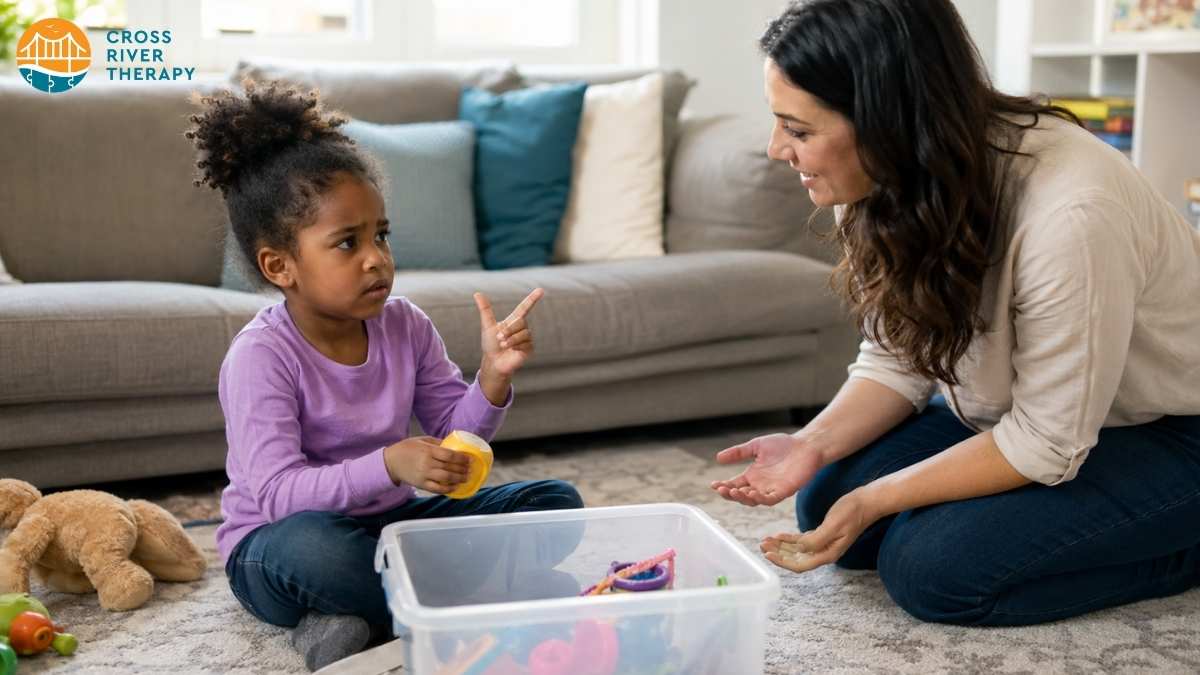
Parents can make communication easier to use during daily life. Start by honoring the child’s current communication. If the child points to water, respond while modeling the word, sign, picture, or device button.
Small changes help:
- Offer two clear choices instead of asking an open-ended question.
- Pause long enough for the child to respond.
- Model the AAC response without demanding it every time.
- Tell the ABA team which signals work at home.
- Keep the same tools available across rooms, caregivers, and routines.
At Cross River Therapy, our ABA therapy locations help families turn meals, play, school prep, and daily routines into communication practice. Our team reviews how your child communicates now, then builds ABA goals around communication that your child can use consistently.
FAQs About ABA Therapy Communication for Nonverbal Children
Does my child need an AAC device before ABA therapy starts?
No. ABA can start by observing how your child already communicates. The team may use gestures, pictures, signs, or a device later. A speech-language pathologist can help select AAC when your child needs a more formal system.
How long does communication progress take?
Progress varies by child, but early signs can be small. A child may reach, point, hand over a picture, or use a device button before spoken words increase. The ABA team should track progress session by session.
What should parents ask before approving communication goals?
Parents should ask whether gestures, AAC, and vocal attempts all count as communication. Parents should also ask how the team avoids forced speech, how goals are measured, and how communication will carry over at home or school.
Start Building Communication Your Child Can Use
Speech can be part of the goal, but communication should not wait for speech. A child needs a reliable way to ask, refuse, choose, and connect.
At Cross River Therapy, we provide at-home, school-based, and center/clinic-based ABA therapy in our listed service areas, including North Carolina, Arizona, Indiana, New Mexico, New Jersey, and Arkansas. Call or complete the online form to share your child’s needs, review whether services match your family, and learn what intake looks like.
Recent News
Related articles

5 Autism Support Groups and Family Resources in New Mexico Alongside ABA Therapy
Autism support groups New Mexico families can use offer peer support, local events, and school help. Cross River can explain ABA therapy options.

Where to Get an Autism Evaluation in New Mexico Before Starting ABA Therapy
Autism evaluation New Mexico options include UNM, NMSU, FIT, and private providers. Compare providers, records, and ABA steps with Cross River.

7 North Carolina Autism Resources to Contact Before ABA Therapy Starts
Autism resources North Carolina families can call for diagnosis, early intervention, rights, and parent support. Start ABA intake with Cross River.

Does Indiana Medicaid Cover ABA Therapy? A Step-by-Step Eligibility Checklist for Parents
Medicaid ABA therapy Indiana covers eligible children under 21 with prior authorization. Your five-step coverage review can start with Cross River.
How to Apply for New Mexico’s DD Waiver While Starting ABA Therapy
Autism waiver New Mexico applications need DD Waiver records and proof of daily support needs. Your next step is to start ABA intake with Cross River.

Is ABA Therapy Covered by Insurance in New Jersey? What Every Parent Should Know
ABA therapy insurance New Jersey may cover medically necessary care based on plan type, network, and authorization. Verify benefits with Cross River.
How ABA Therapy Builds Communication for Nonverbal Children Without Forcing Speech
ABA therapy communication for nonverbal children starts with AAC, signs, and daily routines. See how kids ask, refuse, choose, and get help.

How to Start ABA Therapy in New Jersey With a First-Call Checklist
How to start ABA therapy in New Jersey begins with records, insurance details, and intake questions. Use this first-call checklist before you call.

How to Get an Autism Evaluation in Arkansas Before Starting ABA Therapy
How to get an autism evaluation in Arkansas starts with a referral, provider choice, and key records. Use this parent checklist before ABA intake.

Center-Based vs In-Home vs School-Based ABA Therapy and How to Choose the Right Fit
Center-based, in-home, and school-based ABA therapy each fit different goals, routines, and settings. Compare options before your intake call.

Early Signs of Autism: A Guide for North Carolina Parents
Early signs of autism North Carolina parents notice can include speech, play, sensory, or skill loss patterns. See what to track before screening.

Early Intervention ABA Therapy in Albuquerque, NM: Why Starting Early Matters
Early intervention ABA therapy in Albuquerque, NM helps toddlers practice communication, play, and routines. Spot signs and care options sooner.