








Arizona Autism Laws Every Parent Should Know Before Starting ABA Therapy
Autism laws Arizona parents should know cover ABA insurance, AHCCCS appeals, IEPs, and Section 504 rights. Check ABA coverage with Cross River.


Key Points:
- Autism laws Arizona families use include Steven’s Law, federal parity protections, AHCCCS rules, IDEA, and Section 504.
- Coverage depends on the child’s health plan, medical-necessity records, and authorization requirements.
- Families can appeal ABA denials and pursue separate school supports through an IEP or 504 plan.
Finding the right care requires understanding how different programs protect your family. The autism laws in Arizona that parents encounter include state rules like Steven's Law, federal mental health parity standards, Medicaid coverage, and federal education laws. Understanding these laws helps you access ABA therapy in Arizona faster.
Recent legal updates changed how private insurance works in the state. Steven’s Law no longer contains the old annual dollar caps on behavioral therapy. Your specific insurance rights depend entirely on the type of health plan you have. It is also helpful to know that ABA insurance coverage and school services follow completely different approval systems.
This guide provides general informational support rather than formal clinical or legal advice.
Autism Laws Arizona Parents Should Check Before Intake
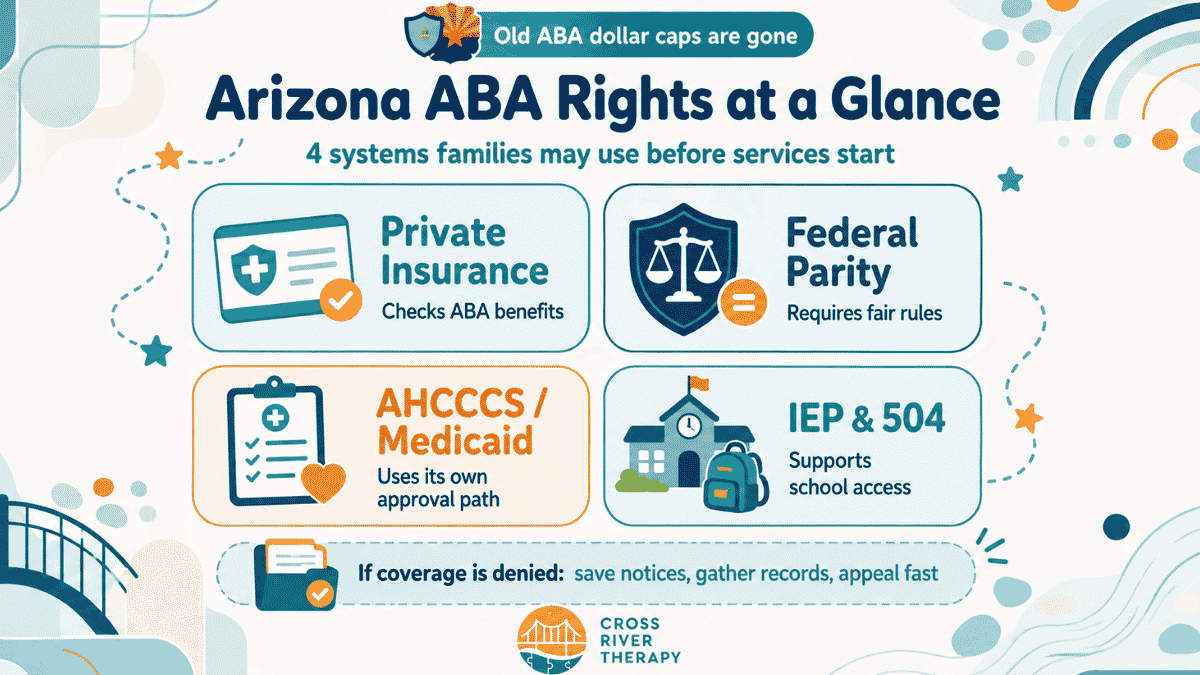
Parents usually deal with four sets of rules before or during ABA intake. Arizona insurance law covers certain state-regulated plans. Federal mental health parity rules may protect other members. AHCCCS members use Medicaid rules and their assigned plan’s appeal process. Schools follow the Individuals with Disabilities Education Act and Section 504.
Each system answers a different question:
- Private insurance: Does the plan cover the requested medical treatment?
- Federal parity: Does the plan apply coverage rules fairly?
- AHCCCS: Does the request meet Medicaid requirements?
- School services: Does the child need support to access education?
A child may qualify for school support without meeting an insurer’s current documentation rules. An ABA approval also does not decide what belongs in an IEP.
Steven's Law No Longer Uses the Former ABA Dollar Caps
When you look up private insurance rights in the Grand Canyon State, you will quickly encounter Steven's Law, which is known as the Arizona autism insurance law. This statute sets the baseline for state-regulated medical coverage.
What Steven’s Law Protects
Under this law, covered state-regulated plans cannot deny eligible treatments solely because a person has an autism diagnosis. The law protects your access to medically necessary behavioral therapy that is provided or supervised by qualified professionals. This does not mean everything is entirely free. Your standard deductibles, copayments, provider network rules and regular medical-necessity reviews still apply to these benefits.
Why Parents Still See the $50,000 Figure Online
If you search online forums, you will see parents talking about strict annual dollar limits. The original 2008 autism legislation in Arizona did put caps on behavioral care. The old rules set a $50,000 annual cap for children younger than nine, and a $25,000 annual limit for children aged nine through sixteen.
However, Senate Bill 1590 completely removed those caps in 2025. The new rule took effect on September 26, 2025. Any article or blog post that presents those dollar amounts as current limits is completely outdated.
State-level mandates like this make a difference for families. A national study found that state insurance mandates were associated with a 3.4-percentage-point increase in monthly autism-related service use.

Your Plan Type Decides Which Insurance Rules Apply
Not every health insurance card opens the same doors. The specific rules governing your coverage depend entirely on how your employer funds the health plan.
What Autism Laws in Arizona Apply to Fully Insured Plans
To see if state rules protect you, check your insurance card and plan documents for signs that the plan is regulated by the Arizona Department of Insurance and Financial Institutions (DIFI). Fully insured employer plans generally must follow applicable state rules.
Self-funded employer plans work differently because they primarily follow federal law instead of state statutes. If your insurance card features the letters "ASO" or says "administered by" a major carrier, your plan is likely self-funded.
You can speak directly with your human resources department for guidance on navigating insurance for ABA therapy coverage. Individual coverage, small-employer plans, limited-benefit policies, and out-of-state health plans may fall outside certain parts of Steven’s Law, though federal protections still apply.
A common concern parents raise in online groups is: "My insurance card lists autism services, so why did the plan deny ABA?" The reality is that having a benefit listed does not guarantee an immediate approval. Plans separate general benefit inclusion from prior authorization rules, medical-necessity reviews, network restrictions, and strict documentation requirements.
Connect With Our Intake Team
At Cross River Therapy, we can check your Arizona insurance benefits and list the records your plan may request before intake. Reach out to us today, or complete our contact form so our team can review your coverage and explain the next steps.

AHCCCS Uses a Separate ABA Coverage and Appeal Process
Families using state Medicaid options must follow a completely separate process for approvals. The autism policy in Arizona for public coverage explicitly lists ABA services for eligible members with an autism diagnosis.
Gather these items immediately from your records:
- The written approval or denial notice.
- The exact reason and policy provision cited by the plan.
- All diagnostic and clinical assessment records.
- The recommended treatment plan from your provider.
- The requested authorization dates.
- The specific appeal deadline.
Always send your appeal directly to your specific AHCCCS health plan’s grievance and appeals department. A denial from a Medicaid plan should never be sent to the state insurance department first.
IEP and Section 504 Rights Cover School Access
School services operate under an entirely different legal framework than medical insurance. Understanding Arizona special education law for autism helps you advocate for your child in the classroom, whether they attend school in Phoenix, Tucson, or Mesa, Arizona.
Your IEP rights for Arizona students with autism mean that the school plan must be highly specific. The document must state:
- Clear, measurable annual goals.
- Specific specialized services and structural supports.
- Classroom accommodations and modifications.
- The exact frequency and location of services.
- Methods for monitoring and reporting progress.
If your child does not need specialized instruction but requires environmental accommodations, a Section 504 plan can provide school-based ABA support. Many parents express worry when a child gets excellent grades but struggles socially or behaviorally. The law covers communication, sensory, behavioral, and social needs, not just report card marks.

What Parents Should Do After an ABA Coverage Denial
Receiving a private or public insurance denial letter can feel incredibly frustrating. However, a denial is a formal step in the process, not necessarily the final word on your child's care. Exercising your autism rights in Arizona is much easier when you approach the appeal with an organized plan and written documentation.
Follow these six structured steps to respond to a coverage denial:
- Read the full denial notice. The document identifies the reason, policy provision, deadline, and appeal process.
- Confirm the plan type. The employer, insurer, or plan administrator should state whether the plan is fully insured, self-funded, or AHCCCS.
- Request the rule in writing. Ask for the clinical criteria, documentation standard, and benefit language used.
- Collect supporting records. Useful records include the diagnostic evaluation, prescription or referral, functional assessment, treatment plan, and clinician letter.
- Submit the correct appeal. Medical-necessity or coverage denials generally require an insurer or health-plan appeal before a separate complaint.
- Keep a contact log. Dates, reference numbers, representatives' names, and submitted documents can support later review.
The Arizona Department of Insurance and Financial Institutions handles these issues carefully. They distinguish formal insurance appeals regarding medical necessity from general complaints about an insurer's business conduct.

FAQs About Arizona ABA Legal Rights
Does Steven’s Law require every Arizona health plan to cover ABA?
No. Steven’s Law only applies to specific state-regulated plans. Self-funded employer plans must follow federal requirements instead. Public options like AHCCCS and individual coverage use separate guidelines. You must confirm your plan's funding type to know which specific rules apply to your coverage.
Can my child receive school support and insurance-funded ABA at the same time?
Yes. School services provide educational access under federal law, while insurance covers medically necessary treatment. The school district and your insurance company make separate funding decisions. You can choose to share records between your school team and private providers to coordinate goals.
Can an insurer request a newer autism evaluation before approving ABA?
An insurance plan can request recent records to verify medical necessity and confirm a diagnosis. You should ask for the exact age requirement for the evaluation in writing. You can file an appeal if the request contradicts your plan document or applies standards unevenly.
Protect Your Child’s Access to ABA Therapy
Arizona law no longer uses the former annual ABA caps, but plan type, medical-necessity records, and appeal deadlines still affect access. A rights check before intake can prevent delays caused by missing records or an appeal sent to the wrong agency.
At Cross River Therapy, we provide in-home, school-based, and center-based ABA therapy for children ages 1–21 across Arizona. Call us today or email info@crossrivertherapy.com to speak with us. Our intake team will review your insurance information, explain which records are needed, and arrange the next step in the intake process.
Recent News
Related articles
Arizona Autism Laws Every Parent Should Know Before Starting ABA Therapy
Autism laws Arizona parents should know cover ABA insurance, AHCCCS appeals, IEPs, and Section 504 rights. Check ABA coverage with Cross River.

ABA Therapist Salary in Arkansas: What BCBAs and RBTs Actually Earn in 2026
ABA therapist salary Arkansas figures compare RBT and BCBA rates, benefits, guaranteed hours, and contract terms. Explore careers at Cross River.

5 Autism Support Groups and Family Resources in New Mexico Alongside ABA Therapy
Autism support groups New Mexico families can use offer peer support, local events, and school help. Cross River can explain ABA therapy options.

Where to Get an Autism Evaluation in New Mexico Before Starting ABA Therapy
Autism evaluation New Mexico options include UNM, NMSU, FIT, and private providers. Compare providers, records, and ABA steps with Cross River.

7 North Carolina Autism Resources to Contact Before ABA Therapy Starts
Autism resources North Carolina families can call for diagnosis, early intervention, rights, and parent support. Start ABA intake with Cross River.

Does Indiana Medicaid Cover ABA Therapy? A Step-by-Step Eligibility Checklist for Parents
Medicaid ABA therapy Indiana covers eligible children under 21 with prior authorization. Your five-step coverage review can start with Cross River.
How to Apply for New Mexico’s DD Waiver While Starting ABA Therapy
Autism waiver New Mexico applications need DD Waiver records and proof of daily support needs. Your next step is to start ABA intake with Cross River.

Is ABA Therapy Covered by Insurance in New Jersey? What Every Parent Should Know
ABA therapy insurance New Jersey may cover medically necessary care based on plan type, network, and authorization. Verify benefits with Cross River.

How ABA Therapy Builds Communication for Nonverbal Children Without Forcing Speech
ABA therapy communication for nonverbal children starts with AAC, signs, and daily routines. See how kids ask, refuse, choose, and get help.

How to Start ABA Therapy in New Jersey With a First-Call Checklist
How to start ABA therapy in New Jersey begins with records, insurance details, and intake questions. Use this first-call checklist before you call.

How to Get an Autism Evaluation in Arkansas Before Starting ABA Therapy
How to get an autism evaluation in Arkansas starts with a referral, provider choice, and key records. Use this parent checklist before ABA intake.

Center-Based vs In-Home vs School-Based ABA Therapy and How to Choose the Right Fit
Center-based, in-home, and school-based ABA therapy each fit different goals, routines, and settings. Compare options before your intake call.